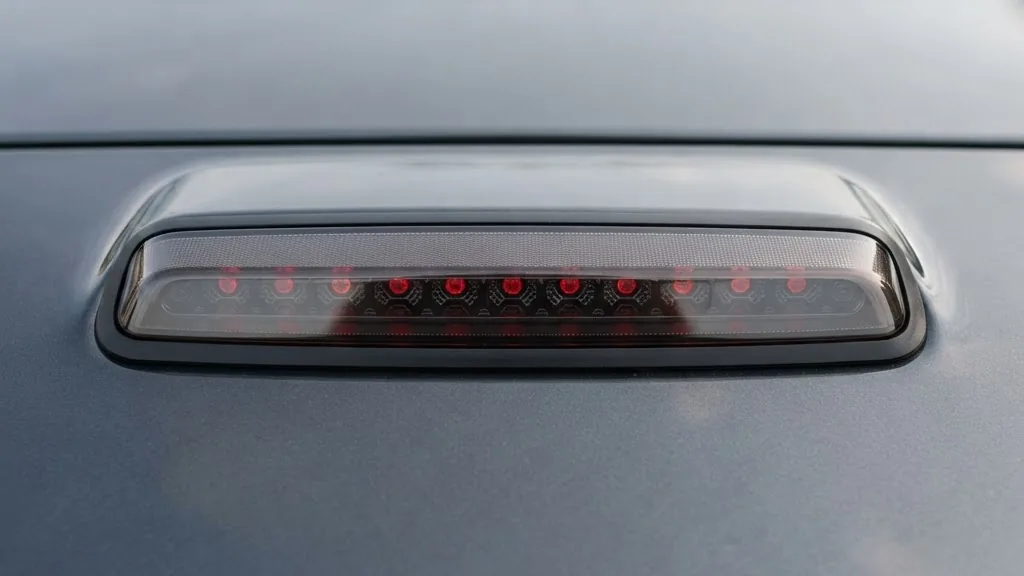
The third brake light on your car is not a styling touch; it is federally mandated safety equipment that has been required on new passenger cars since 1986. Sitting up at eye level above your two normal tail lights, it gives the driver behind you one clear, centered signal that you are slowing down. When it burns out, most owners never notice, because they are sitting in front of it. The car behind notices, and so can a police officer.
This guide from the BrakeTireGuide team explains what a third brake light is, why the government made it mandatory, how well it actually prevents crashes, why it fails, what a repair costs, and whether you can legally drive with it out. This article is educational and is not a substitute for a qualified technician or a hands-on inspection. Follow your state law and your vehicle manufacturer specifications, and when a brake or lighting fault looks marginal, have a professional confirm it before you drive on.
Short answer: the third brake light, or center high mount stop lamp (CHMSL), is required by federal rule FMVSS 108. If your vehicle came with one, it has to work. A dead unit is usually a bulb, a sealed LED strip, a fuse, or a water-damaged connector, and a fix runs anywhere from a few dollars to a couple hundred.
By Corinne Bensai, diagnostics lead at BrakeTireGuide. Last reviewed July 7, 2026.
Most articles just say the third brake light is required. This guide adds the exact federal rule and effective dates, the real crash-reduction figures from NHTSA studies, an original bulb-versus-LED decision table, and a 20-second way to test yours, so you can fix it correctly and understand why it matters.
What a third brake light actually is
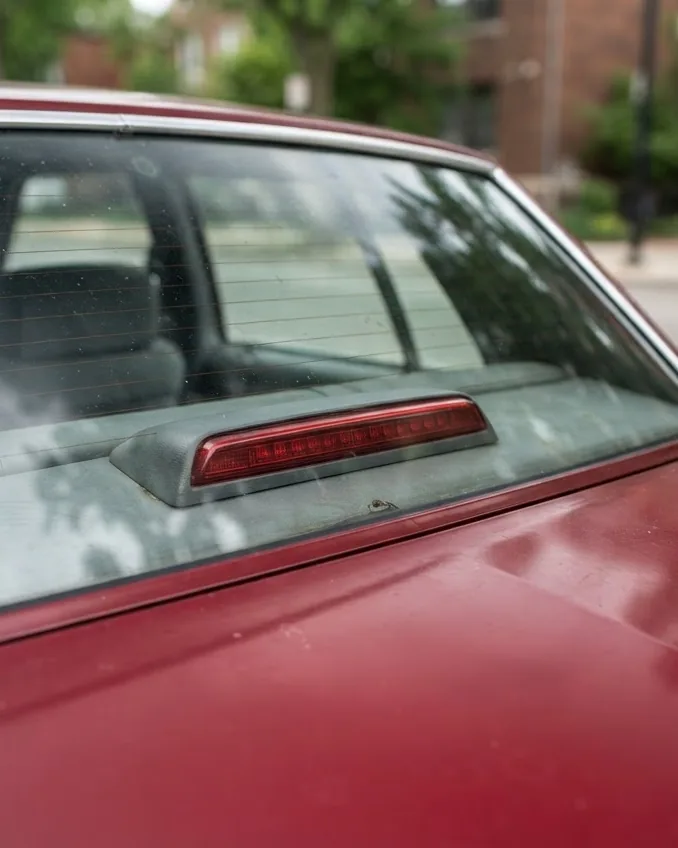
A third brake light is the extra stop lamp mounted high and centered on the back of a vehicle, above the two lower brake lights that live in the tail light housings. Engineers call it the center high mount stop lamp, shortened to CHMSL and pronounced “chim-zel” in the trade. You will also hear it called the center brake light, the high-mount stop lamp, or the eye-level brake light. It lights up only when you press the brake pedal, and unlike your turn signals or hazards it does not blink.
The point of putting a third lamp up high is line of sight. Your lower brake lights can be blocked by the car directly behind you, especially in stop-and-go traffic where bumpers sit close together. A lamp mounted near window height is visible through the glass of the car in front of the following driver, so a chain of drivers two or three cars back can see you braking at the same instant. That extra warning is the entire reason the lamp exists.
Early designs used one or more incandescent bulbs behind a red lens. Most vehicles built in the last decade use a sealed strip of light emitting diodes, or LEDs, which light faster and last longer. Either way the job is the same: one bright, centered, unmistakable signal that you are slowing down. If you are new to how your car warns you about faults in general, our explainer on the check engine soon light is a useful companion, because dashboard warnings and exterior lamp faults often show up around the same time.
The federal mandate: FMVSS 108 and the 1986 rule
The third brake light is required under Federal Motor Vehicle Safety Standard No. 108, written as FMVSS 108 and codified at 49 CFR 571.108. That single standard governs almost every lamp, reflector, and signal device on a road vehicle, and the center high mount stop lamp is one of its requirements. The rule was added by NHTSA, the National Highway Traffic Safety Administration, after years of testing pointed to a real safety gain.
The timeline is specific. NHTSA amended the standard in October 1983, and the requirement took effect for all new passenger cars manufactured on or after September 1, 1985, which is the 1986 model year. That is why 1986 is the year most people remember. The rule was later extended to light trucks, vans, and sport utility vehicles with a gross vehicle weight rating of 10,000 pounds or less, which had to comply on or after September 1, 1993, the 1994 model year.
Two things follow from this. First, if your vehicle was built after those dates, it left the factory with a working third brake light, and federal and most state rules expect it to stay functional. Second, the standard is engineering-driven; the lamp specifications trace back to the kind of automotive lighting work done by bodies such as SAE International, whose lighting practices sit behind a lot of what FMVSS 108 codifies. The regulation is not a suggestion. It is the reason every modern car on the road has that centered red lamp.
How much a third brake light really cuts crashes
This is where the story gets honest, and where a lot of websites stop short. The early results that convinced regulators to act were dramatic. Fleet field tests in the 1970s, many of them run on taxi cabs, showed reductions of 48 to 54 percent in the “relevant” rear-impact crashes where the lead car was braking before it was hit. Because most rear impacts involve pre-impact braking, that worked out to something like a 35 percent cut across all rear-end crashes. On paper it looked like one of the cheapest safety wins ever found.
The real world was more modest. Once every car had the lamp, the novelty wore off and drivers stopped reacting to it as a surprise. NHTSA went back and measured the long-term effect using police-reported crash data from 1989 through 1995. The settled figure was a 4.3 percent reduction in rear-impact crashes for passenger cars, far below the early estimates but still real and still worth having. NHTSA estimated the lamp prevents as many as 137,000 police-reported crashes and up to 55,000 injuries every year.
A 4.3 percent cut sounds small until you scale it across every car in the country. Rear-end collisions are one of the most common crash types, and research groups including the IIHS, the Insurance Institute for Highway Safety, continue to study rear-impact and low-speed crash patterns because they drive so much repair cost and whiplash injury. A cheap lamp that quietly removes tens of thousands of crashes a year is doing exactly the job it was designed to do, which is also why keeping yours working is not optional busywork.
Where the law says it has to sit
FMVSS 108 does not just require a third brake light; it dictates where the lamp lives. The center of the lamp has to sit on the vertical centerline of the vehicle as seen from the rear, which is why the lamp is centered rather than tucked to one side. Height is controlled too. If the lamp is mounted below the rear window, no part of the lens may sit lower than 3 inches below the window on a passenger car, or lower than 6 inches on a convertible, so the signal stays up in the following driver’s line of sight.
Some vehicles cannot fit a single centered lamp, usually because of a split tailgate, a spare tire carrier, or a wide body. In those cases the rule allows two high-mounted lamps instead of one, placed symmetrically about the centerline, matched in size and shape, and mounted at the same height. Each of those two lamps has to project a red illuminated lens area of at least 1452 square millimeters. These details matter if you ever replace a factory unit with an aftermarket one, because a lamp that sits too low or off-center may not meet the standard.
Why your third brake light stops working
Because you sit in front of it, a dead third brake light usually goes unnoticed until someone tells you or you catch its reflection in a garage door. When it does fail, the cause is almost always one of a short list of problems.
Pro tip: Test it in 20 seconds without a helper. Back up to a wall or garage door at night, press the brake pedal, and watch the reflection in your mirror. If the center lamp does not glow with the other two, you have confirmed the fault before spending anything on parts.
- Burned-out bulb. On older or incandescent-equipped vehicles, the single most common cause is simply a bulb that has reached the end of its life. It is also the cheapest to fix.
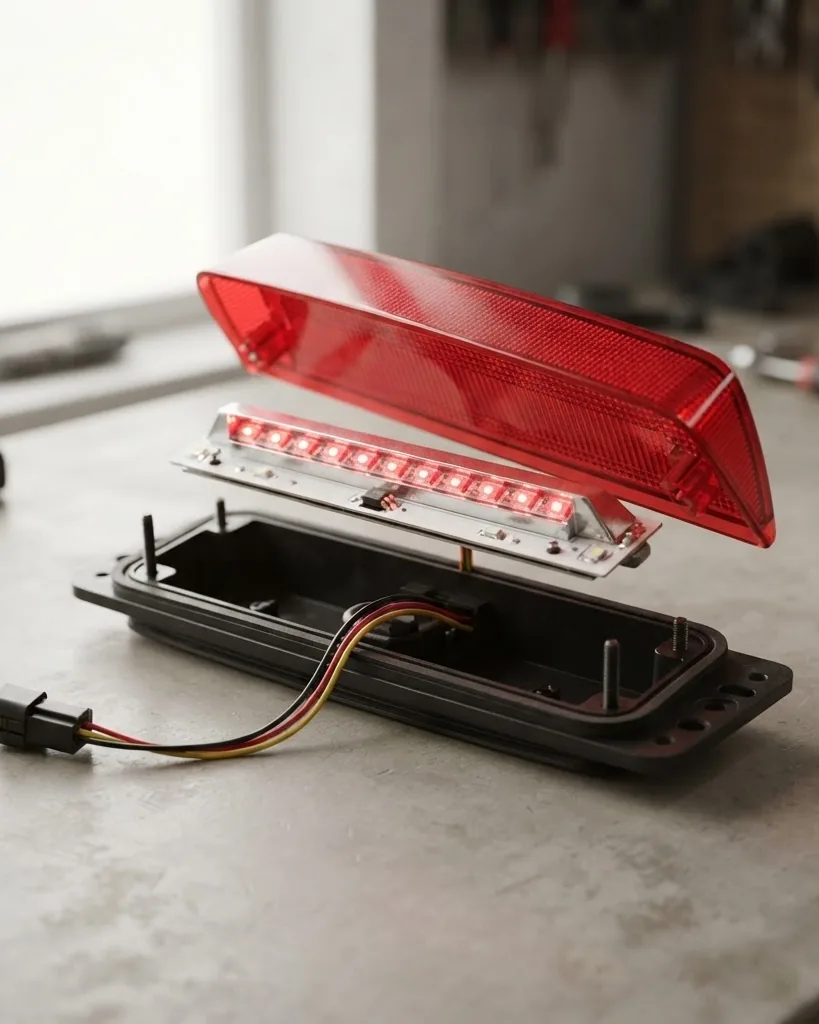
- Failed LED strip. On newer cars the lamp is a sealed LED module. When enough of the diodes die, the whole unit reads as dark or partially lit. You cannot swap one LED; the assembly is replaced as a sealed part.
- Blown fuse. A blown fuse in the stop-lamp circuit can take out the third brake light, sometimes along with the lower brake lights. A fuse is a quick, low-cost check.
- Bad brake light switch. The switch at the top of the brake pedal tells every stop lamp to light. If it fails, none of your brake lights come on, which is a serious safety fault, not just a third-lamp problem.
- Corroded or frayed wiring. The wiring runs up the pillar or through the trunk lid or spoiler, where flexing and moisture can fray, corrode, or break a connector over time.
- Gasket and water leak. A failed seal or a cracked gasket lets rainwater into the housing. Moisture fogs the lens, corrodes the contacts, and shorts the electronics. Water intrusion is one of the most common killers of roof-mounted and spoiler-mounted units.
The order to check is roughly the order of that list: bulb or module first, then fuse, then switch, then wiring and seal. If all your brake lights are dead at once, suspect the switch or the fuse, because a single burned bulb only affects one lamp. In our experience, a foggy lens with water beads inside is a near-certain sign the gasket has failed and the housing needs resealing or replacing before the corrosion spreads.
Bulb versus sealed LED third brake lights
Whether your car uses a replaceable bulb or a sealed LED assembly changes how you diagnose, what you buy, and what it costs. The table below lays out the practical differences the BrakeTireGuide team looks at before quoting a repair.
| Factor | Incandescent bulb type | Sealed LED assembly |
|---|---|---|
| Typical vehicles | Older cars, many trucks pre-2015 | Most vehicles built in the last decade |
| What fails | The single bulb filament | Diodes or the internal circuit board |
| Can you replace just the light? | Yes, swap the bulb | No, replace the whole sealed unit |
| Part cost | $5 to $30 for the bulb | $105 to $150 for the assembly, often more |
| Reaction speed | Slightly slower to full brightness | Lights almost instantly |
| Lifespan | Shorter; filament wears out | Longer, but fails as one unit |
The big practical difference is repairability. A bulb-type lamp is a two-dollar-to-thirty-dollar fix you can often do in your driveway. A sealed LED unit gives you no cheap path: when it goes, you buy the assembly. That is worth knowing before you panic at a dealer quote, because on an LED-equipped car the “expensive” number is normal, not a markup.
How to replace a third brake light step by step
Replacing a bulb-type third brake light is a common driveway job. A sealed LED assembly follows the same access steps but ends in swapping the whole unit. Always work on a cool, parked vehicle. Here is the general procedure; check your specific service manual for the exact fasteners.
- Park and secure the vehicle. Set the parking brake, turn the ignition off, and let everything cool. You will be reaching around wiring, so remove the key or fob from the circuit.
- Find the access point. The lamp may be reached from inside the trunk or hatch, from behind a headliner panel, or by removing the lens cover from outside. Truck and SUV units often sit on the cab roof or the spoiler.
- Remove the cover or trim. Take out the retaining screws or release the clips holding the lens or the housing. Keep the fasteners in a cup so none roll away.
- Disconnect the wiring connector. Unclip the electrical connector from the back of the lamp. Note how it seats so you can reconnect it the same way.
- Swap the bulb or the assembly. For a bulb type, twist out the old bulb and press or twist in the new one without touching the glass. For an LED unit, remove the entire sealed assembly and fit the replacement.
- Check the gasket. Inspect the rubber seal. If it is cracked, flattened, or missing, replace it or reseal, because a bad gasket is what lets water back in and kills the new part.
- Test before you close up. Reconnect the connector, have someone press the brake pedal, and confirm the lamp lights fully and evenly. Only then reinstall the cover and torque the screws snug, not overtight, since overtightening cracks housings and seals.
If the new bulb or assembly still does not light, the problem is upstream: a fuse, the brake light switch, or the wiring. That is your cue to stop swapping parts and start tracing the circuit, which is the point where many owners hand it to a shop.
What a third brake light repair costs
Cost depends almost entirely on whether you have a bulb or a sealed LED unit, and whether you do the work yourself. A replacement incandescent bulb runs about $15 to $30 for an OEM part and as little as $5 to $15 for an aftermarket one, and swapping it yourself is free beyond the part. That makes a burned-out bulb one of the cheapest safety repairs on the whole car.
A sealed LED third brake light is a different bill. The assembly itself commonly costs $105 to $150 at a dealer, and premium or spoiler-integrated units can run higher. If a shop has to trace a wiring fault or fit a full LED assembly, labor typically adds $75 to $200 or more depending on how buried the lamp is. A roof-mounted truck unit or a spoiler lamp that requires panel removal sits at the top of that range. Even so, the total is modest next to the cost of the rear-end collision the lamp exists to prevent, which is the trade the whole federal rule is built on.
Is it illegal to drive with your third brake light out?
In most cases, yes, at least technically. The governing principle across most states is simple: if your vehicle was originally equipped with a center high mount stop lamp, which every post-1986 car and post-1994 light truck was, that lamp has to remain in working order. You are not allowed to delete required safety equipment, and a burned-out lamp counts as a defect.
Enforcement is where states diverge. In states with mandatory safety inspections, such as Pennsylvania and Texas, a dead third brake light is grounds to fail inspection, and you must fix it before the vehicle passes. In states without an annual safety inspection, an officer can still write a fix-it ticket; California is the classic example, where a non-working lamp earns a correctable citation. And in practice, a dead center lamp is an easy, lawful reason for a traffic stop, which is why it comes up so often during nighttime and impaired-driving enforcement. A few states with lighter equipment rules may not cite it, but you cannot count on that.
Legal note: If your vehicle was built with a center high mount stop lamp (every US passenger car since 1986 and light truck since 1994 under FMVSS 108), that lamp must work. Removing or leaving it dark can fail a state safety inspection and is a lawful reason for a traffic stop. Fix it before your next drive.
The safety-first read is straightforward. The lamp is cheap to fix, it is required equipment on your vehicle, and driving with it dark hands a police officer a clean reason to pull you over while also removing a warning the driver behind you relies on. Treat a dead third brake light like any other burned-out stop lamp: fix it promptly.
When to hand it to a mechanic
Plenty of third brake light jobs are driveway-simple, but some findings deserve professional eyes. See a qualified technician when any of these show up.
- All your brake lights are dead. If none of the stop lamps light, suspect the brake light switch or a circuit fault, not the third lamp alone. That is a serious safety issue and worth a same-day fix.
- A new part still will not light. If you replaced the bulb or the LED assembly and it stays dark, the fault is upstream in the fuse, switch, or wiring, and tracing it takes tools and a wiring diagram.
- You find water inside the housing. Moisture means a failed seal and likely corroded contacts. A shop can reseal it correctly so the replacement does not die the same way.
- A dashboard warning appears with the fault. Some cars flag a lamp-out warning on the cluster. If a warning light stays on after the repair, our guide on how to reset a check engine light explains why you should confirm the underlying fault is fixed before clearing any code, rather than just resetting the reminder.
- The lamp is buried in a spoiler or roof panel. Units that require removing body panels or headliner trim are easy to crack or misalign. If you are not sure, let a pro pull it.
None of this replaces the simple habit that catches most problems: once a month, have someone stand behind the car and press the brake pedal while you confirm all three lamps light. It takes 60 seconds and it is the only reliable way to notice a lamp you can never see from the driver’s seat.
Sources and further reading
The safety framing, figures, and standards referenced above draw on the following authorities. Each link points to the organization’s current homepage so it stays valid over time.
- National Highway Traffic Safety Administration (NHTSA), federal motor vehicle safety standards and recalls: https://www.nhtsa.gov/
- SAE International, engineering test methods and standards for brake and vehicle components: https://www.sae.org
- Insurance Institute for Highway Safety (IIHS), independent braking and crash-avoidance research: https://www.iihs.org/
Frequently asked questions
What is a third brake light called?
Engineers call it the center high mount stop lamp, or CHMSL. You will also hear center brake light, high-mount stop lamp, or eye-level brake light. Whatever the name, it is the single centered red lamp above your two lower tail lights that lights only when you press the brake pedal, and it has been federal equipment under FMVSS 108 since the 1986 model year.
Is it illegal to drive with a third brake light out?
In most states, yes. If your vehicle came with a center high mount stop lamp, which every car since 1986 did, that lamp must keep working. States like Pennsylvania and Texas fail it at inspection, California issues a fix-it ticket, and a dead lamp is a lawful reason for a traffic stop almost anywhere. Check your own state rule, but the safe move is to repair it right away.
How much does it cost to fix a third brake light?
A replacement bulb costs about $5 to $30 and is often a free DIY swap. A sealed LED assembly usually runs $105 to $150 for the part, and a shop tracing wiring or fitting an LED unit can add $75 to $200 or more in labor. The final number depends mostly on whether your car uses a bulb or a sealed LED module.
Does a third brake light actually prevent crashes?
Yes, though less than early hype suggested. Fleet tests in the 1970s showed up to 48 to 54 percent fewer relevant rear-impact crashes, but NHTSA’s long-term study of 1989 to 1995 crash data settled on a 4.3 percent reduction in rear-impact crashes for passenger cars. Scaled across the whole fleet, NHTSA estimates that still prevents as many as 137,000 crashes a year.
Can I replace a third brake light myself?
Often, yes. A bulb-type lamp is usually a short driveway job: access the housing, disconnect the connector, swap the bulb, check the gasket, and test with the brake pedal pressed. A sealed LED assembly is replaced the same way but as one whole unit. If a new part still will not light, the fault is a fuse, switch, or wiring, and that is a job for a technician.
Why is there water inside my third brake light?
Water inside the housing means the gasket or seal has failed, usually from age, a cracked seal, or overtightened screws that warped the housing. The moisture fogs the lens, corrodes the contacts, and eventually shorts the electronics. Reseal or replace the gasket when you fit a new lamp, or the replacement will fail the same way. Roof and spoiler-mounted units are especially prone to this.
Do all vehicles have a third brake light?
Every new US passenger car built on or after September 1, 1985 has one, and every light truck, van, and SUV rated at 10,000 pounds GVWR or less built on or after September 1, 1993 has one too. Vehicles older than those dates may not, and were not required to. If your vehicle came with one, federal and most state rules expect it to keep working.
A third brake light is one of the smallest, cheapest pieces of safety gear on your vehicle and one of the easiest to ignore, precisely because you never see it from the driver’s seat. It is required equipment, it removes tens of thousands of crashes a year across the country, and a burned-out one is both a ticket waiting to happen and a warning your fellow drivers no longer get. Check all three lamps once a month, fix a dark one promptly, and when the fault runs deeper than a bulb, let a qualified technician trace it.