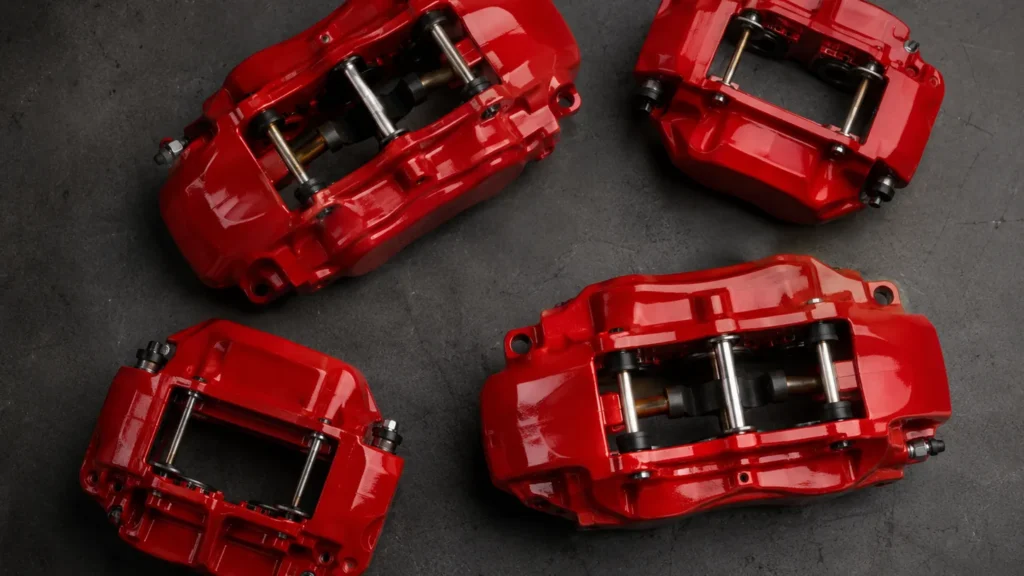
Red brake calipers are one of the most requested looks in car customizing, and the first question we get in the shop is whether they actually stop a car any better. The honest answer sets the tone for everything else here: the color is paint and branding, not braking power. A red caliper can sit on a world-class brake system or a very ordinary one.
This guide from the BrakeTireGuide team explains what red calipers signify, why so many performance cars wear them, whether the color changes anything mechanical, and how to paint your own calipers without creating a safety problem. This article is educational and is not a substitute for a qualified brake technician or a hands-on inspection. Brakes are a safety-critical system, so when anything looks wrong or you are unsure, have a professional confirm it before you drive.
Most articles stop at “red is just paint.” This guide goes further: below you will find an original caliper-color decoder that shows what factory colors actually signal across common brands, a side-by-side paint-versus-powder-coat cost and heat comparison, and the specific temperature limits that decide whether a coating survives, so you can separate a genuine brake upgrade from a cosmetic one before you spend a dollar.
Short version: red calipers are almost always cosmetic. On some cars the factory uses a red caliper to flag an upgraded brake package, but the red itself adds nothing. Real stopping power comes from the pads, the rotors, the caliper design, the brake fluid, and the tires. Paint the calipers because you like the look, not because you expect shorter stops.
By Rohan Pettis, brakes lead at BrakeTireGuide. Last reviewed July 7, 2026.
What red brake calipers actually mean
A brake caliper is the clamp that squeezes the brake pads against the spinning rotor to slow the wheel. Most factory calipers are cast iron or aluminum and come in bare metal, black, or silver. When you see a red one, you are almost always looking at a coat of paint or powder coating over that same casting, or a factory finish chosen to make the brakes stand out behind the wheel spokes.
The red look carries a message more than a function. Over decades, high-end brake makers painted their calipers in bold colors so their hardware would be recognized through the wheel, and red became shorthand for sport braking. So when a buyer sees red calipers, the brain reads performance. That association is marketing and history, not physics. The paint does not change how hard the pistons push or how much friction the pads make.
There is a grain of truth worth being precise about. Some automakers do use caliper color as a code for the brake option fitted at the factory. A red caliper on one trim might mean a larger rotor and a bigger caliper than the base car got. In that narrow case the color is correlated with better brakes, but the hardware is what improved, and a can of red paint on the base car would not copy that. Treat factory color codes as a hint about the original build, never as proof of current condition.
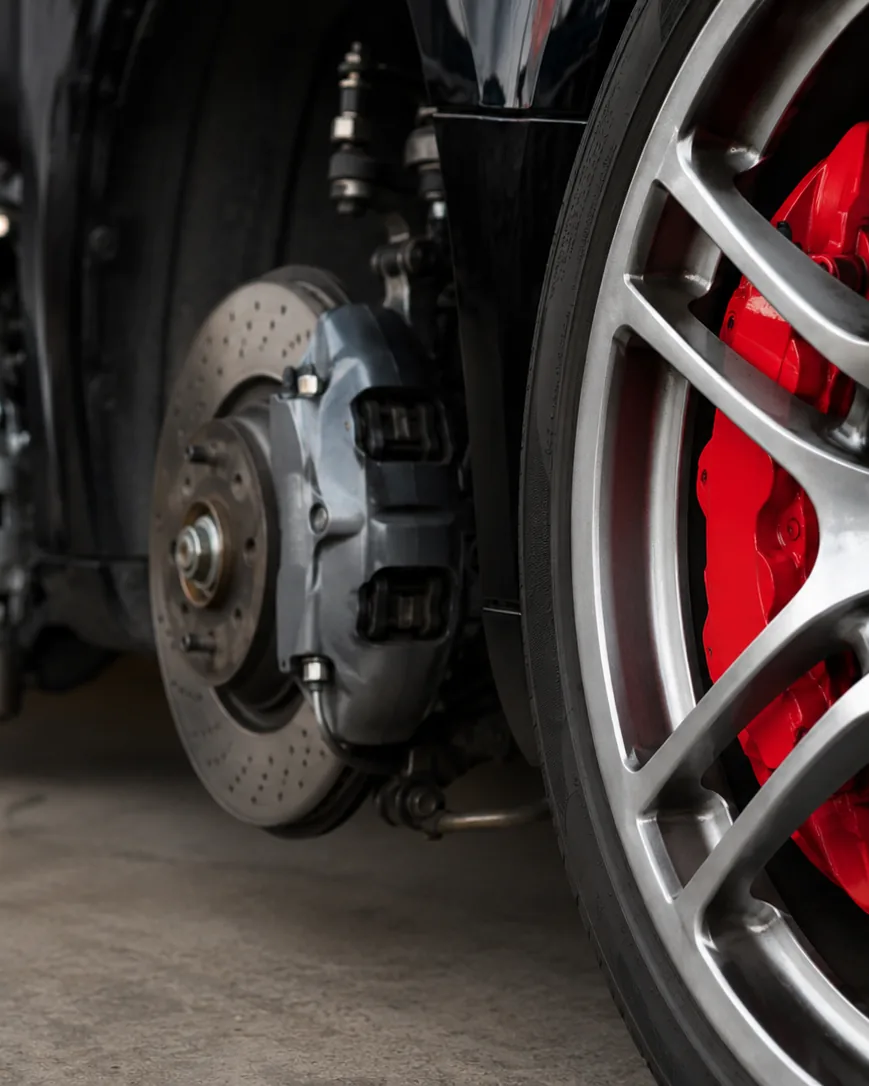
Do red brake calipers mean better brakes?
No. This is the question that drives most searches, so we will answer it plainly and then explain what does matter. Painting a caliper red, or buying a car because the calipers are red, tells you nothing reliable about stopping distance, fade resistance, or pad life. Two identical cars, one with red calipers and one with black, stop exactly the same if the underlying parts are the same.
What actually determines how well a car stops is a short list of real components:
- Brake pads. The friction compound is the single biggest lever. A performance pad bites harder and resists fade at high temperature, while a cheap pad fades and glazes. Color has nothing to do with it.
- Rotors. Diameter, thickness, and venting decide how much heat the system can absorb and shed. A bigger, vented rotor manages heat better on repeated hard stops.
- Caliper design. Piston count, stiffness, and clamping area matter. A rigid multi-piston caliper applies pressure more evenly than a flexing single-piston one. The paint on the outside is irrelevant to that.
- Brake fluid. Fresh fluid with a high boiling point keeps a firm pedal under heat. Old, moisture-laden fluid boils and the pedal goes soft.
- Tires. The brakes can only use the grip the tires provide. Worn tires stop poorly no matter what the calipers look like.
If you want shorter stops, spend on those items, not on paint. Independent safety testers such as the IIHS measure braking as part of vehicle evaluation, and their numbers track with pads, tires, and system design, not with caliper color. The paint is the last thing you do, purely for looks, once the mechanical parts are right.
Caliper color decoder: what factory colors usually signal
Because factory caliper color is a loose convention rather than a regulated code, it varies by brand and model year, but some patterns hold often enough to be useful. We compiled the table below from common factory usage and aftermarket practice. Treat it as a starting hint to verify against the specific vehicle, never as proof of the brakes fitted today.
| Caliper color | What it often signals | What to verify |
|---|---|---|
| Bare metal or black | Standard base brakes, or a caliper that was never finished | Nothing implied; judge by rotor size and pad type |
| Red | A sport or upgraded package on some trims, or pure styling | Whether the rotor and caliper are actually larger than base |
| Yellow or gold | Often a high-performance or premium brand cue (for example some Brembo fitments) | The caliper maker stamped on the body, not just the color |
| Silver or gray | Frequently a specific supplier finish or mid-tier package | Piston count and caliper stiffness, which drive real performance |
| Any repainted color | Owner customization; tells you nothing about the hardware | Everything: pads, rotors, fluid, and caliper design |
Where the red-caliper look comes from
The trend traces back to premium brake suppliers who colored their calipers so the brand was visible through the wheel. Brembo, the Italian brake maker, made red a signature and has offered colored calipers for decades. Over time the palette grew, and Brembo now offers roughly 100 colors, including yellow, black, gray, and bespoke shades. That expansion is the clearest sign that color is a styling choice: if red meant better brakes, a maker would not sell the same caliper in a hundred finishes.
Automakers picked up the idea because a colored caliper is a cheap way to make a car look faster in the showroom. Red reads as sporty, yellow reads as exotic, and a bare caliper reads as economy, even when the parts underneath are similar. None of that is dishonest on its own, but it is styling, and it is why the aftermarket sells so much red caliper paint. People want the look, and the look is easy to buy.
Does caliper color change brake heat or cooling?
Almost not at all in any way you would feel. In theory the color and finish of a surface affect how it radiates heat, but a caliper sheds most of its heat by conduction and airflow, and the paint layer is a few thousandths of an inch thick. The heat that matters lives in the rotor and the pad, which are not painted. Changing the caliper from black to red does not move the needle on brake temperature, fade, or cooling in normal use.
The finish does matter in one direction: a coating that cannot take heat is worse than bare metal. If you use ordinary spray paint instead of a high-temperature caliper coating, it can discolor, bubble, or flake when the caliper warms up, and flakes can end up where you do not want them. So the goal of caliper paint is not to cool the brake. The goal is to survive the heat the brake already makes without failing. Use a product rated for the job and the color is a free choice.
How hot brakes really get: the numbers
To paint calipers safely you have to respect the heat they live in, so here are realistic figures. In everyday street driving the rotor surface runs roughly 220 to 400 degrees Fahrenheit while the caliper body itself typically stays below about 250 degrees. Push the car hard, on a track or a long mountain descent, and caliper surfaces sit around 300 to 325 degrees even after a cool-down lap. Ceramic-resin caliper paints are rated to about 500 degrees, and the strongest DIY epoxy on the market carries a rating near 980, so a properly chosen product covers that world with margin to spare.
Hard use is a different story. Caliper seals and dust boots start to suffer above roughly 428 degrees Fahrenheit, which is about 220 degrees Celsius, because the rubber degrades and can let fluid weep. That is exactly why the components you must never coat are the rubber parts and the friction surfaces, and why a proper high-temperature product is not optional.
Safety warning: Never let paint reach the friction surfaces, the rubber piston dust boots, the bleeder screw, or the brake lines. Paint on a rotor face or pad ruins braking, and a solvent-swollen dust boot can seize a piston. If you cannot mask a part cleanly, do not paint near it.
Quality caliper paints are built for this. A common brush-on and spray option is rated to resist about 900 degrees Fahrenheit, which is 482 degrees Celsius, on an intermittent basis. That rating comfortably covers street driving and gives a safety margin for the occasional spirited stop, though sustained track heat is another matter and is best discussed with a brake specialist. The engineering test methods behind friction and thermal ratings come from bodies like SAE International, whose brake standards define how these systems are measured, which is why reputable products can quote a real temperature number instead of a vague claim.
How to paint your calipers red the safe way
Painting calipers is a realistic weekend job for a careful DIYer, and it is where a brake project can either go smoothly or go wrong. Work on cool brakes, never right after driving. Before you start, review our guide to the brake hardware so you can tell a caliper from a bracket; if a caliper is corroded or seized, a brake caliper rebuild kit may be the smarter first step before any paint touches it.
The general sequence looks like this. Follow the instructions on your specific product, because brush-on epoxy kits and high-temp sprays differ in prep and timing.
- Loosen the lug nuts, then lift and support the car. Use jack stands on a level surface, never a jack alone, and chock the wheels that stay on the ground. Remove the wheel to expose the caliper.
- Decide whether to paint on or off the car. Brush-on kits let you paint the caliper in place, which is the common DIY route. Powder coating and the cleanest spray jobs mean removing the caliper, which involves opening the brake hydraulics and is a bigger, more advanced task.
- Clean the caliper thoroughly. Spray with brake cleaner and scrub off brake dust, grease, and loose rust with a wire brush. Paint will not stick to a dirty or oily surface. Let it dry fully.
- Mask everything that must not be painted. Cover the bleeder screw, the brake line and hose fittings, the rubber piston dust boots, and any part of the pads or rotor. This masking step is the safety heart of the whole job.
- Apply thin, even coats. Whether brushing or spraying, two to three light coats beat one heavy coat that runs and traps solvent. A typical kit covers about four standard calipers with two to three coats each.
- Respect the cure schedule.
- Remask, reinstall, and test. Remove the masking, remount the wheel, torque the lug nuts to the manufacturer specification, and test the brakes gently at low speed before any normal driving. Confirm the pedal is firm and the car tracks straight.
Pro tip: Paint the calipers in place with the wheels off and the pads still installed, then apply two or three thin coats rather than one thick one. Thin coats cure harder and resist brake heat far better, and leaving the pads in keeps overspray off the rotor face.
Because you are working right next to the pads, this is a natural moment to inspect them. If you are not sure how, our walkthrough on how to check brake pads covers what to look for while the wheel is off. Fixing worn pads is a real safety upgrade; the paint is just the finish on top.
What you must never paint
This is the part where a cosmetic job becomes a hazard if it is rushed. Getting coating on the wrong surface can reduce braking, jam a component, or hide a leak. Keep paint completely off all of the following.
- Friction surfaces. Never coat the brake pad friction material or the rotor face. Paint between pad and rotor kills friction and lengthens stops.
- Rubber piston dust boots and seals. Paint and its solvents can attack rubber, and a torn or stiffened boot lets in dirt and moisture that seize the piston.
- The bleeder screw. If you paint it shut, you cannot bleed the brakes for service later. Mask it every time.
- Brake lines, hoses, and fittings. Coating can hide a developing leak and interfere with proper sealing at the fittings.
- Any sliding or mating surface. Caliper guide pins and the pad abutment points need to move and seat cleanly; paint there causes drag or uneven wear.
If paint does land where it should not, clean it off before it cures rather than driving on it. When in doubt, stop and ask a technician. The National Highway Traffic Safety Administration, or NHTSA, treats brakes as a core safety system for good reason, and a caliper is not the place to gamble on a redo.
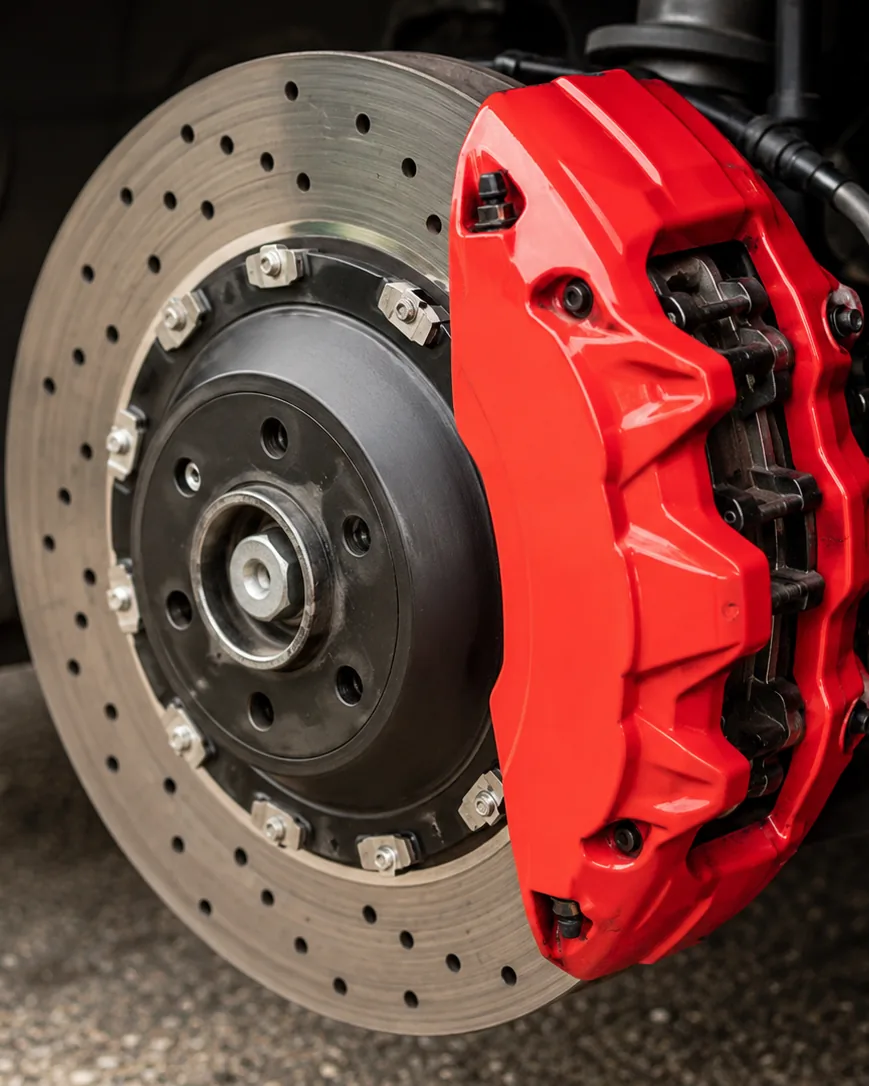
Red caliper paint versus powder coating
Two finishes give you red calipers, and they are not equal. Brush-on or spray paint is the accessible DIY route. Powder coating is a shop process that bakes a tough finish onto bare metal, which looks excellent but demands more. The table compares them on the points that matter.
| Factor | High-temp paint | Powder coating |
|---|---|---|
| Who does it | ||
| Caliper removal | ||
| Heat tolerance | ||
| Durability | Good if prepped well | |
| Rubber seal risk | Low if you mask correctly | Cure oven heat can damage boots and seals if not removed |
| Typical cost | ||
| Downtime | Car down while calipers are out |
The rubber seals and dust boots cannot survive the curing oven. On the street either finish is fine. If you do serious track days, talk to a brake specialist first, because sustained high heat can soften a powder coat enough to contaminate pads and seals, and that is a braking problem, not just a looks problem.
What red brake calipers cost
The price swings a lot depending on who does the work. The figures below come from published retail prices and documented owner jobs; confirm local pricing before you budget.
- DIY paint. Ceramic aerosol cans run about $8 to $15, complete spray kits about $45, brush-on kits about $55, and 2-part epoxy kits $60 to $80. One kit typically covers all four calipers, and even with brake cleaner, tape, and a wire brush added, documented DIY totals stay under $250 all-in.
- Professional painting. A documented shop paint job on all four calipers came in around $380, labor included.
- Powder coating. Because it requires removal, disassembly, and oven curing at a specialist, a documented four-caliper powder-coat job ran about $1,200.
Whichever route you take, respect the cure clock. A common caliper paint is dry to the touch in about 30 minutes and safe to handle in about an hour, but it needs a full 24 hours of cure before the car drives, because uncured paint is soft enough for brake fluid to strip it. For most people the DIY kit is the sensible choice: a strong result for the price of a nice dinner, as long as you follow the masking rules. If you want a flawless, long-lived finish and you are already doing a brake overhaul that has the calipers off the car anyway, powder coating starts to make sense. Either way, budget the money for the mechanical parts first and the color second.
Common myths about red calipers
A few beliefs come up again and again, and clearing them up saves money and avoids bad assumptions when buying a car.
- Myth: red calipers stop the car faster. They do not. Stopping comes from pads, rotors, fluid, caliper design, and tires. Paint is inert.
- Myth: red paint helps the brakes run cooler. The effect is negligible. Heat lives in the rotor and pad, and a few thousandths of an inch of paint on the caliper does not cool the system.
- Myth: red calipers always mean a performance brake package. Sometimes a factory uses color as a code, but anyone can paint a base caliper red. Judge the hardware, not the color.
- Myth: any spray paint works. Ordinary paint can bubble and flake with brake heat. Use a coating rated for high temperature.
- Myth: painting calipers is risk-free. It is safe only if you keep paint off the friction surfaces, boots, and bleeder. Skip the masking and you can create a real brake fault.
When to see a mechanic
A paint job is well within DIY territory, but some situations call for a professional before or instead of the brush. See a qualified technician when any of these apply.
- The caliper is seized, leaking, or badly corroded. A caliper that drags, sticks, or weeps fluid needs repair or rebuild, not paint over the problem.
- You would need to open the brake hydraulics. Removing calipers for spray or powder coat means bleeding the brakes afterward, which is a task to do correctly or leave to a pro.
- The pedal is soft, low, or pulsing. Those are signs of air, worn parts, or a warped rotor, and they matter far more than the color of the caliper.
- You are planning track use with a coated caliper. Sustained heat behavior is worth a specialist’s input before you push a painted or powder-coated caliper hard.
- Anything feels off after the job. A dragging wheel, a pull to one side, or a warm hub after a short drive means stop and get it checked.
Doing your own cosmetic work does not replace routine brake service. Fresh fluid, good pads, healthy rotors, and correct torque are what keep the car stopping. The safety agencies that study crashes, from NHTSA to the IIHS, all point at the same thing: working brakes, not pretty ones.
Sources and further reading
The safety framing, thermal limits, and testing standards referenced above draw on the following authorities. Each link is to the organization’s current homepage so it stays valid over time.
- National Highway Traffic Safety Administration (NHTSA), federal brake safety standards and recalls: https://www.nhtsa.gov/
- SAE International, engineering test methods and friction and thermal standards for brake components: https://www.sae.org
- Insurance Institute for Highway Safety (IIHS), independent braking and crash-avoidance testing: https://www.iihs.org/
Frequently asked questions
Do red brake calipers make a car stop faster?
No. The color is paint or powder coating and has no effect on stopping distance. Braking performance comes from the pad compound, the rotor size and type, the caliper design, the brake fluid, and the tires. If you want shorter stops, upgrade those parts. Testing bodies like the IIHS measure braking against real hardware, never caliper color.
Why do so many sports cars have red calipers?
Because red became a visual shorthand for performance, led by brake makers like Brembo that colored their calipers so the brand showed through the wheel. Automakers use bright calipers to make a car look sporty in the showroom. On some models a red caliper does flag a bigger brake package, but the color itself adds nothing.
Is it safe to paint my own brake calipers?
Yes, if you use a high-temperature caliper coating and mask carefully. Keep all paint off the friction surfaces, the rubber piston boots, the bleeder screw, and the brake lines. Work on cool brakes and apply thin coats. Skipping the masking is what turns a safe job into a brake fault.
What temperature does caliper paint need to handle?
Look for a product rated well above normal brake temperatures. Quality caliper paints are rated near 900 degrees Fahrenheit, or 482 degrees Celsius, intermittent, which covers street driving with margin.
Should I paint or powder coat my calipers?
For a DIY job on the street, high-temperature paint is the practical choice. Choose paint for simplicity, powder coat for a premium finish during a brake overhaul.
Do red calipers mean the brakes are new or upgraded?
Not reliably. A factory may use color to mark an upgraded brake option, but paint is cheap and anyone can make a base caliper red. When buying a used car, judge the brakes by pad thickness, rotor condition, fluid, and how the pedal feels, not by the caliper color. The paint tells you about taste, not condition.
Red brake calipers are a clean, low-cost way to make a car look sharper behind the wheels, and there is nothing wrong with wanting that. Just keep the two ideas separate: the color is style, and the stopping power lives in the pads, rotors, fluid, and tires underneath. Do the mechanical work first, mask carefully, use a coating built for the heat, and let a professional handle anything that touches the brake hydraulics. Get that order right and you end up with brakes that both look good and work the way they should.