Federal law puts a number on it: under the standard that governs light vehicles, a passenger car’s parking brake has to hold the car motionless on a 20% grade for 5 minutes, pointed both up the slope and down it, with the transmission in neutral. The neutral part is the tell. So what is a parking brake, in federal terms? It is a holder that gets tested entirely on its own, with no help from the transmission’s Park position, which is the clearest proof that the two are separate systems doing separate jobs.
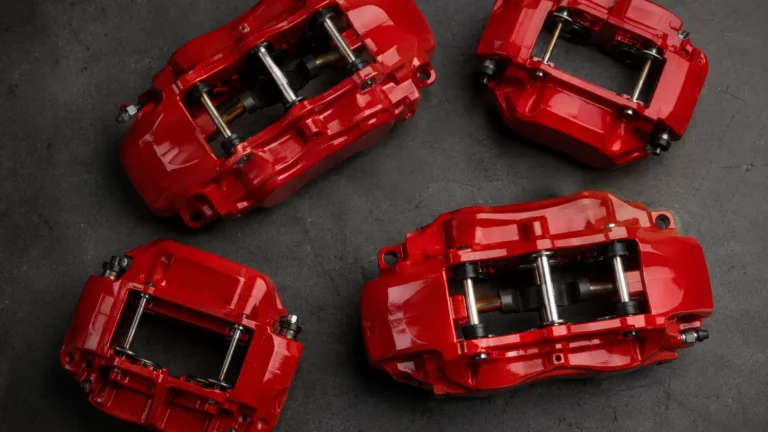
A parking brake is a friction device, held engaged by purely mechanical means, whose one job is to keep an already-stopped vehicle from rolling. Its control sits apart from the service-brake pedal you press to slow down, and in federal terms it is a different thing again from an emergency brake, which is defined as a way to stop a vehicle after the service brakes have failed. The control can be a hand lever, a foot pedal, or a push-button electronic switch, but the function behind all three is the same: holding a parked car in place without help from the engine or the transmission.
Parking brake, service brake, emergency brake: three different jobs
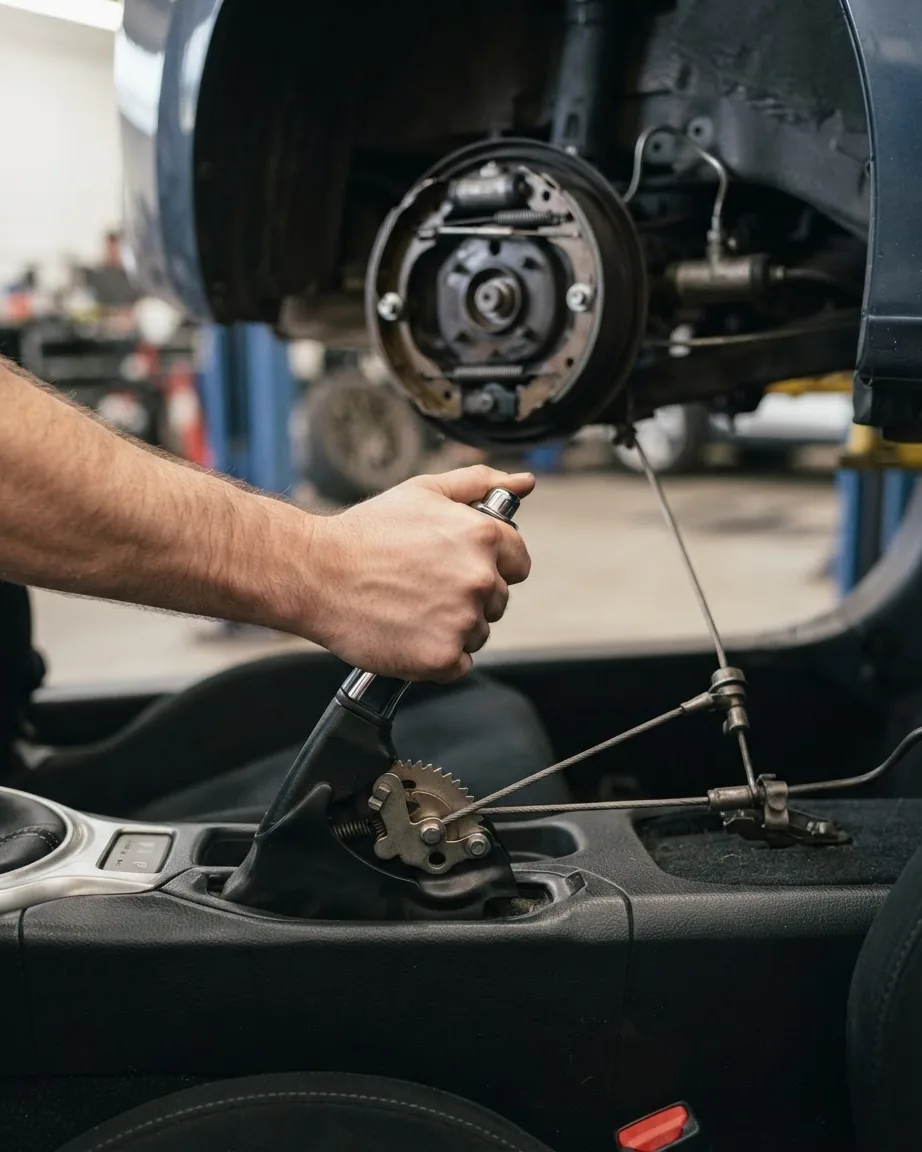
Everyday speech runs these together. People call the hand lever a “handbrake,” call the whole thing an “e-brake,” and assume emergency brake and parking brake are two names for one part. The federal standard that defines light-vehicle braking draws sharper lines. The service brake is the primary system, the pedal that slows and stops you in normal driving. The emergency brake is defined by what it does after a failure: a means of stopping the vehicle if the service brakes quit. The parking brake has the narrowest job of the three, holding a vehicle that is already stationary.
The standard also dictates how the parking brake is built. Its control has to be independent of the service-brake control, and it can be worked by hand or by foot. It must be a friction device held engaged by purely mechanical means, not something that leans on hydraulic pressure or engine vacuum to stay clamped. That mechanical-hold requirement is why a properly set unit keeps holding after the engine is off and the car is locked, and why a leak that kills your hydraulic pedal does not touch it. The official text of these rules, 49 CFR 571.135, is published by the Legal Information Institute at Cornell Law School.
What FMVSS 135 requires your parking brake to do
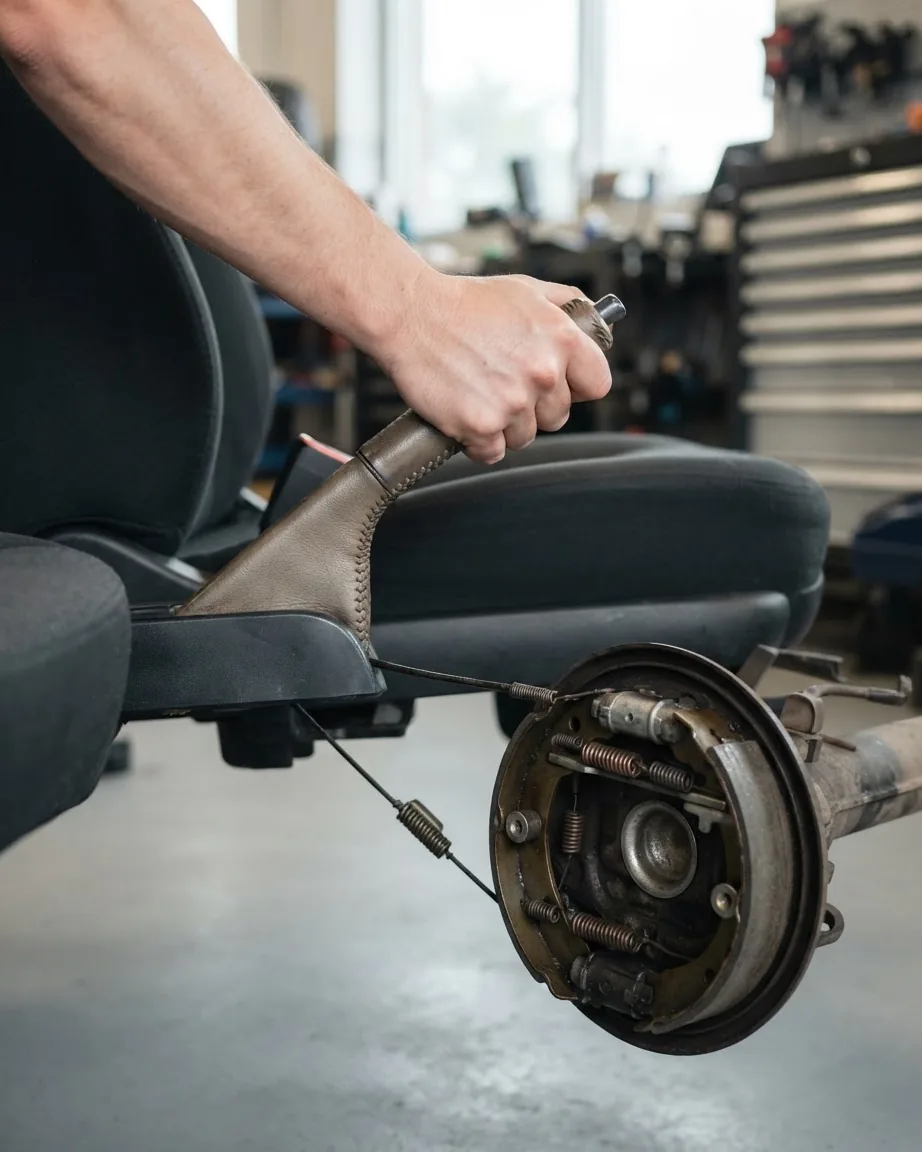
FMVSS 135 is one of the federal motor vehicle safety standards administered by the National Highway Traffic Safety Administration (NHTSA), and its performance bar is concrete. A light vehicle’s parking brake, set by the driver, has to hold the car stationary on a 20% grade for 5 minutes, tested facing up the grade and facing down it, with the transmission in neutral. The force a driver applies to the control is capped as well: no more than 89.9 lb for a hand control and no more than 112.4 lb for a foot control. Those two limits pull in opposite directions on purpose. The brake must do genuine holding work, yet an average person has to be able to set it without straining.
Which vehicles this covers is spelled out by weight and build date. FMVSS 135 applies to passenger cars built on or after September 1, 2000, and to multipurpose passenger vehicles, trucks, and buses with a gross vehicle weight rating of 3,500 kg (7,716 lb) or less built on or after September 1, 2002. Vehicles above that 3,500 kg (7,716 lb) rating fall under a separate standard, FMVSS 105, whose current text is maintained in the Electronic Code of Federal Regulations by the Office of the Federal Register. Within FMVSS 135 itself, certain heavier trucks and multipurpose vehicles rated above 10,000 lb are handled under their own provisions.
Reading the two standards together answers a practical question: the rule your car’s parking brake was certified against depends on how much the vehicle weighs and when it was built. A light passenger car and a heavy-duty pickup are not held to the same document.
“It’s in Park” is not the same as setting the parking brake
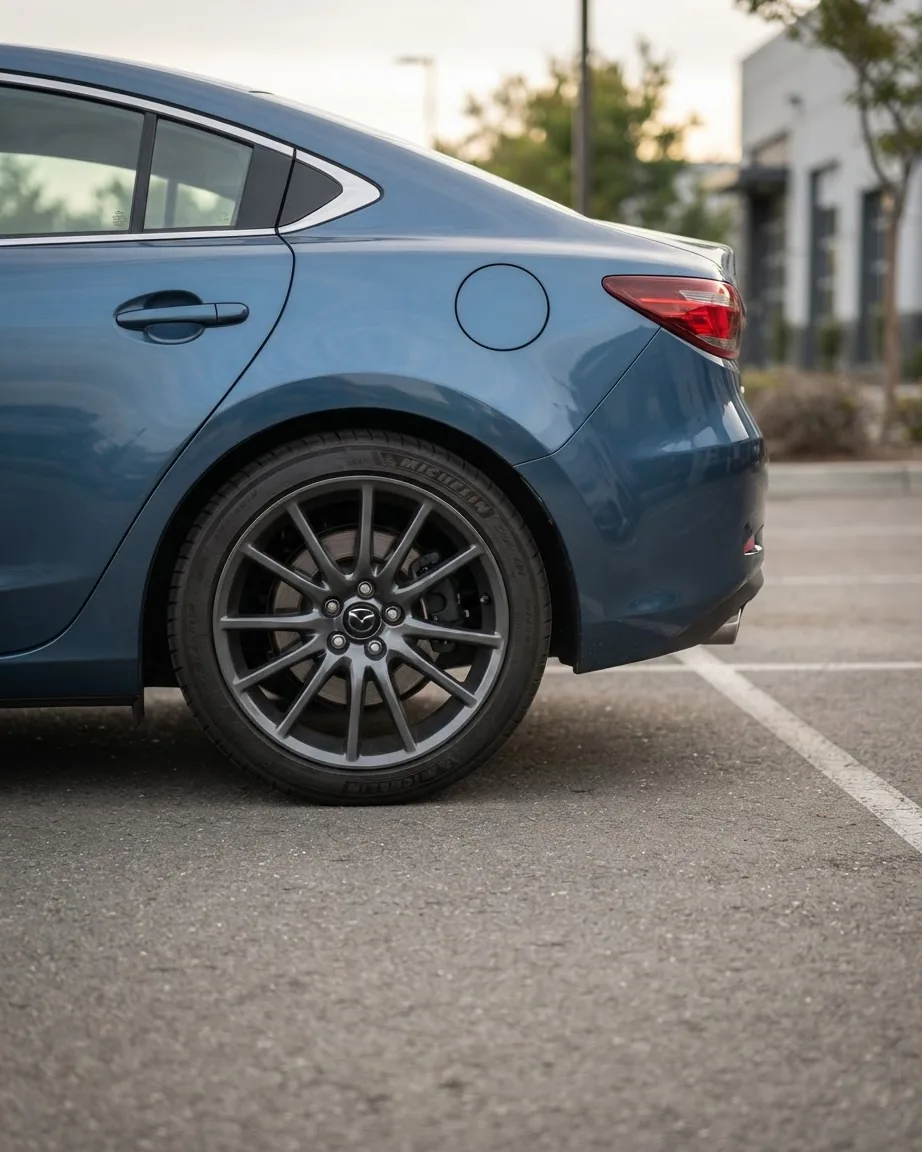
Because the federal holding test runs with the transmission in neutral, the parking brake is engineered to do its job without the Park pawl, the small locking part inside an automatic transmission. That cuts against a common assumption, that leaving an automatic in Park makes the parking brake pointless. It does not. The Park pawl and the parking brake are two independent ways of keeping a car from rolling, and the standard practice drivers are taught is to use both: set the holder and leave the car in Park or in gear, rather than lean on either one alone.
On a slope the logic gets sharper. The Park pawl is a small component, and letting a parked car’s full weight settle onto it alone is avoidable when the holder can share that load through the braking hardware at the wheels. Setting both is the belt-and-suspenders version, and it keeps a car on an incline from depending on a single internal latch. The habit costs nothing and removes a failure point.
Hand lever, foot pedal, or electronic switch
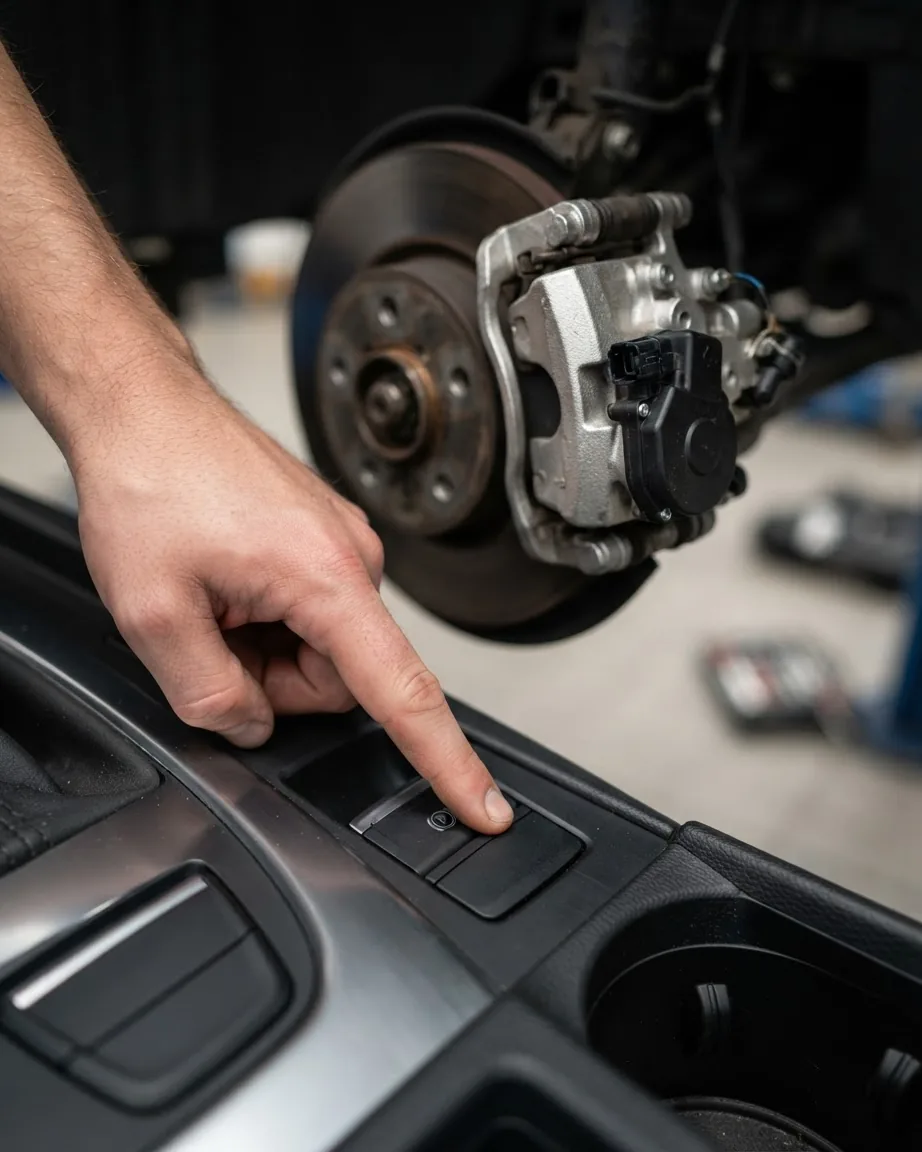
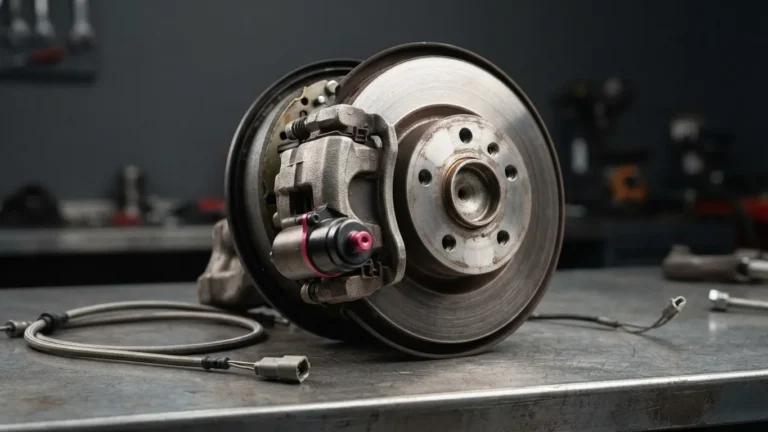
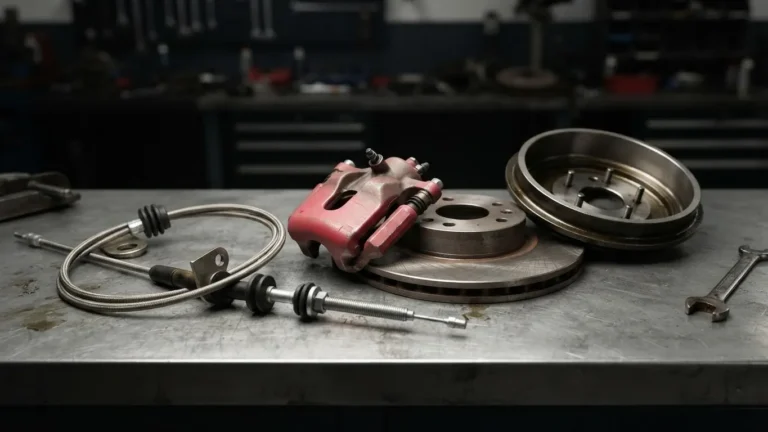
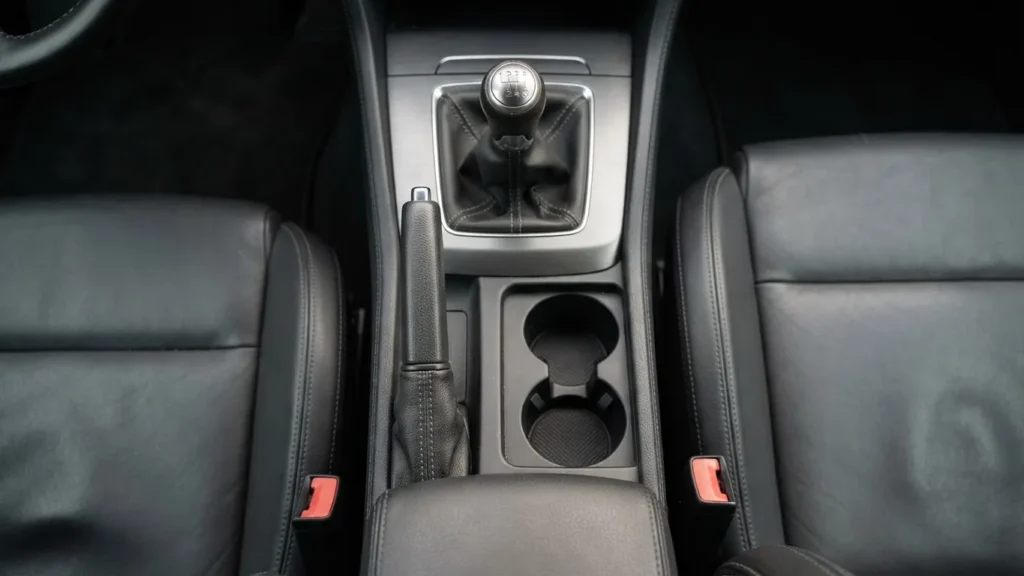
Three control types cover almost every car on the road. A hand lever between the seats, the classic handbrake, pulls a cable that clamps the rear brakes. A foot pedal down by the firewall does the same through a different linkage, usually released by a small pull-handle or a second press. Both are purely mechanical, so once set, they hold with no power needed and no electronics in the loop. On cable-operated parking brakes, see also our parking brake cable guide.
An electronic parking brake (EPB) swaps the lever or pedal for a switch and a pair of small motors at the rear calipers, and it adds behaviors a cable system never had. Many EPBs apply automatically when you shift into Park, and many release automatically as you drive away, so the set-and-release routine can happen without you touching the switch at all. The trade-off is dependence on the electrical system. On Ford’s electronic parking brake, a low or discharged battery can stop it from both applying and releasing, a failure mode a mechanical handbrake does not have.
There is one more EPB behavior worth knowing, because it contradicts a rule people repeat as gospel. “Never use the parking brake while moving” is not universally correct. Some electronic systems are built to slow the car in an emergency: Ford Motor Company states that above 4 mph (6 km/h), braking force keeps applying for as long as you hold the switch, which it documents in its owner’s manual. Routine use while rolling is still a bad idea, and it is still worth avoiding, but the emergency capability exists on some designs and not others.
That split is the reason the manual matters more than any generic advice. Auto-apply, drive-away release, dead-battery lockout, and held-switch emergency braking are all vehicle-specific, not guaranteed features of every EPB. Manufacturers such as Ford, Hyundai, and Kia publish the exact procedure for each model, and on an EPB-equipped car that document, not habit carried over from an older vehicle, tells you how your parking brake behaves.
When a brake warning light means stop and see a mechanic
The parking brake ties into the same dashboard warning as the hydraulic braking system, and that overlap trips people up. If the brake warning light stays on after you have fully released the control, it is not always a sticky lever. It can flag a fault in the brake system itself rather than a control that just needs resetting, and that is a reason to have the car inspected rather than waved off as a glitch.
Some signals move from “get it checked soon” to “stop driving now.” If the brake warning light and the ABS warning light are lit at the same time, have a certified mechanic diagnose it before you count on the brakes. And if the brake pedal sinks slowly under your foot or drops toward the floor, that is an emergency, not a quirk: pull over, stop driving, and get it inspected before the car moves again. The parking brake is one part of the larger brake system, and none of its mechanical holding ability substitutes for working hydraulic brakes. See also our electric parking brake problem guide.
What happens if I drive with the parking brake on?
It overheats the braking system and can prematurely wear or damage the components. Even a partly set brake drags against the rear drums or rotors, building heat the parts were never meant to shed at road speed. A brief distance usually does little lasting harm; keeping it engaged over a long drive is what cooks the hardware. Release it fully before you move off, and if you smell hot brakes, stop and check.
Is the “handbrake” or “e-brake” the same as the parking brake?
In everyday talk, yes. “Handbrake” and “e-brake” are both common names for the control you set when you park. Federal terminology is stricter. It reserves “emergency brake” for a system that stops a moving vehicle after the service brakes fail, which is a different function from holding a stopped car. So the nickname points at the right part, while the formal emergency-brake role stays defined as something separate.
How much harder you’re allowed to push: hand vs. foot force caps
FMVSS 135 caps parking-brake setting force at 89.9 lb for a hand control and 112.4 lb for a foot control. Those are not arbitrary near-equal numbers: the foot limit is 22.5 lb higher, which works out to roughly 25% more force a driver is allowed to apply before a foot-operated unit fails the standard. In plain terms, the rule lets a foot pedal demand about 1.25 times the effort of a hand lever, reflecting that your leg can push harder than your arm can pull while both stay within what an average person can manage.
- Hand control cap: 89.9 lb; foot control cap: 112.4 lb (both from the article text).
- Difference: 112.4 − 89.9 = 22.5 lb more allowed on a foot control.
- Ratio: 112.4 ÷ 89.9 ≈ 1.25×, i.e. about 25% more permitted setting force.