Most cars finish their entire service life without a mechanic ever touching this part. The ones that do run into trouble share a profile: RepairPal reports that a parking brake cable usually only needs replacing on vehicles past 10 years old with more than 145,000 miles behind them. So if yours is acting up and the odometer is nowhere near that, the odds favor a cheaper fix than a full swap. The trick is telling the difference before you pay for the wrong one, and knowing when a soft, high-pulling lever means “adjust me” versus “I’ve already snapped.”
This part lives in the brake system, but it works on its own circuit, separate from the hydraulic brakes you use at every stoplight. That separation is exactly why a dead cable can hide for months and then surprise you on a hill.
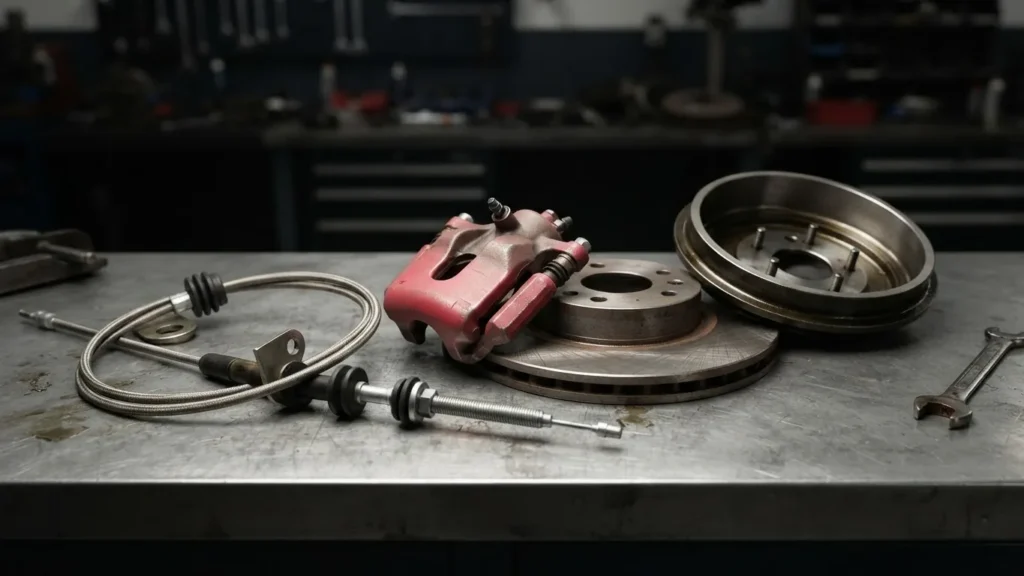
A parking brake cable is the steel line that ties your hand lever or foot pedal to the rear brakes and holds them with mechanical force alone, with no hydraulic help. If the cable still slides and carries tension but the car won’t stay put, you usually need an adjustment, not a new part. A cable that’s seized solid, snapped, or stretched past its adjustment range needs replacement. Across all vehicles, the job runs roughly $161.51 to $909.67, and where you land depends mostly on whether your rear brake is a disc with an external caliper connection or a drum design that forces deeper teardown to reach the cable end.
How the Cable Works, and the Three Signs It’s Going
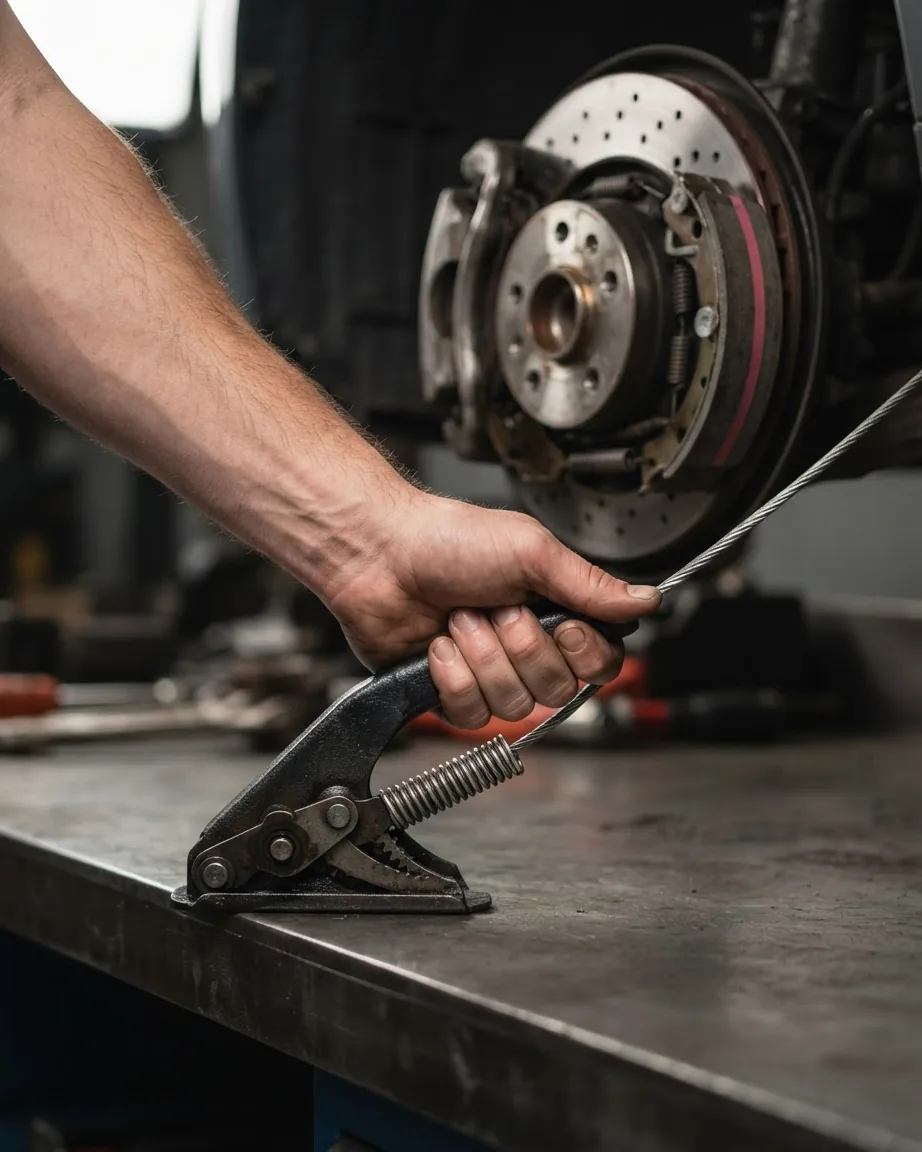
RepairPal describes the setup plainly: the parking brake, also called the emergency brake, uses a cable connected to the rear brakes to set them by hand when the vehicle is parked. Pull the lever or press the pedal, and the inner wire slides inside its outer sheath, transmitting your pull to the back of the car.
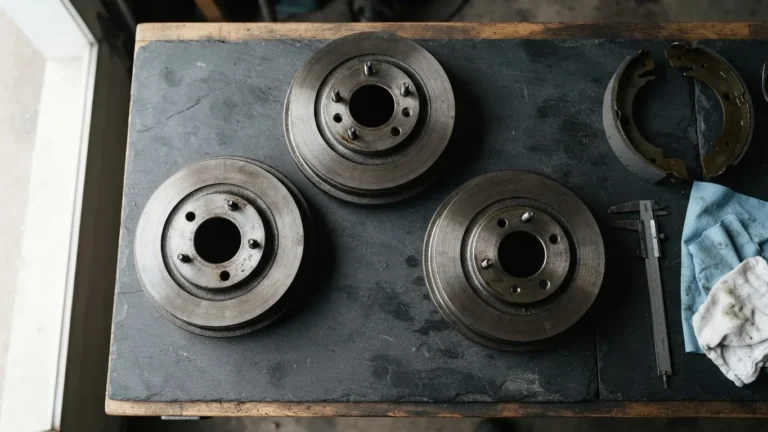
Where that pull goes depends on your rear brakes. On a disc setup, the tension clamps the rear pads against the rotor. On a drum setup, it forces the shoes outward against the drum. Many newer rear-disc vehicles add a small auxiliary drum tucked inside the rotor’s hat section, used only for parking. The trade publication BrakeAndFrontEnd calls this a mini drum brake dedicated to the parking function, and you’ll hear shops refer to it as a drum-in-hat design. It matters later, because that little drum is what makes some replacements far pricier than others.
When the cable starts failing, YourMechanic points to three symptoms a driver will actually notice:
- The parking brake warning light comes on. The dash tells you the system isn’t where it expects to be.
- The brake won’t release. Rust has seized the inner wire inside the sheath, and the shoes or pads stay clamped even after you drop the lever.
- You set it and the car still rolls. The clearest sign of all – tension isn’t reaching the rear brakes, or there isn’t enough of it to hold.
That last one is the symptom most people search for, and it’s also the one that forces a decision about whether you’re looking at an adjustment or a new cable.
Adjust or Replace: How to Read Your Own Cable
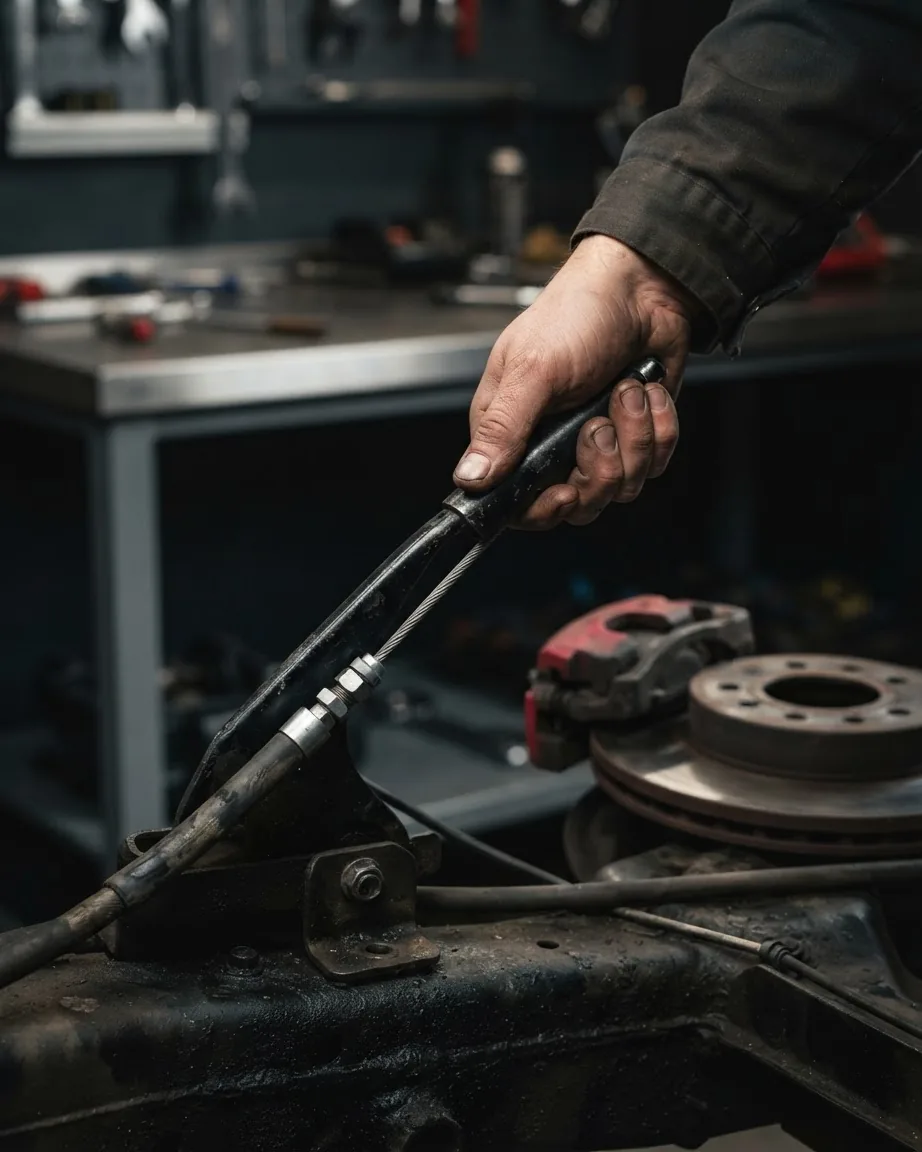
This is where people waste money in both directions – paying for a new cable that only needed tightening, or chasing an adjustment on a cable that’s already dead. The test RepairPal describes is simple enough to run in a driveway with the car safely chocked.
Work the lever or pedal and feel for movement inside the sheath. A healthy cable moves; you can sense tension traveling through it when it’s actuated. From there the logic splits:
- Cable intact, still moves and tensions, but the car won’t hold → adjustment. RepairPal states directly that if the cable is intact and the brake doesn’t engage, the cable may just need adjusting. Nothing is broken; the slack has grown past where the mechanism can take it up.
- Cable seized, snapped, or stretched past any remaining adjustment → replacement. There’s nothing left to tighten.
- Auto-adjusting system that seized from disuse → try before you buy. Some vehicles take up cable slack automatically as you brake. A cable that stiffened from sitting unused can sometimes free up if you set and release the brake firmly several times, restoring enough movement to self-adjust.
The reason disuse causes this at all is mechanical, not mysterious. RepairPal notes that failing to use the parking brake over a long stretch can let the cable seize. The fix and the prevention are the same action: use it. Setting the brake routinely keeps the cable sliding freely and the adjustment current.
If you’ve never heard your car click through self-adjustment, that’s normal – it happens quietly during ordinary braking on the vehicles that have it. On those systems, maladjustment is driven far more by sitting idle than by miles covered.
Why a Dead Cable Is Worse in a Manual Than an Automatic
Here’s a difference that changes how urgently you should treat this. An automatic transmission has a park pawl – a metal pin that drops into a gear and physically locks the output shaft when you shift to P. It’s a second, independent mechanical lock. Even with a failed parking brake, a car in Park has that backstop.
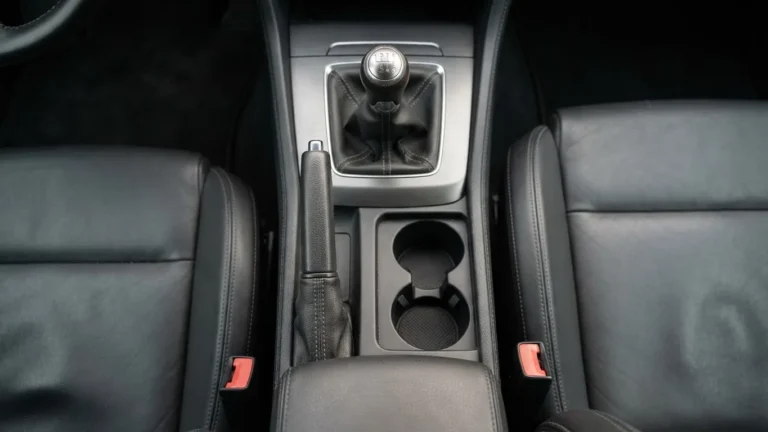
A manual transmission has no equivalent. Leaving it in first or reverse resists rolling through engine compression, but RepairPal is explicit that this is not a lock. The gearbox has no secondary catch, and on a grade the weight of the car can overcome the gear and let it roll anyway. So when the parking brake cable fails on a stick-shift car, the thing you’d normally fall back on isn’t really there.
That’s the core of why you don’t keep driving on a known-bad park brake. RepairPal frames it bluntly: it isn’t safe to drive with any braking problem, because a non-functioning park brake can signal rear brake failure or cause a runaway vehicle. The recommended move until repair is to chock the wheels rather than trust the lever. For manual owners especially, a dead cable removes the only reliable thing holding the car still when the key is out.
This is also where electronic systems diverge from cable ones entirely. If your car uses a button instead of a lever and throws a fault, the diagnosis is different – see our write-up on the electric parking brake problem.
What Makes a Parking Brake Cable Fail, and How to Slow It Down
There’s no mileage interval for this part. YourMechanic is clear that there’s no set replacement mileage; the cable’s life comes down to wear, conditions, and how often you actually use it. What kills it is almost always corrosion.
Over time, YourMechanic explains, the cable rusts, weakens, and eventually breaks, and that sequence tends to hit hardest on cars where the brake sits unused. Rust needs moisture and time, and a cable that never moves gives rust an undisturbed place to lock the inner wire to its sheath.
Road salt accelerates everything. RepairPal observes that vehicles in colder climates, where salt clears ice off the roads, fail more often, because salty water eats at the cable and its protective jacket. If you park outdoors through northern winters, assume your cable is aging faster than a garage-kept car in a dry state.
Two prevention steps follow directly from the cause:
- Set the parking brake routinely – every time you park, not just on hills. Regular use keeps the inner wire moving and stops it from seizing in place.
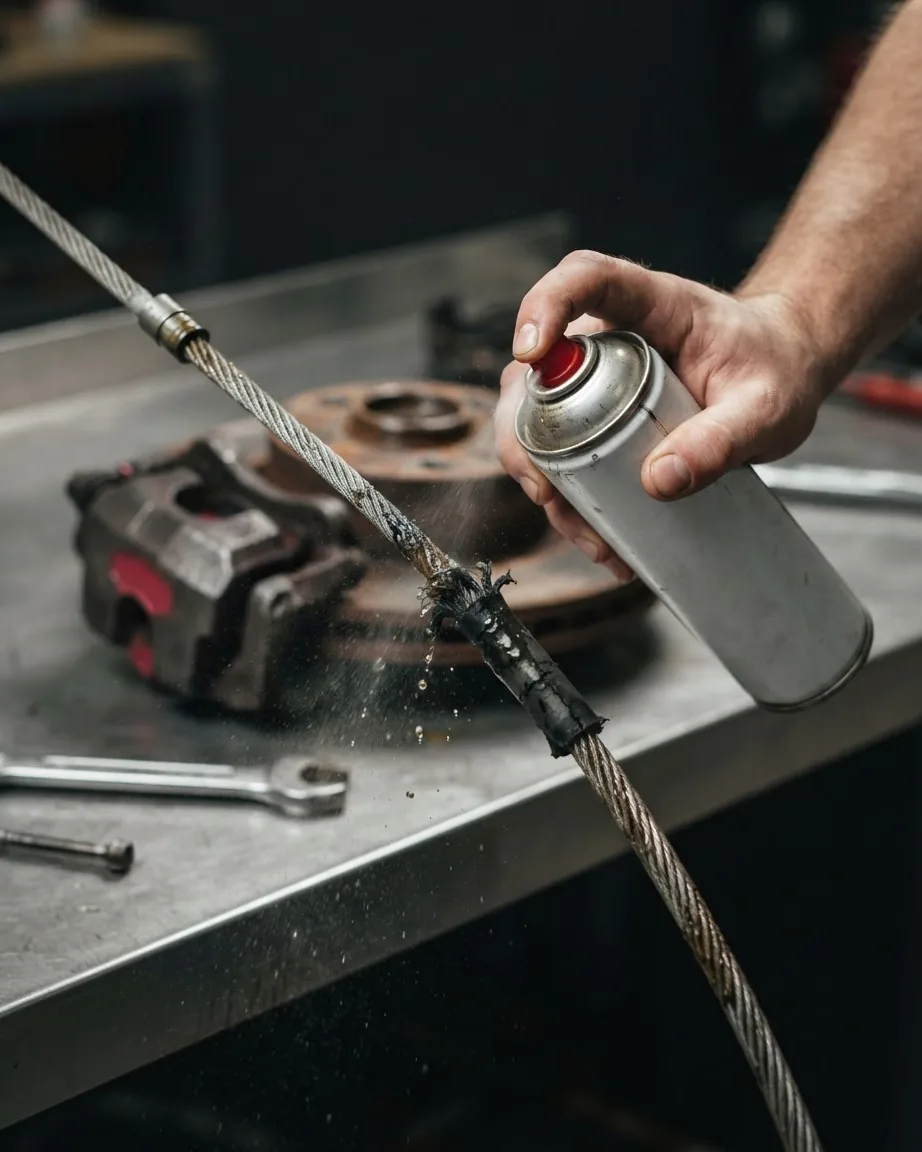
- Spray the cable with a rust penetrant now and then. YourMechanic recommends having a rust penetrant chemical applied to the cable periodically to fight corrosion before it can take hold.
Neither step is a substitute for a shop inspection if the brake is already failing, but together they’re the difference between a cable that lasts the life of the car and one that seizes in a salty winter. This is also a reason not to ignore your rear service brakes, since they share the same wet, salted environment – our guide on when to replace brake pads sits alongside this one for a reason.
Replacement Costs: $161.51 to $909.67 and Why Quotes Differ So Much
The price spread on this job is wide, and the width is not random. YourMechanic lists an all-vehicle range of $161.51 to $909.67 for emergency/parking brake cable replacement. That’s a span across every make and model they cover, so it tells you the ceiling and floor but not your number.
RepairPal’s estimates narrow it per vehicle. A given model comes in at one band on RepairPal’s estimator, while other models land in a different band entirely. These are separate populations measured different ways – YourMechanic’s single wide span and RepairPal’s model-specific rows don’t average into one true figure, and you shouldn’t try to blend them.
What actually moves your cost is the rear brake design, and RepairPal spells out the mechanism:
- Rear disc with no auxiliary drum (cheap end). The cable disconnects from the outside of the rear caliper. Only the wheel comes off for access. Minimal labor.
- Drum or drum-in-hat design (expensive end). The rotor or drum has to come off to reach the cable’s attachment. More disassembly, more labor time.
There’s a sharper edge to the drum-in-hat case. RepairPal notes that those auxiliary parking-brake drums can’t be resurfaced, because most resurfacing machines can’t reach into drums that small. So if the little drum is scored or damaged – which happens when the brake gets dragged while driving – it’s a replacement, not a cleanup, and the bill climbs. RepairPal adds that leaving the park brake engaged while driving for any extended period forces a complete rear service-brake and parking-brake job afterward.
Before you approve any quote, ask the shop one question: is my rear brake a plain disc, or does it have a parking drum inside? The answer tells you whether you’re at the floor or the ceiling of that range.
The 20% Grade Spec Your Parking Brake Must Pass
“It barely holds on my driveway” is a complaint with an actual benchmark behind it. The federal standard sets a measurable bar, and you can sanity-check your own brake against it.
Under the Federal Motor Vehicle Safety Standards, a passenger-type vehicle rated at 10,000 lb GVWR or less must keep the car stationary for 5 minutes, in both forward and reverse, on a 20 percent grade – roughly a steep driveway. It has to do that with no more than 90 lb of hand force on a hand-operated control, or 125 lb of foot force on a foot-operated one. The rule, published by NHTSA in a FMVSS 105 proposed rule, also requires that the system hold by “solely mechanical means” – no hydraulics, no electronics holding pressure, just friction and a latch.
That force figure is specific to light vehicles, and it’s easy to misquote. Heavier vehicles above 10,000 lb GVWR get different allowances. So there’s no single universal “the parking brake force limit is X”; it depends on weight class and on whether you pull a lever or press a pedal. For your car or crossover, the number that matters is 90 lb at the hand or 125 lb at the foot.
How to use this: if your brake needs a white-knuckle yank and still won’t hold a modest slope for a few minutes in both directions, it’s out of spec. A healthy system holds a 20 percent grade without you leaning your whole arm into it. Falling short means lost tension somewhere – stretched cable, bad adjustment, or worn friction material – and it’s a reason to get it looked at, not a reason to pull harder.
The Handle Pulls Up High Now, and What That Actually Means
A lever that suddenly travels way up, or feels loose and easy, gets misread constantly. The instinct is “I just need to crank it harder.” That reading is usually wrong, and the reason is in how the linkage is built.
Automotive textbook author James Halderman points out that every park-brake linkage contains one or more levers that increase application force – intermediate levers and an equalizer – precisely because a person can’t apply enough raw muscle to clamp the brake directly. The system is a force multiplier by design. A healthy one shouldn’t demand brute strength.
So when the handle goes high and light, the problem is almost never that you’ve gotten weaker. It’s that tension isn’t getting through: a stretched or broken cable, or an adjustment that’s slipped. The lever climbs because it’s taking up slack that should have been taken up at the brake end.
There’s a related reason the system can feel inefficient even when it’s working. BrakeAndFrontEnd notes that cables routed through tight, protected paths lose force along the way – commonly 30 – 50% of what you apply never reaches the brake, eaten up by friction in the routing. That built-in loss is normal and accounted for in the design. What’s not normal is a lever that keeps rising trip after trip, which points to a cable giving up rather than friction in the sheath.
If the handle travel keeps growing, the cable or its adjustment is the thing to fix.
One Lever, Two Wheels: The Equalizer and Multiple Cables
“Replace the cable” can mean more than one part, and a quote listing two or three cables isn’t a shop padding the bill. Most systems split the pull between the two rear wheels through an equalizer.
A U.S. patent for the conventional layout, viewable through Google Patents, describes a pair of parking brake cables joined at one end to an equalizer, which connects through a wire back to the lever. The equalizer’s job is to balance tension so both rear brakes clamp evenly – pull one side, and it distributes the force left and right.
That architecture explains two things drivers run into. First, why a job can involve a front or intermediate cable plus separate left and right sections: there’s rarely just one wire running the whole length. Second, why one wheel can hold while the other barely grips – uneven holding sometimes traces back to the equalizer or its adjustment, not to a cable at all.
On drum-brake cars, Halderman describes the cable’s actuating lever mounted on the rearward (secondary) shoe, so pulling the cable levers that shoe out against the drum. It’s a compact piece of mechanical advantage repeated at each rear wheel, fed by the balanced tension the equalizer sends down each cable.
Buying a Replacement: Matching the Right Cable
If you or your shop is sourcing the part, the wrong cable is a cable that doesn’t fit or doesn’t last. The retailer JEGS lays out the selection criteria, and they map cleanly onto what fails these parts in the first place.
- Year, make, and model. Routing and length are vehicle-specific; a cable that’s close isn’t a cable that bolts in.
- Disc versus drum. The end fitting differs by brake type, matching how the cable attaches at the wheel.
- Length, for custom setups. Modified or non-stock vehicles may need a specific length rather than an off-the-shelf part.
- Construction. JEGS notes that where it’s offered, you choose a galvanized or stainless steel cable.
That last choice is the one worth pausing on, because it connects straight to the main failure cause. Corrosion from road salt is what kills most cables. Stainless steel resists that corrosion better than galvanized, so if you live where the roads get salted every winter, paying up for stainless buys you time against the exact process that would otherwise seize and snap the cable. It’s the cheapest form of prevention you can build into the repair itself.
When a Parking Brake Problem Means Stop and See a Mechanic
Some symptoms are a “fix it this month” issue. Others mean don’t rely on the car until a professional has looked at it. For the cable itself, treat these as stop-driving signs: the car rolls when the brake is set, the brake won’t release because rust has seized it, or the handle has gone high and loose. Until it’s repaired, chock the wheels instead of trusting the lever, and keep in mind that a manual-transmission car has no backup lock to lean on.
A recall case shows how specific these failures get. In 2019, NHTSA documented a park brake cable recall (campaign 19V-174/175) on certain motorhomes where the extension cable could slip out of its retainer clips and cause complete park-brake failure. That particular slip-from-clip defect was an RV issue, not a pattern you’d expect on a passenger car, but it’s a reminder that “the brake just stopped holding” has real, documented mechanical causes – and that the validated hand-apply force on that heavy vehicle couldn’t exceed 125 lb, a reflection of its weight class, not a number to apply to your sedan.
One more line to keep separate in your head: the parking brake cable is not your hydraulic brakes. If your regular brake pedal ever sinks toward the floor, or the main brake warning light stays lit – especially alongside an ABS light – that’s a service-brake problem, and it’s urgent. Don’t keep driving to diagnose it yourself. Get the car to a certified mechanic. Caliper or hydraulic work is never a stand-in for a professional inspection, and a brake that goes soft underfoot is the one failure on this list you never wait on.
What the Price Swing Actually Means
The quoted all-vehicle range, $161.51 to $909.67, isn’t a vague estimate – the gap between its ends is the whole story of this repair. Run the arithmetic on the two numbers already in front of you:
- The full spread runs from the cheapest to the most expensive version of the same job.
A swing this wide on one named part isn’t labor-rate noise; it’s the design difference doing the work. A disc setup with an external caliper connection sits near the bottom, where the cable end is easy to reach. A drum or drum-in-hat design, which forces a deeper teardown to get at the cable, pushes you toward the top. Before you call a shop, the single question that moves your quote by hundreds of dollars is which rear brake your car has – not the cable itself, which is cheap in every case.
Frequently Asked Questions
Can I pass a state inspection with a weak parking brake?
Many states check that the brake holds the car against a mild grade, and a lever that needs a full-arm pull without stopping the vehicle will typically flag. The federal benchmark for light vehicles is holding a 20 percent slope with 90 lb of hand force or less. If yours can’t manage that, expect a failed inspection and address the adjustment or cable before the appointment.
Does leaving my car in Park wear out the cable faster?
No – if anything, the opposite risk applies. On an automatic, relying only on Park means the cable sits unused, and disuse is what lets corrosion seize the inner wire. Setting the parking brake each time you park actually protects the cable by keeping it moving. The wear that matters here is rust from sitting still, not mileage from being used.
Why did my shop quote two or three cables instead of one?
Most vehicles route tension through an equalizer that splits the pull to each rear wheel, so the assembly often includes a front or intermediate section plus a left and a right. Replacing “the cable” can legitimately mean replacing several linked pieces. It’s also why one rear wheel can grip while the other slips, since the fault may sit at the balancing point rather than in a single wire.
Is it worth paying extra for a stainless steel cable?
In salt states, yes. Corrosion is the dominant reason these cables die, and stainless resists it better than galvanized. The upcharge is small against a repeat failure in a few winters. In a dry climate without road salt, the benefit shrinks, and a standard galvanized cable matched to your exact model will usually serve fine. Match year, make, model, and brake type either way.