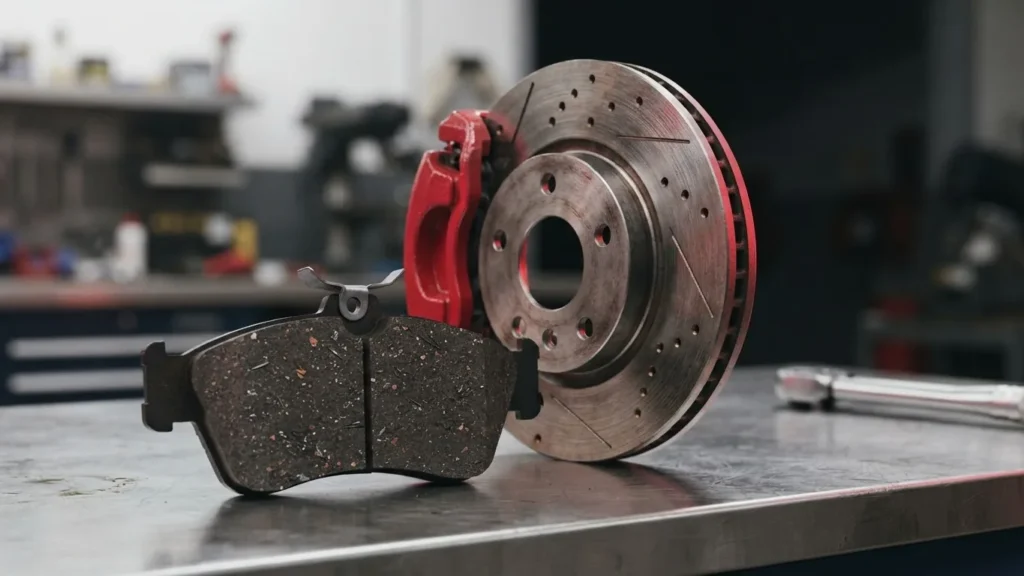
A semi-metallic brake pad is not mostly metal, and it is not mostly resin either. It sits between the two, and the exact split is the first thing worth knowing before you buy. Semi-metallic brake pads are a blend of metal shavings held in a resin binder with friction modifiers, and the metal fraction typically runs about 30 to 70 percent. That range decides almost everything that follows: how well the pad bites when cold, how much dust it throws, how fast it wears your rotors, and whether it can shed the heat a loaded trailer or a mountain descent dumps into the brakes. This guide gives you the numbers to match a pad to how you actually drive, the friction code that most buyers read wrong, and the copper rule that now shapes what sits on store shelves.
Quick answer: Semi-metallic brake pads contain roughly 30 to 70 percent metal (steel, iron, copper, or alloy fibers) mixed with graphite and resin. They give stronger cold bite and a wider working temperature range than organic pads, and they shed heat better than ceramic, which makes them the sensible pick for towing, cold climates, and performance driving. The trade-offs are more noise, more dark dust, and faster rotor wear. The two-letter code stamped on the edge rates lab friction only; it does not tell you the material family or guarantee a shorter stop. Match the compound front and rear, and bed the pads in before hard use.
What’s actually inside a semi-metallic brake pad
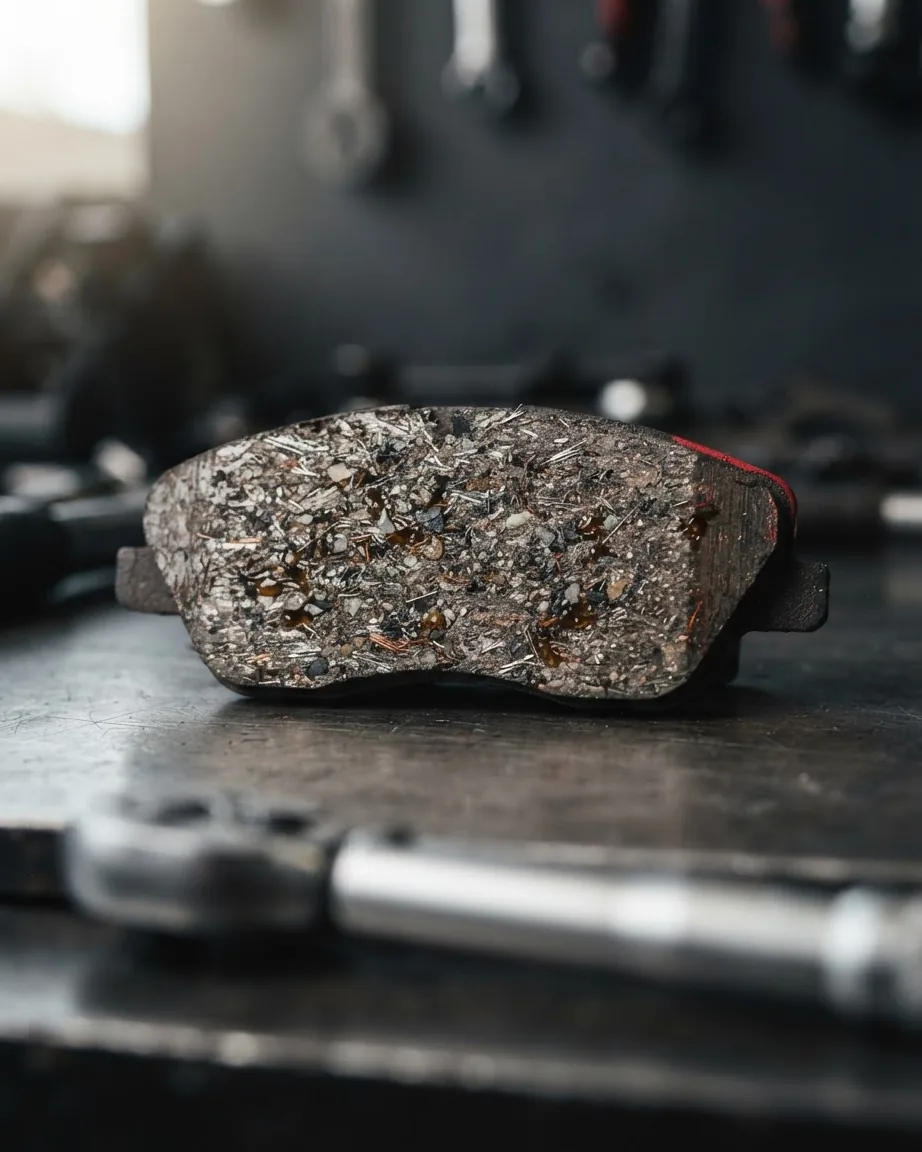
Semi-metallic compounds are built around metal fibers. AutoZone’s material guidance describes them as a blend of metal shavings such as steel, iron, or copper mixed with fillers and resin, and puts the metal content at about 30 to 70 percent. Bridgestone’s maintenance content gives the same window, listing copper, iron, steel, or composite alloys combined with graphite lubricant and fillers at 30% to 70% metal.
One manufacturer figure lands lower at the top. FrictionMaster, which makes and distributes brake friction material, states that semi-metallic pads contain 30 to 65% metal by weight. The ceiling differs, 70% versus 65%, and the basis differs too: FrictionMaster measures by weight, while the retailer figures do not specify. Treat them as describing the same class of pad from slightly different angles rather than as a conflict. The practical takeaway is steadier: any pad labeled semi-metallic is substantially metal, and that metal is what gives it the properties below.
The resin binder and graphite are not filler in the dismissive sense. Graphite acts as a dry lubricant that keeps the metal from grabbing and screeching at every light touch, and the resin holds the matrix together as temperature climbs. Summit Racing’s technical knowledge base groups these pads with the high-heat, high-duty end of the friction-material spectrum for exactly that reason.
Semi-metallic vs ceramic: match the compound to your duty cycle
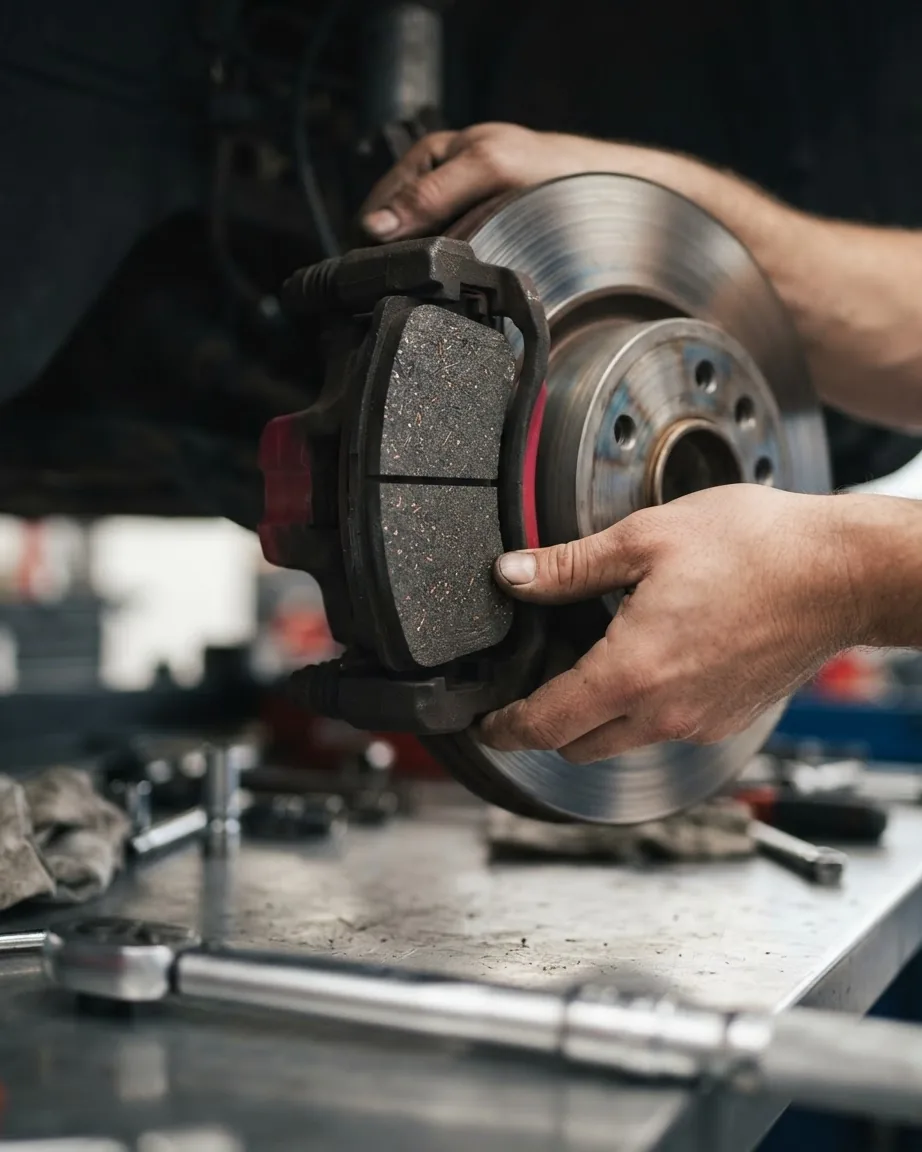
The honest way to choose is by what you ask of the brakes, not by which pad sounds premium. Semi-metallic earns its place in four cases: towing, cold climates, spirited or track-adjacent driving, and any duty where the brakes see sustained high heat. The reason is heat behavior. Metal is a good thermal conductor, so a semi-metallic pad pulls heat out of the interface and gives a wider usable temperature range and better cold bite than organic pads.
Ceramic is quieter and leaves lighter, less visible dust, which is why it suits a commuter who mostly brakes gently on flat roads. But “gentle” is not one-directional. Ceramic is a weaker heat sink, so instead of absorbing heat it tends to push more of it into the rotor and the rest of the system. Under a towing load or a long grade, that can work against you. Semi-metallic absorbs and dissipates more of that energy itself.
Here is the clean decision rule:
- Daily flat-road commuting, noise and dust sensitivity: ceramic is the easier companion.
- Towing, hauling, mountain descents, cold winters, performance use: semi-metallic gives the cold bite, the temperature range, and the heat dissipation you want, and it out-stops organic across the board.
- Mixed: weight the choice toward how you drive on your hardest day, not your average one.
The trade-offs you accept with semi-metallic are real: more noise, more dark brake dust on the wheels, and faster rotor wear because harder material grinds the rotor more over time. If those bother you and your driving is light, that is a legitimate reason to pass. For a deeper side-by-side on this exact pairing, see our ceramic vs semi-metallic guide.
The two-letter friction code: what FF and GG really tell you
Nearly every pad carries a two-letter code on its edge, like FF or GG, and it is the most misread spec in braking. It does not name the material family, and it does not promise a shorter stopping distance. It classifies measured friction in a lab, nothing more.
The standard is SAE J866. As the automotive technical publication HotRod explains, the code is read in two halves: the first letter designates the normal low-temperature (200 to 400 degrees F) friction performance, and the second letter the high-temperature (300 to 650 degrees F) friction performance. Each letter maps to a band of the friction coefficient. The brake vendor ICOOH Store lays out those bands: C is 0.15 or below, D is 0.15 to 0.25, E is 0.25 to 0.35, F is 0.35 to 0.45, G is 0.45 to 0.55, and H is above 0.55. So a GG pad holds a higher friction band both cold and hot than an FF pad; a GC pad would start strong and fade badly when heated.
The temperatures attached to those letters come from specific test points. ICOOH Store notes the normal coefficient is calculated from measurements at 200, 250, 300, and 400 degrees F (93, 121, 149, and 204 degrees C). HotRod frames the same J866 system as performance bands across 200 to 400°F and 300 to 650°F. These are not contradictory; they describe one standard from two angles, the test-point temperatures versus the performance-band ranges.
What the code will not do is tell you whether a pad is semi-metallic, ceramic, or organic. A high code does not guarantee a shorter stop in your car, because real stopping distance depends on your rotors, calipers, tires, and vehicle weight, not on a bench number. Read the code as a consistency rating, pair the pads to match across an axle, and ignore anyone who sells “GG” as proof of superiority.
Copper limits and the LeafMark you can read on the box
The metal in a semi-metallic pad used to include a lot of copper, and copper from brake wear washes off the road into waterways. The Washington State Department of Ecology, which administers the Better Brakes law, estimates that roughly 66 tons (60,000 kilograms) of copper a year enter Puget Sound from brake pads, accounting for up to half the copper reaching those waters. That is the pressure behind the rule.
The phase-out runs in steps. Pads made after January 1, 2015 had to contain 0.1% or less asbestos, hexavalent chromium, mercury, cadmium, and lead. Pads made after January 1, 2021 had to contain less than 5% copper by weight. Pads manufactured after January 1, 2025 must contain less than 0.5% copper by weight. Each stage ratchets the copper down.
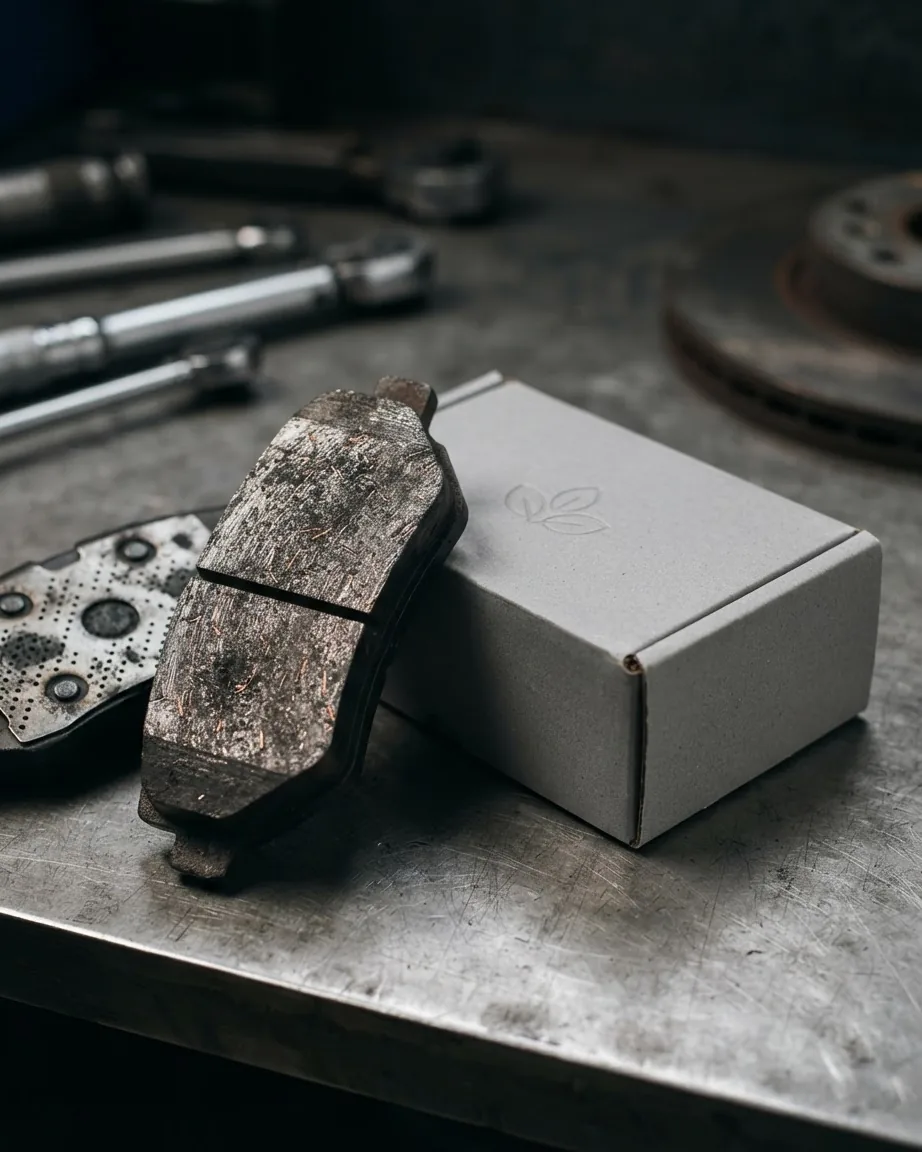
You can read a pad’s status without a lab, because the compliance level is printed as a three-leaf LeafMark symbol on the packaging and the pad:
- One leaf, Level A: meets the 2015 restrictions on asbestos and heavy metals.
- Two leaves, Level B: meets Level A plus less than 5% copper, the 2021 requirement.
- Three leaves, Level N: meets all requirements, including the 2025 copper limit.
Four of the main material-comparison pages a shopper reads never mention this at all, yet it is printed on the box in front of you. Washington’s statute is the one with published, enforceable copper thresholds; parallel national or California limits are often cited but are not something this guide can confirm, so treat the leaf symbol as your reliable on-shelf signal.
Bedding in semi-metallic pads: the gray layer you want, the glaze you don’t
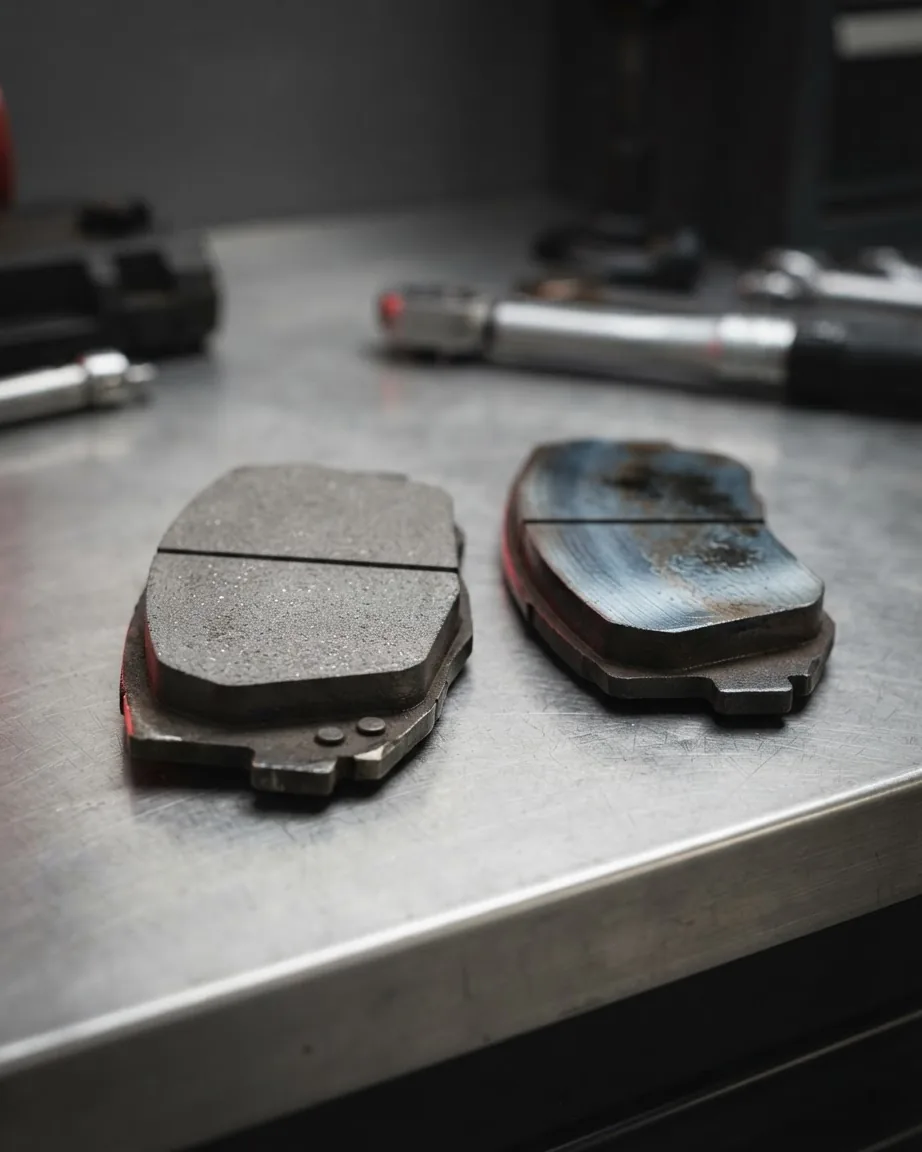
New semi-metallic pads do not reach full performance the moment they are installed. Bedding in transfers an even layer of friction material onto the rotor and cures the pad surface. Skip it and you invite uneven deposits, vibration, and early glazing.
AutoZone’s bedding procedure gives a concrete sequence: from 30 to 40 mph, apply moderate brake pressure without coming to a complete stop, and repeat five to six times. Follow that with three to four firmer stops from around 50 mph, then a 5 to 10 minute cool-down where you keep rolling and avoid using the brakes so the heat you built up can leave gradually rather than baking a print of the pad into one spot.
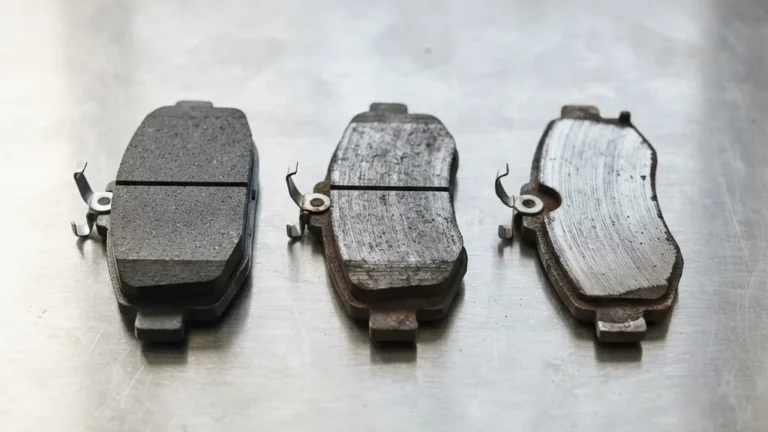
Read the results on the rotor. A successful bed-in leaves an even gray transfer layer across the rotor face. The failure sign is glazing, a shiny, hardened pad surface that comes from overheating the pads before the layer set, often from dragging the brakes or stopping completely while everything was still scorching. One caveat matters for semi-metallic specifically: the exact speeds and repeat counts are formulation-dependent, so if the pad maker prints its own numbers, those win over any general procedure.
Mixing compounds across an axle: a balance mistake to avoid
Here is a decision that looks harmless and is not. Putting a semi-metallic compound on one axle and a different compound, say ceramic, on the other can shift the front-to-rear brake torque balance your car was engineered around. The two materials bite at different rates and hold friction differently as they heat, so one axle can do more of the stopping than the designer intended.
The safe practice is to match the compound front to rear, or at minimum match it side to side on the same axle, and read the friction codes together so you are not pairing an F-rated pad against a G-rated one across the car. Because brake balance is a safety-critical system and the symptoms of getting it wrong, pulling, instability under hard braking, show up exactly when you most need the car to behave, this is work to hand to a certified mechanic if you are unsure. See also our how often to replace brake pads guide.
Reading wear and warning signs before you buy new pads
Choosing a semi-metallic pad only matters if the ones on the car actually need replacing, and a few numbers and symptoms tell you that. Measure the inner and outer pad on the same caliper, because they often wear unevenly, a sticking caliper slide or piston can grind the inner pad far thinner than the outer while the car still feels normal.
Three warning signs mean inspect now rather than later:
- A soft or spongy pedal: a reason to stop driving hard until it is checked by a mechanic.
A mechanic measuring pads reaches for a brake pad gauge or caliper. For measuring at home before a shop visit, our brake pad gauge guide walks through the tool.
As for cost, a semi-metallic pad set is generally an affordable choice relative to premium ceramic, and a per-axle pad replacement at a shop is a modest job compared with rotor or hydraulic work. Pads and balance are safety-critical, so confirm any replacement with a certified mechanic rather than treating a parts-counter conversation as the final word. You can read more across our brake pads section.
The copper numbers on the box, worked out
The Better Brakes copper limits look like small percentages, but the math shows how aggressive the phase-out really is. Pads made after January 1, 2021 had to stay under 5% copper by weight; pads made after January 1, 2025 must stay under 0.5%. Dividing one by the other, the 2025 ceiling is ten times tighter than the 2021 ceiling. That is the difference between a two-leaf LeafMark (Level B) and a three-leaf LeafMark (Level N) on the package in your hand.
The scale that pressure is aimed at is just as easy to recover. Washington’s Department of Ecology estimates brake pads drop roughly 66 tons (60,000 kg) of copper a year into Puget Sound, and says that is up to half of all the copper reaching those waters.
- 10x tighter: 5% (2021, Level B) divided by 0.5% (2025, Level N) = a tenfold reduction in the copper ceiling.
- Up to 132 tons/year: 66 tons from brake pads represents up to half, so the implied all-source total is 66 x 2.
Frequently asked questions
Do semi-metallic pads really wear rotors out faster?
Yes, and it is the main downside to weigh. Because the compound is substantially metal fibers, it is harder than organic or ceramic material and abrades the rotor surface more over its life. The payoff is heat handling and bite under load. If your driving is light and flat, that extra rotor wear buys you a benefit you rarely use.
Does a GG rating mean my car will stop shorter than with FF pads?
No. Under SAE J866 those letters rate a friction coefficient measured on a lab bench, with G sitting at 0.45 to 0.55 and F at 0.35 to 0.45. Actual stopping distance in your car depends on tires, rotors, vehicle weight, and brake balance. A higher code signals steadier friction, not a guaranteed shorter stop.
Can I install semi-metallic in front and keep ceramic in the rear?
It is risky. Different compounds bite and fade at different rates, which can throw off the front-to-rear torque split the car was built around and cause pulling or instability under hard braking. Match the compound across the car where you can, and let a certified mechanic sign off on any mismatched setup before you rely on it.
How do I know if a pad meets the 2025 copper limit?
Check the LeafMark on the packaging. Three leaves (Level N) signals the pad meets all requirements, including less than 0.5% copper by weight for pads made after January 1, 2025. Two leaves is the earlier under-5% copper tier from 2021, and one leaf covers only the 2015 asbestos and heavy-metal rules.
What does a bad bed-in look like weeks later?
Glazing is the telltale. Instead of an even gray transfer film, the pad face turns shiny and hardened, usually because it overheated before the layer set, and you may feel reduced bite and a smell under braking. Uneven deposits can also cause a pulsing pedal. At that point the pads and rotors often need professional attention rather than a second bed-in.