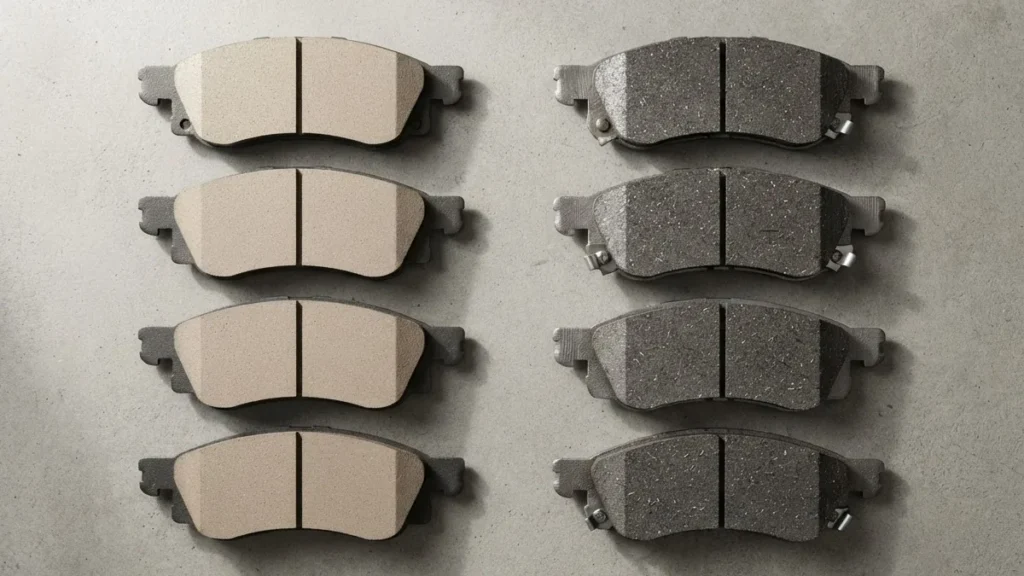
The debate over ceramic vs semi metallic brake pads comes down to how you actually drive. Stand in the brake aisle or scroll a parts site and you will run into the same fork in the road: ceramic or semi-metallic. Both stop your car. Both are sold for almost every make and model. Yet they behave differently in ways you feel through the pedal, hear at the curb, and pay for at the counter. Pick the wrong compound for how you actually drive and you can end up with squeal, chewed-up rotors, or brakes that go soft on a long grade.
This guide from the BrakeTireGuide team breaks down what ceramic and semi-metallic pads are made of, how they perform cold and hot, what they do to your rotors, and which one fits a commuter, a tow rig, or a cold-climate driver. We also touch on organic and non-asbestos organic (NAO) pads for context. One note before we start: this article is educational and is not a substitute for a qualified mechanic. Your vehicle manufacturer’s specifications always take priority over any general rule you read here, so check your owner’s manual and the pad maker’s instructions before you buy or install anything.
The quick verdict
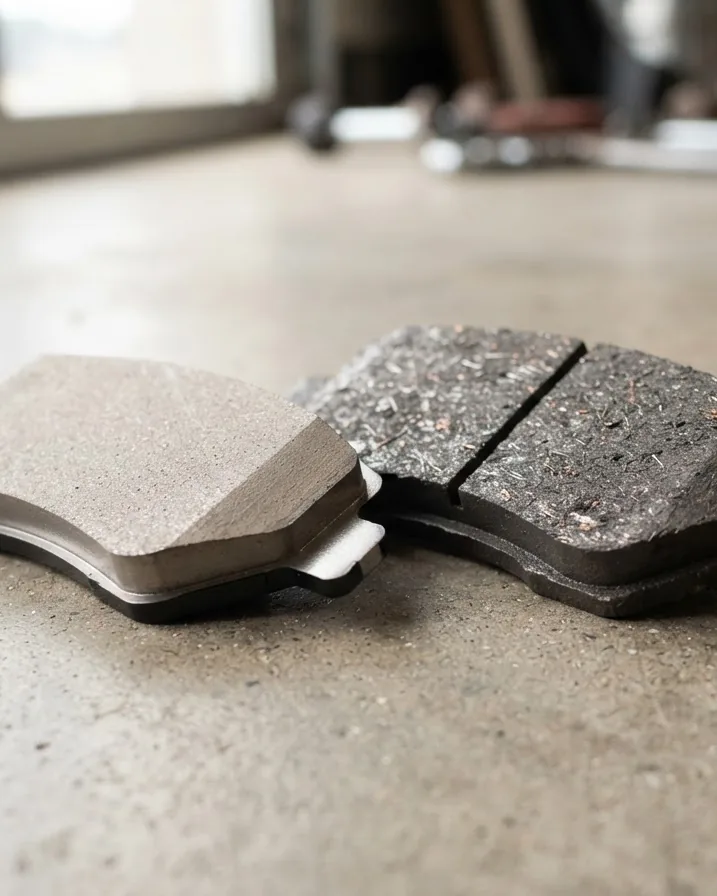
If you want the short answer before the details, here it is. For most daily commuters and family vehicles, ceramic pads are the easy call: they are quiet, they leave very little dust on your wheels, and they tend to last longer between replacements. For towing, hauling, spirited or track driving, and genuinely cold winters, semi-metallic pads usually make more sense because they bite harder from cold and shed heat better under repeated hard stops.
Neither compound is “better” in a vacuum. A semi-metallic pad on a grocery-getter is overkill that costs you noise and rotor life. A ceramic pad on a loaded trailer hauler down a mountain pass may fade sooner than you want. The right pick is the one matched to your load, your terrain, your climate, and what your vehicle’s maker recommends. The rest of this guide gives you the reasoning so you can make that call with confidence.
What each pad is made of
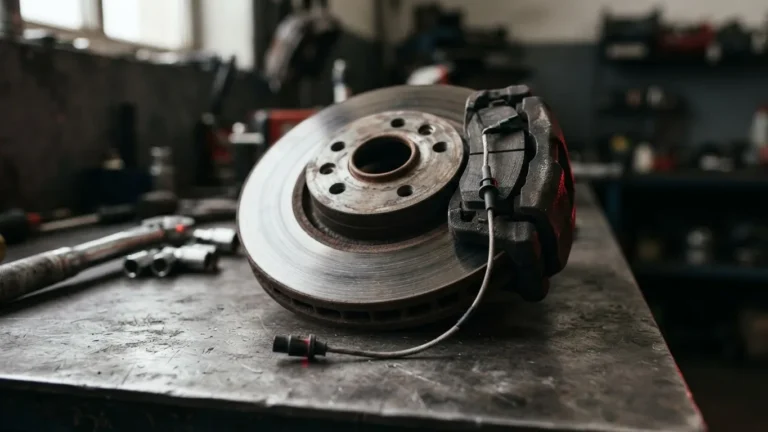
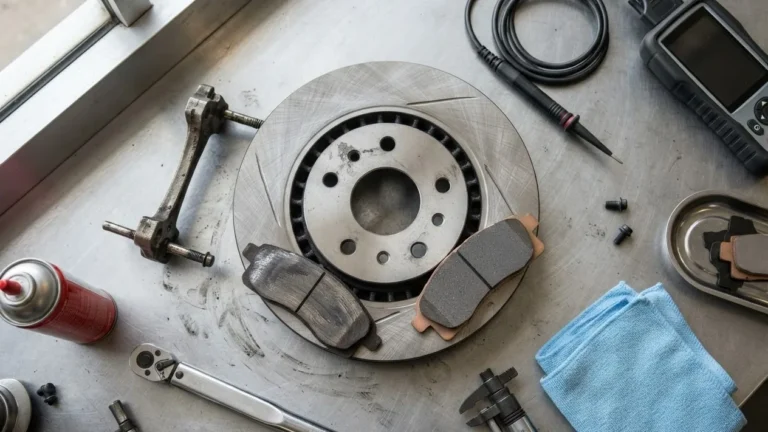
A brake pad is a friction block bonded to a steel backing plate. When you press the pedal, hydraulic pressure squeezes the pad against a spinning rotor, and the friction converts your car’s motion into heat. What that friction block is made of is exactly what separates ceramic from semi-metallic.
Semi-metallic pads are built around metal. Depending on the formula, they contain roughly 30 to 70 percent metal by weight, typically steel, iron, and copper fibers, blended with organic fillers and held together by a high-temperature bonding resin. That metal content is what gives them their strong, immediate grip and their ability to move heat away from the friction surface quickly.
Ceramic pads take a different route. They use dense ceramic fibers combined with non-ferrous filler materials, historically fine copper strands, to manage friction and heat. The category dates to the mid-1980s and was developed largely to cut the noise and dust that metal-heavy pads produce. Ceramic pads sit at the refined end of what the industry calls the non-asbestos organic, or NAO, family, which also includes softer plain organic pads made from glass, rubber, aramid fibers such as Kevlar, and resin. Organic pads are the quietest and cheapest but wear fastest and fade soonest, which is why most drivers today choose between ceramic and semi-metallic rather than plain organic.
One material change cuts across every modern pad regardless of type: copper. Under the U.S. Environmental Protection Agency (EPA) Copper-Free Brake Initiative, a 2015 agreement among the EPA, states, and the brake industry, pad makers agreed to cut copper to under 5 percent by weight by 2021 and under 0.5 percent by weight by 2025. The effort grew out of California and Washington state laws, the latter known as the Better Brakes Law, aimed at keeping copper dust out of waterways where it harms aquatic life. The testing and marking rules were written into standards from SAE International, notably SAE J866 and SAE J2975. In practice this means the pads on the shelf today, whether ceramic or semi-metallic, are reformulated to be copper-lean, and you may see a small leaf symbol stamped on the box that signals the compliance level.
Stopping performance: cold bite vs warm grip
Raw stopping power is where a lot of shoppers start, and the honest answer is that it depends on temperature. “Bite” is the grip you feel in the first fraction of a second after you press the pedal, before the brakes have warmed up. Semi-metallic pads generally have stronger cold bite. Many semi-metallic formulas carry a cold coefficient of friction in the range of 0.45 to 0.50, which translates to firm, confident grip the instant you touch the pedal on a cold morning or a wet road.
Ceramic pads take a little warmth to reach their best. When cold, they can feel slightly less grabby than a semi-metallic set. Once they are up to normal operating temperature, though, a quality ceramic pad delivers stopping performance on par with semi-metallic for ordinary street driving, roughly at rotor temperatures below about 570 degrees F. For the vast majority of commuting, errands, and highway miles, you are unlikely to notice a safety-relevant difference in stopping distance between good pads of either type on a healthy braking system.
If you want an objective yardstick, SAE International’s J866 standard assigns edge codes that grade a pad’s friction level with letters. As a rough map, an E rates a coefficient of friction of 0.25 to 0.35, F is 0.35 to 0.45, G is 0.45 to 0.55, and H is above 0.55. The two letters stamped on the pad edge represent the friction level cold and then hot, so you can compare compounds on paper before you ever install them. It is a useful sanity check, though real-world feel also depends on your rotors, calipers, fluid, and tires.
Heat tolerance and brake fade
Brake fade is the loss of stopping power that happens when the friction material gets too hot. It is the single most important reason to match your pad compound to your driving. When pads overheat, the resins that bind them can start to break down and off-gas, and the coefficient of friction drops, so the same pedal pressure produces less deceleration. In extreme cases the pedal feels fine but the car simply does not slow the way it should.
This is where semi-metallic pads earn their keep. The metal content that gives them cold bite also gives them high heat capacity and good thermal conductivity, so they absorb heat and shed it to the surrounding air quickly. Semi-metallic formulas are engineered to stay usable well past 500 degrees F, and their typical operating window is often cited from around 100 degrees F up to roughly 700 degrees F. Under repeated hard stops, such as descending a long grade with a trailer, that fade resistance is a genuine safety margin. Some formulas do lose a slice of their bite at very high temperatures, on the order of 15 to 25 percent above about 570 degrees F, but they recover as they cool and generally hold together where an organic pad would give up.
Ceramic pads are thermally stable across the wide band of temperatures a street car sees, which is part of why they feel so consistent day to day. Their limitation shows up under sustained, extreme heat: continuous hard braking on a race track or a very long mountain descent can push a ceramic pad past its comfort zone sooner than a semi-metallic set built for the job. For normal roads this rarely matters. For heavy or performance use, it is the deciding factor.
Noise and brake dust
Two of the most common complaints drivers bring to us are squealing brakes and filthy wheels, and pad choice drives both.
Semi-metallic pads are the noisier of the two. The hard metal fibers that grip so well can also chatter and vibrate against the rotor, producing squeal or, in worse cases, a grinding note, especially when cold or lightly applied. They also throw off a darker, grittier dust that clings to wheels and, over time, can leave a corrosive film if you never wash it off. None of this is dangerous by itself, but it is a daily annoyance on a car you keep clean.
Ceramic pads were designed largely to solve exactly these problems. According to AAA, ceramic friction material tends to generate sound waves outside the range of human hearing, so the same braking event that squeals on metal can be effectively silent on ceramic. Ceramic pads also produce a lighter-colored dust in much smaller amounts, which keeps alloy wheels looking clean far longer between washes. For a driver who parks in front of the house and notices every mark, that difference alone often settles the decision.
Rotor wear and what it costs you
Pads are consumables you expect to replace. Rotors are the more expensive discs the pads clamp, and how hard a pad is on them changes your total cost of ownership. Semi-metallic pads, with their abrasive metal content, are tougher on rotors and tend to wear them faster. Over the life of a vehicle that can mean an extra rotor replacement or resurfacing you would not have needed with a gentler compound.
Ceramic pads are easier on rotors. The friction material is less abrasive, so rotors typically last longer and stay smoother, which means fewer machining jobs and fewer replacements. When you tally the real cost of a brake job, remember it is not just the pads: it is the pads plus the wear they impose on the rotors around them. A cheaper pad that shortens rotor life is not always the cheaper choice in the end.
Cost and lifespan, side by side
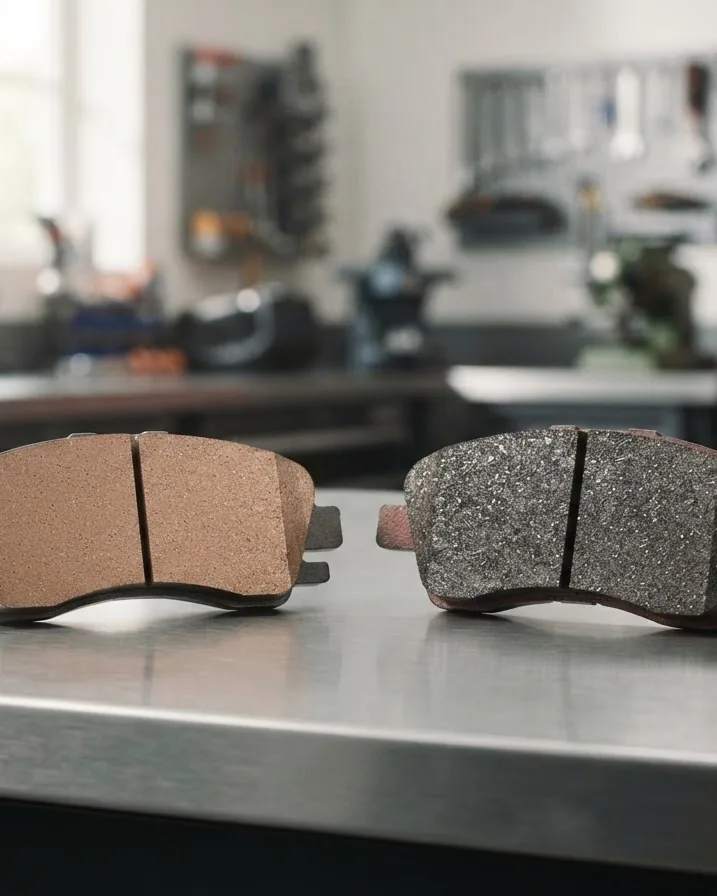
Up front, semi-metallic pads are usually the more affordable option, and ceramic pads carry a higher sticker price. As a rough guide for a per-axle set of parts, semi-metallic pads often land somewhere around 30 to 80 dollars, while ceramic sets commonly run from about 50 to 150 dollars, with real prices varying widely by vehicle, brand, and where you shop. Treat those as ballpark ranges, not quotes.
Lifespan usually tips the long-run math back toward ceramic. Under normal driving, semi-metallic pads tend to last roughly 25,000 to 40,000 miles, while ceramic pads commonly reach about 40,000 to 70,000 miles. Because ceramic pads also spare your rotors, the higher purchase price is spread over more miles and less collateral wear, which often produces a lower cost per mile despite the bigger number on the box. That said, your mileage genuinely will vary: aggressive braking, heavy loads, steep terrain, and stop-and-go traffic shorten any pad’s life.
Here is the head-to-head at a glance.
| Factor | Ceramic | Semi-metallic |
|---|---|---|
| Stopping power / bite | Strong once warm; softer cold bite | Strong immediate bite, cold and wet |
| Heat tolerance / fade | Stable on the street; fades under sustained extreme heat | Excellent; holds past 500 F, made for hard, repeated stops |
| Brake dust | Light-colored, minimal | Dark, gritty, more of it |
| Noise | Quiet, often inaudible | Louder; can squeal or vibrate |
| Rotor wear | Gentle, rotors last longer | Abrasive, wears rotors faster |
| Price (per-axle set) | Higher, about 50 to 150 dollars | Lower, about 30 to 80 dollars |
| Lifespan | About 40,000 to 70,000 miles | About 25,000 to 40,000 miles |
| Best use | Daily commuter, family car, quiet, hot-dry climates | Towing, hauling, performance, cold winters |
Which to choose by driving type
The cleanest way to decide is to describe your own driving and match it to a compound. AAA’s consumer guidance lines up closely with what we see in the field.
- Daily commuter or family sedan. Choose ceramic. You want quiet operation, clean wheels, long pad life, and consistent street performance, and ceramic delivers all four for the kind of moderate braking a commute involves.
- Pickup, SUV, or anything towing or hauling. Choose semi-metallic. Heavier loads mean more heat, and semi-metallic pads dissipate that heat and resist fade better, giving you the robust, repeatable stopping power heavy work demands.
- Performance or track driving. Choose semi-metallic, or a purpose-built performance compound. Aggressive grip and fade resistance under sustained heat matter more here than dust or noise. For dedicated track days, ask about track-specific pads rated for the temperatures you will generate.
- Mixed use with occasional loads. Consider a quality semi-metallic if the hardest thing you ask of the brakes is an occasional heavy tow, or a premium ceramic if towing is rare and comfort matters more day to day. Some makers also offer hybrid or “ceramic-enhanced” formulas that split the difference.
Whatever category you fall into, cross-check against your vehicle maker’s recommendation. If your truck came from the factory with a specific pad type rated for its tow capacity, that rating reflects engineering you should respect.
A note on cold climates
Cold weather deserves its own mention because it flips one of ceramic’s few weaknesses into a real consideration. Ceramic pads need a little heat to reach their best grip, so on a frigid morning the first stop or two can feel slightly less sharp until the brakes warm up. Semi-metallic pads do not need to warm up to bite hard; their cold coefficient of friction is high enough that they feel strong from the first press, which is exactly what you want on an icy or snow-packed road where every foot of stopping distance counts.
If you live where winters are long and genuinely cold, that cold-bite advantage can outweigh semi-metallic’s noise and dust penalties. Drivers in hot, dry climates rarely feel ceramic’s warm-up lag and can enjoy its quiet, clean-wheel benefits year round. As always, keep the rest of your winter braking in order too: proper tires, healthy fluid, and good rotors all matter as much as the pad compound when the road turns slick.
Bedding in your new pads
No matter which compound you install, new pads need to be bedded in, sometimes called breaking in, before they perform their best. Bedding transfers a thin, even layer of friction material onto the rotor face and lets the pad contour itself to the rotor’s microscopic imperfections. Skip it and you invite uneven deposits, which show up later as pulsing or vibration under braking.
There are two ways to bed pads, and the right one is whatever the pad maker prints on the box. The gentle method is simply to drive normally and avoid hard stops for the first stretch, often around 300 to 500 miles, letting the pads seat gradually. The controlled method is a deliberate sequence of moderate stops, for example a series of firm but not panic slowdowns from roughly 35 mph and then from roughly 55 mph, with a cool-down cruise between each so you do not overheat fresh pads. Expect the first few stops after installation to feel weak; that is normal, so leave extra following distance until the brakes come in. Whichever procedure you follow, do not sit on hot brakes at a stoplight right after a hard bedding cycle, because parked pressure on a glowing rotor can leave a deposit you will feel for the life of the pad.
When to see a mechanic
Brakes are a safety system, and there is no shame in handing the job to a professional. See a qualified mechanic if any of the following apply. You hear grinding, which can mean the friction material is gone and metal is contacting your rotor. You feel a pulsing pedal or steering-wheel shimmy under braking, which often points to rotor problems that new pads alone will not fix. The brake warning light is on, the pedal feels soft or sinks toward the floor, or you notice fluid near a wheel or under the car. Any of these can signal a problem beyond a simple pad swap.
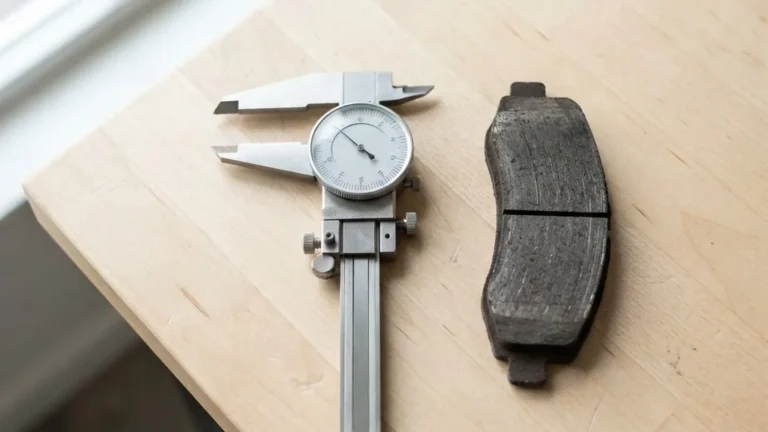
Even if you are comfortable turning wrenches, a mechanic should assess the whole corner, including rotors, calipers, hardware, and hydraulic fluid, not just the pads. If you want to keep an eye on wear yourself between visits, our walkthrough on how to check brake pads shows what to look and listen for. And because healthy hydraulics are just as important as friction material, our guide to what brake fluid color tells you can help you spot fluid that needs attention.
Two authorities are worth keeping in view here. The National Highway Traffic Safety Administration (NHTSA) sets and enforces federal motor vehicle safety standards for braking and consistently advises servicing your brakes according to your vehicle maker’s schedule and specifications. And if you want to understand the copper-free reformulation stamped on your new pads, the EPA Copper-Free Brake Initiative explains why the compound in the box changed. When general advice and your manufacturer’s specification ever seem to conflict, follow the manufacturer and, if in doubt, a certified technician.
Frequently asked questions
Are ceramic brake pads always better than semi-metallic?
No. Ceramic pads are quieter, cleaner, and longer-lived, which suits most daily driving, but semi-metallic pads bite harder cold and resist heat fade better, which suits towing, performance, and cold climates. “Better” depends entirely on how and where you drive, and on what your vehicle maker recommends.
Do semi-metallic pads really wear rotors faster?
Generally yes. The metal fibers that give semi-metallic pads their grip are more abrasive, so they tend to wear rotors faster than ceramic pads do. That extra rotor wear is part of why the cheaper pad is not always cheaper once you count the whole brake job over time.
Which pads are better for towing and heavy loads?
Semi-metallic. Heavy loads generate more heat, and semi-metallic pads dissipate heat and resist fade better, staying usable well past 500 degrees F. That makes them the safer choice for trucks and SUVs that tow or haul, provided the pad is rated for your vehicle and load.
Why are my ceramic brakes weak on cold mornings?
Ceramic friction material needs a little warmth to reach its best grip, so the first stop or two on a cold day can feel slightly softer before the brakes warm up. This is normal. If strong cold bite matters to you, such as in a snowy climate, semi-metallic pads warm up faster and grip harder from cold.
How long do brake pads last?
It varies with driving style, load, and terrain, but as a rough guide semi-metallic pads often last about 25,000 to 40,000 miles and ceramic pads about 40,000 to 70,000 miles under normal driving. Aggressive braking, heavy loads, and stop-and-go traffic shorten those numbers. Have the pads inspected if you are unsure.
What is the copper-free rule I keep seeing on brake pad boxes?
It comes from the EPA Copper-Free Brake Initiative, a 2015 agreement built on California and Washington state laws that cut copper in pads to under 5 percent by weight by 2021 and under 0.5 percent by 2025 to protect waterways. SAE International standards J866 and J2975 define the testing and the leaf marking you see on the box. Both ceramic and semi-metallic pads sold today are reformulated to comply.
Do I need to bed in new brake pads?
Yes. Bedding transfers an even friction layer onto the rotor and lets the pads seat properly, which prevents pulsing and gives you full stopping power. Follow the pad maker’s instructions, which usually means either about 300 to 500 miles of gentle driving or a controlled series of moderate stops with cool-downs. Expect the first stops to feel weak, and leave extra following distance until the brakes come in.