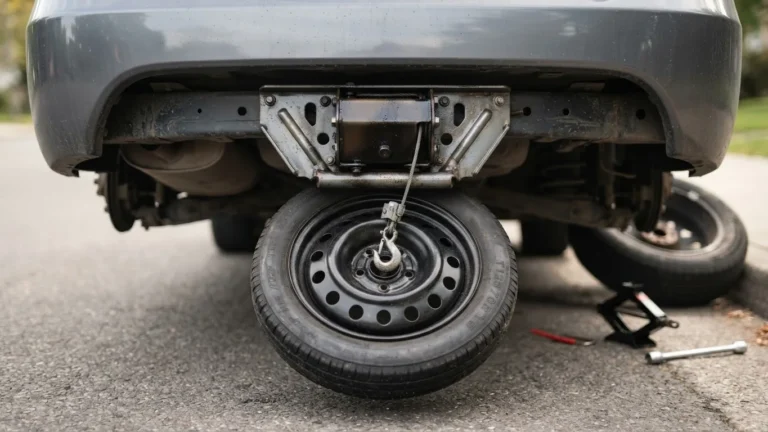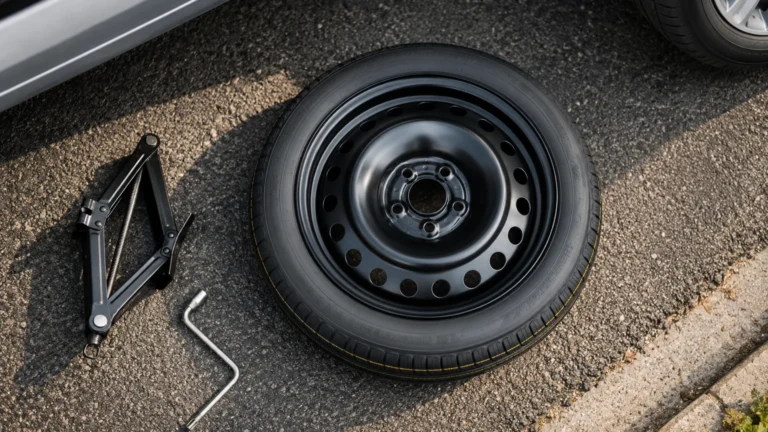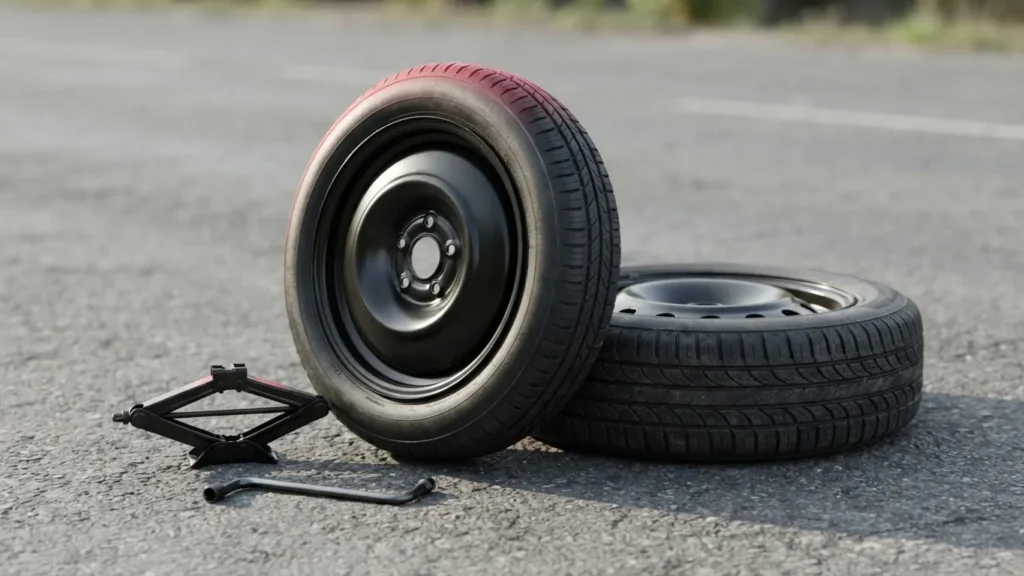
Mastercraft Tires puts the figure plainly: T-type temporary spare tires require 60 psi (420 kPa). A donut spare tire is the small, narrow emergency wheel tucked in your trunk well, built to get you off the shoulder and to a shop – nothing more. It looks like a tire and bolts on like a tire, but almost every rule you know about driving on a normal tire changes the moment it’s on your car.
This guide gives you the three numbers to trust, the mistakes that wreck a drivetrain, and the moment you need a professional instead of a plug.
Quick answer: Keep a donut spare tire under 50 mph, drive it no more than about 50 to 70 miles, and inflate it to roughly 60 psi – check its own sidewall, which overrides the door placard. Stay in the right lane, skip the highway when you can, and never tow on it. A donut is not repairable and cannot be reused; it buys you a trip to the tire shop and no more. Head there the same day. Prolonged driving on a donut stresses the differential, transmission, and suspension, and can trip ABS, traction-control, or AWD warning lights.
How Fast and How Far You Can Drive on a Donut Spare Tire
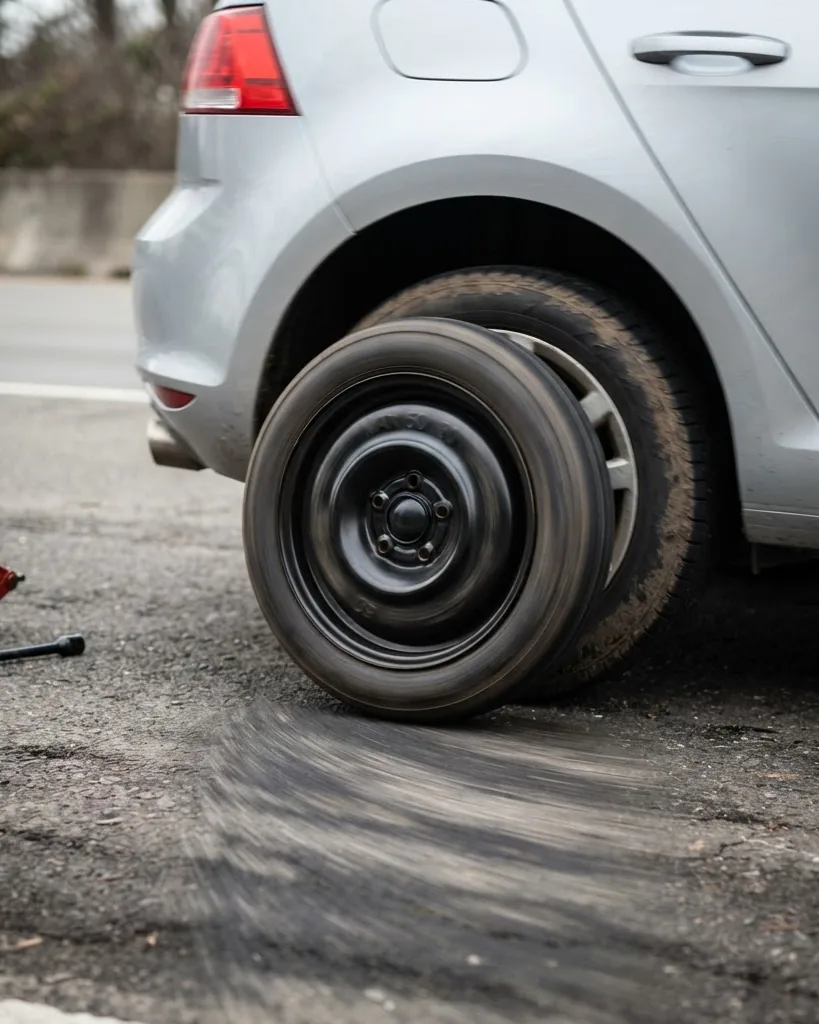
Two numbers govern a donut: speed and distance. On speed, the sources agree. Utires.com states that the manufacturers’ recommended speed limit for driving on a donut tire is usually 50 mph, and NAPA’s Know How blog lands in the same place, pairing the 50 mph cap with a reminder to confirm against your owner’s manual.
Distance is where sources split, and the gap matters. Plymouth Rock Assurance is the most conservative, stating that space-saver spares or donuts should be driven no more than 50 miles. Utires.com and NAPA both give a wider band: NAPA advises drivers to limit driving range on a compact temporary tire to 50 to 70 miles, or the distance in the owner’s manual.
These are not contradictory failure points. They’re guidance margins, and both defer to your specific owner’s manual. The safe read: treat 50 miles as your planning target and 70 miles as the absolute ceiling, and if your manual names a number, that number wins. Manufacturer specs always override a general figure.
Why so strict? Dually Wheels explains the mechanism: the 50 mph cap exists because a small spare spins more times per mile and builds heat in a lighter-build tire at highway speed. Utires.com adds the consequence – exceeding the speed limit on a donut raises blowout risk precisely because the smaller tire heats up faster. For a deeper breakdown of what changes past those thresholds, see our drive on a spare tire guide.
Why a Donut Spare Needs 60 PSI, Not 35
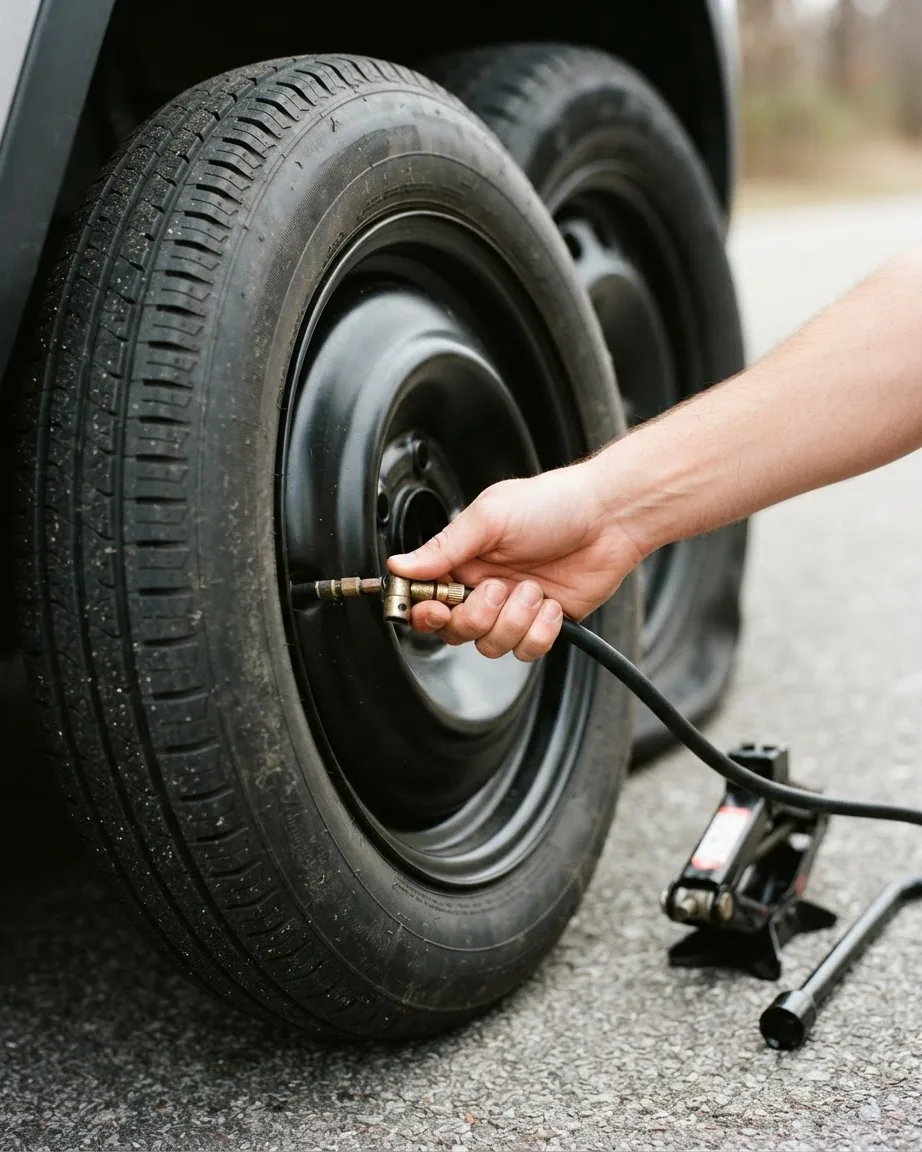
A compact spare runs far higher pressure than a road tire. Mastercraft Tires specifies 60 psi for T-type temporary spares, and NAPA echoes that your temporary spare should sit at 60 psi.
One wrinkle changes how you fill it. Dually Wheels notes that a donut should be set to the pressure printed on its own sidewall, not the door-placard figure that governs your four road tires. The placard is for the tires the car shipped with; the donut carries its own spec.
Inflation technique matters too. Mastercraft Tires warns to add air in small amounts, since a smaller tire’s pressure changes rapidly – it’s easy to overshoot 60 psi and hard to notice. This is not a tire to top off by feel.
There’s a reason to check it long before you ever need it. NHTSA, through its TireWise program, recommends you check the pressure of all tires, including the spare, at least once a month when cold – and the same agency reports that only 19 percent of consumers properly inflate their tires. If a dashboard warning is what sent you hunting, our tire pressure monitoring light guide is a sensible next stop.
Donut vs. Full-Size vs. Dissimilar Spare: Which Rules Apply
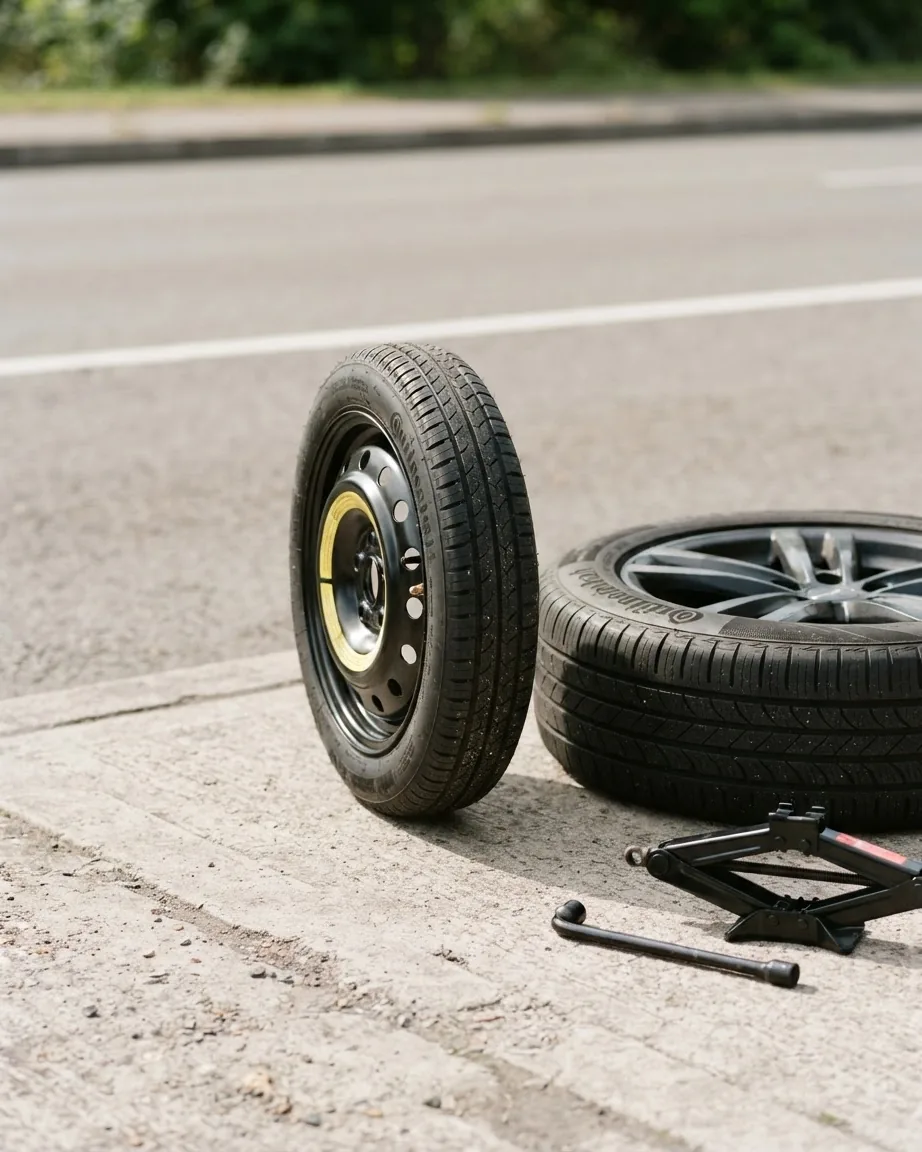
Not every spare is a donut, and the limits above only apply to one kind. Dually Wheels lays out three categories worth knowing before you assume your trunk holds a 50 mph tire.
- Compact (donut) spare: smaller and narrower than your road tires, with a size that often starts with “T.” This is the tire bound by 50 mph, roughly 50 to 70 miles, and 60 psi.
- Full-size matching spare: identical to your other four tires. Dually Wheels notes it has no special mileage or speed limit and can be driven like a normal road tire.
- Dissimilar full-size spare: full-size but different in brand, size, or appearance. Ford, as cited by Dually Wheels, classifies this as a “dissimilar” spare – temporary use only, despite being full-size.
So the right question isn’t “how long can I drive on a spare” but “which spare do I have.” A matching full-size tire frees you from the donut rules entirely. A dissimilar one looks capable but isn’t. Check the sidewall for a “T” and compare it to your other tires before you plan a longer drive.
One federal caveat even for full-size spares: NHTSA recommends a full-size spare not be used as a replacement for worn tires except in emergencies. A spare that doesn’t match the wear and age of your other three is still a compromise.
What a Donut Does to Your Differential, ABS, and AWD System
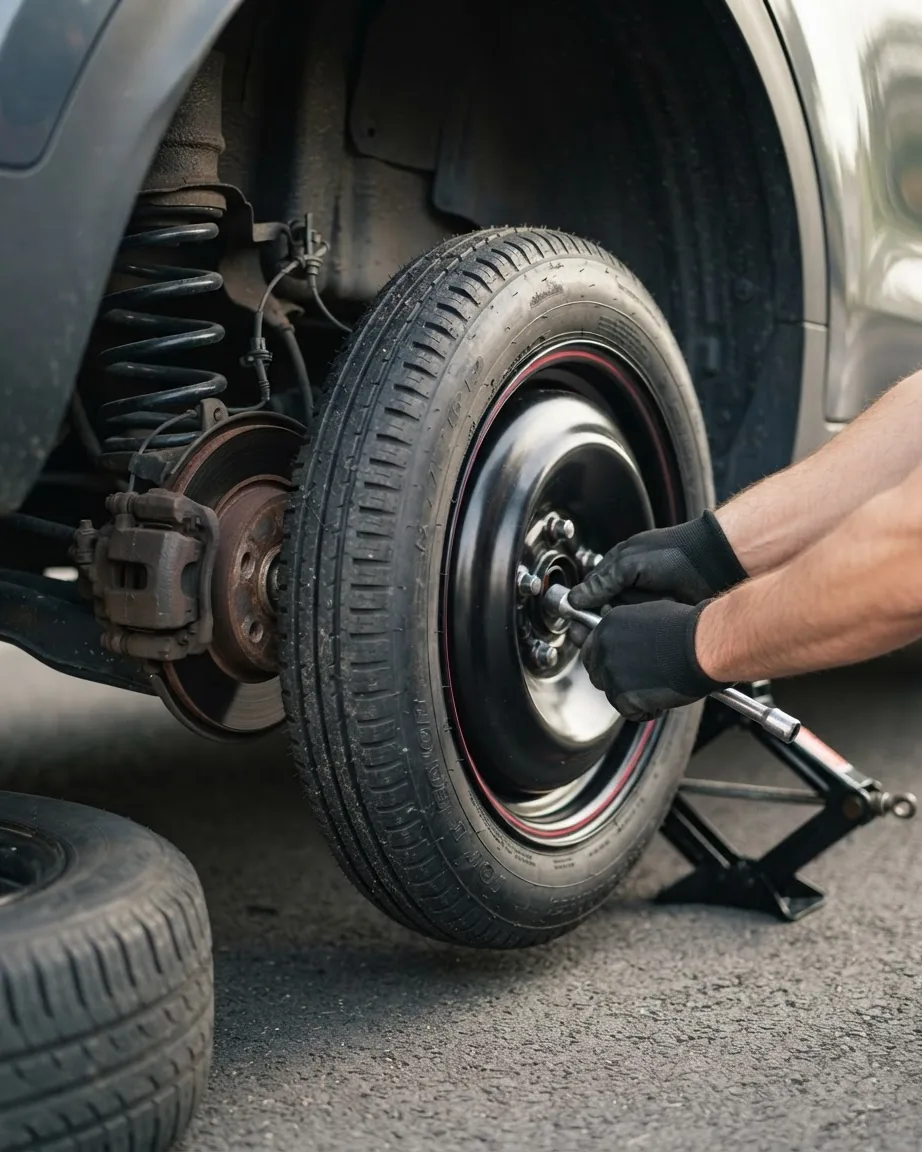
The limits aren’t arbitrary caution – a mismatched wheel diameter forces hardware to fight itself. Because a donut is smaller, it rotates faster than your other three tires to cover the same ground, and your car’s systems notice.
NAPA’s Know How blog spells out the chain of effects. A donut makes the differential work harder and can lead to a breakdown, a risk that sharpens on vehicles with a limited-slip differential. The faster-spinning compact spare is detected by the wheel-speed sensor, which can trigger brake and ABS warning lights. With ABS and traction control affected, NAPA advises you to anticipate longer stopping distances – as you would on slick or icy roads – and to keep cruise control switched off.
All-wheel-drive owners face a sharper version. Utires.com warns that on AWD vehicles, driving on a mismatched donut can damage the transmission and trigger the AWD failure lamp. If you drive AWD, the “get to a shop immediately” advice isn’t a nicety; it’s protecting a repair that costs far more than a tire. AWD drivers can read more in our AWD tire rotation guide.
Plymouth Rock Assurance adds the slower-burn damage: prolonged use of a donut can cause stress and damage to the transmission or suspension. None of this shows up in the first mile. It accumulates – which is the real reason the mileage cap is low.
Flat Tire Response: Get Off the Flat, Then Get to a Shop
The worst thing you can do with a flat is keep driving on it. A deflated tire lets the wheel rim grind the road, destroys the tire beyond any repair, and can damage the wheel and brake components. Pull over safely, swap to the donut, and treat the clock as running from that moment.
Once the donut is on, the goal is reaching a tire shop the same day – not resuming your trip. Plymouth Rock Assurance gives the driving posture: avoid highways and stay in the far-right lane under 50 mph. That keeps you out of merging traffic and within the speed the spare was built for.
A hard “do not” for drivers hauling anything: Dually Wheels states plainly that you should not tow a trailer on a compact spare, and that many owner’s manuals prohibit it. The donut can’t handle its own car’s weight for long, let alone a load behind it. If you’re towing when you get a flat, that’s a call-for-roadside-help situation, not a drive-it-home one.
Plugs, Patches, Run-Flats, and Why a Donut Can’t Be Repaired
When you reach the shop, the flat tire – not the donut – is what gets evaluated. Here’s where the repair choices live, and where the donut rules end.
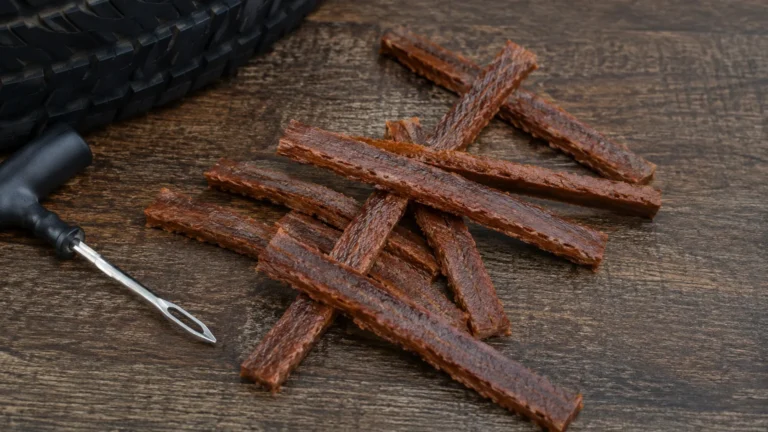
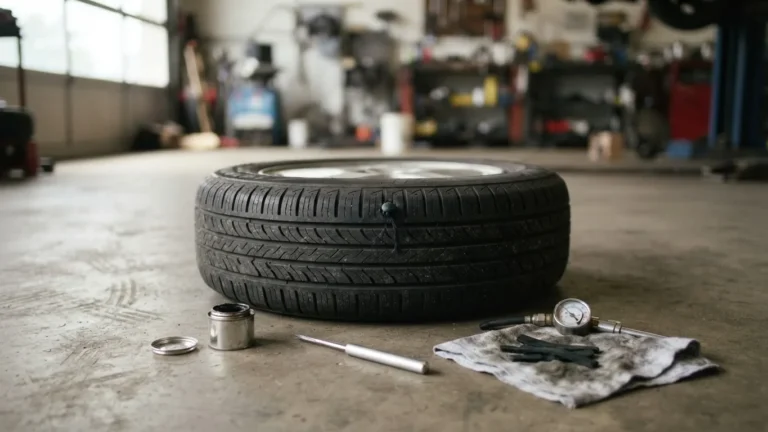
For the flat, the repair you want depends on the puncture. A plug seals a puncture from the outside and is fast and cheap, but on its own it’s a temporary measure, not a permanent fix – it doesn’t seal the tire’s inner liner. A patch is applied from the inside after the tire is dismounted and inspected. The method tire professionals treat as the proper repair is the combination plug-patch (a patch with an integrated stem) installed from inside the tire: it fills the puncture channel and seals the liner in one piece. That combo is the durable repair; a bare plug is the roadside stopgap.
Two repairs are off the table entirely. Any sidewall damage, and any run-flat tire, belong to a professional – do not rely on a DIY plug for either. A sidewall puncture compromises the tire’s structure where repair isn’t safe, and run-flats have construction that requires specialized inspection.
The donut itself is never part of this conversation. Boucher Buick GMC of Waukesha is direct: donuts aren’t designed for repair or reuse. You don’t plug a donut, you don’t rotate a donut into service, and once it’s done its emergency run, it goes back in the trunk – not onto a tire-change schedule.
How Old Is Your Donut? Reading the DOT Date Before It Fails
A spare can time out sitting in the dark. Rubber ages whether or not it ever touches pavement, and a donut is especially exposed because no one thinks to check it. Boucher Buick GMC of Waukesha notes that most manufacturers recommend replacing a spare every 6 to 10 years, even if it’s never been used.
That range isn’t one dealer’s opinion. NHTSA, through TireWise, states that some vehicle and tire manufacturers recommend replacing tires that are six to 10 years old, regardless of treadwear – and Dually Wheels points out that spare tires are especially prone to aging. The figures line up across all three.
You can read your spare’s age yourself. Plymouth Rock Assurance explains the DOT code: a tire’s four-digit DOT number gives its manufacture date, with the first two digits the week and the last two the year. Find that number on the sidewall, do the math, and if your donut is pushing a decade old, replace it before you ever need it – not on the shoulder of a highway.
Two more constraints keep the donut doing its job when the day comes. Mastercraft Tires warns never to use more than one temporary spare tire at a time, and that T-type spares should only be used with rims and wheels specifically intended for them. A donut is a single-point emergency tool, and it only works as designed.
Want the wider picture on emergency and backup wheels? Browse our spare tires section.
The 3,000-Mile Figure That Isn’t a Driving Distance
One number online tempts drivers into trouble, and it’s worth ending on. Dually Wheels reports that Yokohama says its temporary spares can deliver up to 3,000 miles of tread life, yet Yokohama still caps them at 50 mph, calls for 60 psi, and treats them as temporary only.
Read that carefully: 3,000 miles describes how much tread the rubber has in it before it wears out – not how far you’re cleared to drive. It’s a materials figure, not a safety allowance. The safety guidance is still the same roughly 50 to 70 miles at under 50 mph that every other source gives. A manufacturer stating its spare can physically survive 3,000 miles of wear while capping its safe use at a 70-mile emergency trip is not contradicting itself; it’s describing two different things.
Treat the donut as what it is – a one-trip tool. The tread-life number buys you confidence that a short emergency drive won’t shred the tire, not permission to postpone the tire shop. The 50 mph cap, the 60 psi spec, and the same-day repair are the numbers that keep you and your drivetrain intact.
Your Donut’s Real Clock: How Much Driving Time 50 – 70 Miles Buys You at 50 mph
The article gives you a speed cap of 50 mph and a distance window of 50 to 70 miles, but it never translates those into the number that actually governs your decision on the shoulder: time. At the mandatory 50 mph, a donut spare buys you a surprisingly short window to reach a tire shop, and doing the arithmetic reframes “get there the same day” into “get there within the hour.”
- 50-mile planning floor: 50 miles ÷ 50 mph × 60 = 60 minutes of driving. That is the conservative Plymouth Rock limit – one hour behind the wheel, and no more.
- 70-mile absolute ceiling: 70 miles ÷ 50 mph × 60 = 84 minutes. The widest band NAPA and Utires allow still only stretches to about an hour and twenty-four minutes.
- The margin between them: 84 − 60 = just 24 extra minutes. The whole gap that sources “disagree” about amounts to under half an hour of driving – which is why the safe read is to plan for the 60-minute floor and treat anything beyond it as borrowed time.
A spare that has slowly bled down over the years is nowhere near its one job, which is exactly why it belongs on a monthly check, not a someday one.
Frequently Asked Questions
My spare is fully inflated but five years old – is it safe?
Pressure and age are separate questions. A donut holding its 60 psi can still be near the end of its 6-to-10-year recommended life. Check the four-digit DOT code on the sidewall for the manufacture week and year. Rubber degrades from heat and time even in a dark trunk, so a well-inflated but decade-old spare deserves replacement regardless of how it looks.
Does the 50 mph limit apply if I have a full-size spare?
Only if that full-size spare is a mismatch. A full-size spare identical to your other four tires carries no special speed or distance restriction. But a full-size tire that differs in brand, size, or appearance – Ford’s “dissimilar” category – is temporary-use only, and federal guidance discourages using any spare as a long-term replacement for worn tires except in emergencies.