Tire plugs are a fast way to seal a nail hole and get rolling again, but a plug on its own is not a permanent, industry-approved tire repair. That single fact catches a lot of drivers off guard. A plug can hold air for weeks or even months, yet the tire makers, the safety agencies, and the repair trade all agree that a plug by itself is a temporary emergency measure, not the fix that sends a tire back into full service.
This guide from the BrakeTireGuide team explains what tire plugs are, how a plug compares with a patch and with the combination plug-patch repair, when a puncture can be repaired at all, and how to plug a tire safely if you have to. This article is educational and is not a substitute for a qualified tire technician or a hands-on inspection. A punctured tire is a safety component, so when a repair looks marginal or the damage is anywhere near the sidewall, have a professional make the call before you drive on.
Short answer: a plug alone will usually get you off the shoulder and to a shop, but the only repair the U.S. Tire Manufacturers Association, NHTSA, and the tire trade endorse for the long haul is a combination plug-patch installed from inside the tire. Treat a plug as a way home, not the end of the story.
By Garrett Stowe, tire and wheel systems lead at BrakeTireGuide. Last reviewed July 7, 2026.
Most articles say plugs are temporary and stop there. This guide adds exactly when a puncture is repairable under industry rules, an original plug-versus-patch-versus-combination comparison, the no-repair zones with real dimensions, and a safe step-by-step, so you know whether to plug it or replace it.
What tire plugs are and how they work
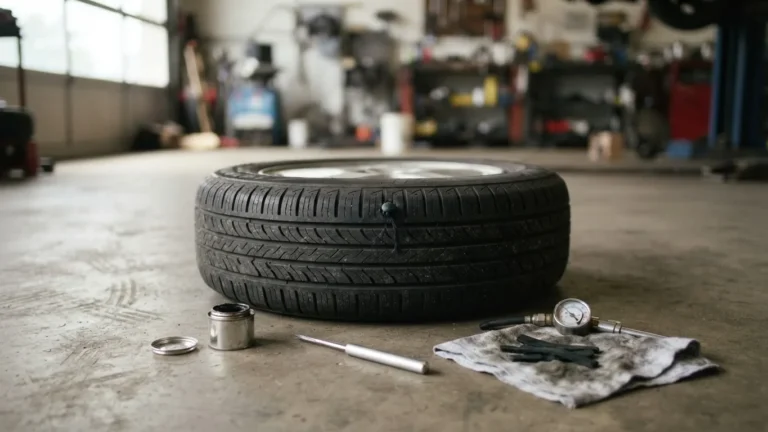
A tire plug is a short strip of sticky, leather-and-rubber cord coated in an adhesive compound. You push it into a puncture from the outside of the tire using an insertion tool, and it swells and grips the walls of the hole to slow or stop the leak. Most kits come with a handful of plugs, a reaming tool to clean and roughen the hole, and a needle-eye insertion tool to drive the plug home.
The appeal is obvious. A plug is cheap, it fits in a glovebox, and you can install one on the side of the road without ever taking the wheel off the car. For a nail or screw caught in the middle of the tread, a plug can seal the leak in a few minutes and let you drive to a shop under your own power instead of waiting for a tow.
The limitation is just as important. A plug seals the puncture channel from the outside, but it does nothing to seal the innerliner, the airtight rubber layer bonded to the inside of the casing. It also cannot inspect that inner surface for hidden belt or cord damage, because the wheel never comes off the rim. That is the core reason every major authority treats an external plug as a stopgap rather than a finished repair. If you have just limped onto a spare instead of plugging the flat, our guide on how long you can drive on a spare tire covers those limits too.
Plug vs patch vs plug-patch combination
People use the words plug and patch loosely, but they describe three different repairs with very different safety ratings. Getting the difference straight is the whole game.
- Plug only. A rubber cord pushed into the puncture from outside. Fast and cheap, but it does not seal the innerliner and the tire is never inspected from the inside. USTMA, NHTSA, AAA, and the Tire Industry Association all classify a plug alone as an unacceptable permanent repair. It is an emergency tool.
- Patch only. A rubber patch bonded to the inner surface over the injury. A patch seals the innerliner, but on its own it does not fill the puncture channel, so water and road debris can still work into the hole and reach the steel belts. A bare patch is not considered a complete repair either.
- Combination plug-patch. A single unit with a stem that fills the puncture channel and a patch base that seals the innerliner. The tire is dismounted, the injury is inspected from the inside, the channel is cleaned, and the unit is installed and sealed. This is the only repair the tire industry and the National Highway Traffic Safety Administration, or NHTSA, endorse as permanent, and a proper one can restore its original speed rating.
The reason the combination wins is simple: a puncture injures the tire in two places at once, the outer channel and the inner liner, and only a repair that addresses both directions actually restores the tire. The table below lays the three side by side.
| Repair type | Seals channel? | Seals innerliner? | Inside inspected? | Status |
|---|---|---|---|---|
| Plug only | Yes | No | No | Temporary / emergency only |
| Patch only | No | Yes | Yes | Not a complete repair |
| Plug-patch combination | Yes | Yes | Yes | Industry-approved permanent repair |
If a shop offers to plug your tire from the outside without dismounting it and calls that a finished repair, that is a red flag. The correct professional process always takes the tire off the wheel.
When a puncture is repairable
Not every flat can be fixed, and no plug or patch changes that. The U.S. Tire Manufacturers Association publishes clear criteria, and a repair is only allowed when all of them are met. Miss even one and the tire must be replaced.
- Size. The puncture must be no larger than 1/4 inch, which is 6 mm, in diameter. Anything bigger has damaged too much of the casing structure to trust.
- Location. The injury must sit in the tread area, roughly the central three-quarters of the tread face. Damage in the shoulder or sidewall is not repairable at any size.
- Condition. The tire must not have been driven flat or badly underinflated, because running on a soft tire overheats and frays the internal structure even when the outside looks fine.
- Internal integrity. There can be no broken belts, no exposed or cut cords, and no bubbles or separations. This is why the tire has to come off the rim to be inspected.
- Spacing. A new repair cannot overlap an old one, and multiple repairs must be at least 16 inches apart to keep the tire balanced and structurally sound.
Angle matters too. A nail that went in straight through the tread is a good candidate. A nail that entered the tread but angled sideways into the shoulder is not, because the actual injury sits in the no-repair zone even though the entry point looks fine. When in doubt, a technician marks the injury and checks it from the inside.
The no-repair zones: shoulder and sidewall
The single most common unsafe repair we see is a plug jammed into a sidewall or a shoulder. It feels like it should work because the plug grips and holds air, but the location is the problem, not the seal.
The sidewall is the flexible wall between the tread and the wheel. It bends thousands of times a minute as the tire rolls and carries the vehicle’s weight through constant flexing. A plug or patch cannot survive that repeated motion, and a sidewall puncture also usually means the internal cords are cut. The shoulder, the curved zone where the tread rolls into the sidewall, flexes almost as much and sits over the belt edges, so it is treated as non-repairable as well.
Safety warning: Never plug a sidewall or shoulder puncture, and never plug a hole larger than 1/4 inch (6 mm). A sidewall repair can fail without warning at highway speed. If the damage is outside the central tread band or the tire ran flat, replace the tire rather than repairing it.
That is why the repairable window is only the central portion of the tread. A puncture there sits over the reinforced belt package and in the part of the tire built to be rigid. If your leak is anywhere outside that band, no plug makes it safe, and the honest answer is a replacement casing. A quick way to keep an eye on tread and overall tire health between problems is a cheap gauge; our guide to using a tire tread gauge walks through it.
Pro tip: Before you plug, mark the puncture with chalk and pull the object out only after you can reach the hole, then check the angle. A shallow, angled puncture near the shoulder often sits closer to the no-repair zone than it looks from outside, so measure from the tread edge before you commit to a repair.
How to plug a tire step by step
If the puncture meets the repairable rules and you need to get moving, here is the safe way to use a plug kit. Treat the result as a temporary fix and head to a shop afterward.
- Find and mark the leak. Locate the nail or screw. If the object is still in the tire, note where it is before you pull it. Spraying soapy water over the tread makes a slow leak bubble so you can pinpoint it.
- Confirm it is in the repairable zone. Check that the puncture is in the central tread, not the shoulder or sidewall, and that it is no wider than 1/4 inch. If it fails either test, stop and use your spare instead.
- Remove the object and ream the hole. Pull the nail with pliers, then push the reaming tool in and out several times. This cleans debris, roughens the walls, and sizes the channel so the plug can grip.
- Load the plug. Thread a plug through the eye of the insertion tool so equal lengths hang from each side. A little rubber cement on the plug, if your kit includes it, improves the seal.
- Push the plug in. Drive the insertion tool straight into the hole until only about one-third of the plug shows on the outside. Then pull the tool out fast and straight so the plug stays behind.
- Trim and inflate. Cut the excess flush with the tread. Re-inflate the tire to the pressure on the driver door-jamb placard, in psi, not the maximum molded on the sidewall, and spray it again to confirm the leak has stopped.
Once the tire holds air, drive gently and get to a tire shop as soon as you can. A plug installed on the roadside has not been inspected from the inside, so a professional still needs to verify there is no hidden damage and convert it to a proper repair or replace the tire.
Temporary or permanent: what a plug really buys you
A plug buys you time and mobility, not a restored tire. AAA describes an external plug as a temporary, emergency fix meant only to get a vehicle safely to a repair shop, and that framing is exactly right. Drive on a plug the way you would drive on a compact spare: carefully, and with a plan to fix it properly soon.
Practical guidance for the drive to the shop is to keep speeds modest, generally under 50 mph, and go straight there rather than running errands. The plug has not been checked from the inside, the innerliner is not sealed, and pushing the tire hard on the highway is the kind of gamble that ends in a blowout. A blowout at speed is far more dangerous than the slow leak you started with.
There is also the speed-rating question. A tire carries a speed rating that assumes it is intact. A professionally installed combination plug-patch, done to specification, can restore that full rating so the tire is safe for normal driving again. An external plug does not, which is another reason it is treated as a bridge to a real repair rather than the repair itself.
What a tire plug repair buys you
Cost is usually why drivers reach for a plug kit in the first place, but the smarter comparison is what each option buys you in miles and years, because that is where the real value sits. Prices swing by region and shop, so get a local quote; the longevity figures below are the stable part of the decision.
| Option | How long it lasts | What you get |
|---|---|---|
| DIY string plug | Temporary: roughly 100 to 1,000 miles depending on speed and wear | A reamer, insertion tool and plugs; gets you off the shoulder and to a shop |
| Professional plug-patch combination | Up to about 10 years or 25,000 miles when done to standard | Tire dismounted, inspected from the inside, sealed and re-balanced |
| Replacement tire | A full tire life | The only correct answer for sidewall damage or an out-of-limits puncture |
Read the middle column twice: the difference between a string plug and a proper plug-patch is the difference between a few hundred miles and a couple of decades of tire life. The DIY kit earns its keep as the emergency tool that gets you off the shoulder, not as the way to dodge a proper repair, and whichever repair you get, keep any two repairs at least 6 inches apart and stay gentle on speed, ideally under 50 mph, until a shop has confirmed the fix holds pressure.
Safety limits and common mistakes we see
A plug is a legitimate tool used correctly and a hazard used wrong. These are the mistakes that turn a simple flat into a real risk.
- Plugging the sidewall or shoulder. The most dangerous error. Those zones flex too much and usually hide cut cords, so the location alone makes the tire non-repairable no matter how well the plug holds.
- Trusting a plug for the life of the tire. A plug can hold air for weeks or months, which fools people into leaving it. It is still not sealed to the innerliner and was never inspected inside. Convert it to a proper repair or replace the tire.
- Plugging an oversized or torn injury. Anything larger than 1/4 inch, or a gash rather than a clean round hole, is beyond what a plug can safely seal.
- Ignoring how many repairs a tire already has. Repairs must not overlap and must sit at least 16 inches apart. A tire dotted with plugs is a tire to retire.
- Driving flat to get to the plug. Rolling any real distance on a flat or badly underinflated tire ruins the internal structure and can make an otherwise repairable puncture non-repairable.
The through-line is that a plug fixes a leak, not a tire. It restores air pressure but not the layered structure of belts, cords, and liner that lets a tire carry weight at speed. Respect that limit and a plug is a fine emergency tool. Ignore it and you are betting on rubber that was never designed to hold under those conditions.
Run-flats, multiple punctures, and special cases
Some tires and some situations change the answer entirely, and it is worth knowing them before you reach for a kit.
Run-flat tires are built with reinforced sidewalls that let you drive a limited distance after a total loss of pressure. Because that feature stresses the tire structure in ways ordinary tires never see, many manufacturers restrict or forbid repairs on run-flats, especially if the tire was driven in run-flat mode. Always follow the tire maker’s guidance, and when in doubt, replace rather than repair.
Multiple punctures are the other case. A single repairable puncture in the tread is routine. Two close together, or a new injury that would overlap an old repair, is not. The industry rule is that repairs cannot overlap and should sit at least 16 inches apart, so a tire that has picked up several nails may be past the point of safe repair even if each hole looks minor on its own.
Age and wear matter as well. If a tire is already near the wear bars or is many years old, spending on a repair makes little sense; the tire is close to replacement anyway. Standards work from bodies such as SAE International underpins how tires are built and rated, and the consistent message across NHTSA, USTMA, and AAA is the same: repair only within the defined limits, and replace when a tire falls outside them.
When to see a mechanic
A roadside plug is a bridge, and a professional still needs to close the gap. See a qualified technician when any of these apply.
- You installed an emergency plug. Even a textbook plug needs a shop to dismount the tire, inspect the inside, and either convert it to a combination repair or condemn the tire.
- The puncture is near or in the shoulder or sidewall. Do not plug it. A technician confirms the injury location and tells you honestly whether the tire is done.
- The tire lost all its air and you drove on it. Any distance run flat calls for an internal inspection before the tire goes back into service.
- There are several punctures or an old repair nearby. Spacing and overlap rules are hard to judge from outside; let a pro measure and decide.
- You are simply unsure. On a load-bearing safety part spinning at highway speed, a second opinion is cheap. When a repair looks marginal, have a professional confirm it.
None of this means a plug kit is useless. Kept in the trunk and used within the rules, it is one of the best few dollars of emergency gear you can carry. It just is not a replacement for the inspection and combination repair that actually returns a tire to full duty.
Sources and further reading
The safety framing, figures, and standards referenced above draw on the following authorities. Each link points to the organization’s current homepage so it stays valid over time.
- National Highway Traffic Safety Administration (NHTSA), federal tire and vehicle safety standards and recalls: https://www.nhtsa.gov/
- U.S. Tire Manufacturers Association (USTMA), industry tire safety and maintenance guidance: https://www.ustires.org/
- SAE International, engineering standards and test methods behind tire and vehicle systems: https://www.sae.org
Frequently asked questions
Are tire plugs safe to drive on?
A tire plug is safe as a short-term, emergency measure to get you to a shop, not as a permanent repair. AAA and the U.S. Tire Manufacturers Association treat an external plug as a temporary fix because it does not seal the innerliner and the tire is never inspected from the inside. Keep speeds modest, generally under 50 mph, and have the tire properly repaired or replaced soon after.
How long can a tire plug last?
A plug can hold air for weeks or even months, which is exactly why people leave them in too long. Holding air is not the same as being safe. Because the plug does not seal the innerliner and the inside was never inspected, it should be converted to a combination plug-patch repair or the tire replaced, rather than trusted for the full life of the tire.
What size puncture can be plugged?
Under U.S. Tire Manufacturers Association guidelines, a repairable puncture must be no larger than 1/4 inch, which is 6 mm, in diameter, and it must sit in the tread area. A hole bigger than that, or a cut and tear rather than a clean round puncture, has damaged too much of the tire structure to repair safely and calls for a new tire.
Can you plug a tire in the sidewall?
No. Sidewall and shoulder punctures are not repairable at any size. Those areas flex constantly as the tire rolls, a plug or patch cannot survive that motion, and a sidewall injury usually means cut internal cords. If your leak is in the sidewall or shoulder, the tire must be replaced, not plugged.
Is a plug or a patch better?
Neither alone is a complete repair. A plug fills the puncture channel but does not seal the innerliner; a patch seals the liner but does not fill the channel. The combination plug-patch does both and is the only repair endorsed as permanent by NHTSA, USTMA, and the tire trade. It requires dismounting the tire so the injury can be inspected and sealed from the inside.
Can run-flat tires be plugged?
Often not. Many run-flat tire makers restrict or forbid repairs, especially if the tire was driven with low or no pressure in run-flat mode, because that stresses the structure in ways a repair cannot restore. Follow your specific tire manufacturer’s guidance, and when the maker does not clearly permit a repair, replace the tire.
Tire plugs are a genuinely useful piece of emergency kit when you respect what they are: a way to seal a repairable tread puncture and drive safely to a shop. The rules are not complicated. Keep the injury under 1/4 inch and in the central tread, never plug a sidewall or shoulder, drive gently to a professional, and let a combination plug-patch or a new tire do the permanent work. Handle a flat that way and you get the convenience of a plug without gambling on the part that keeps you on the road.