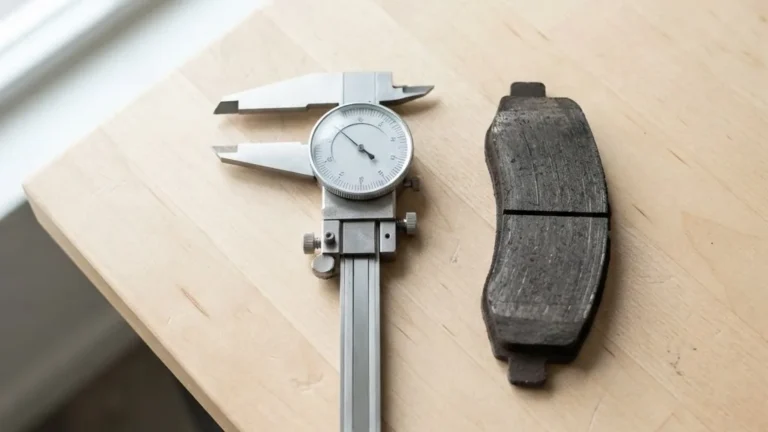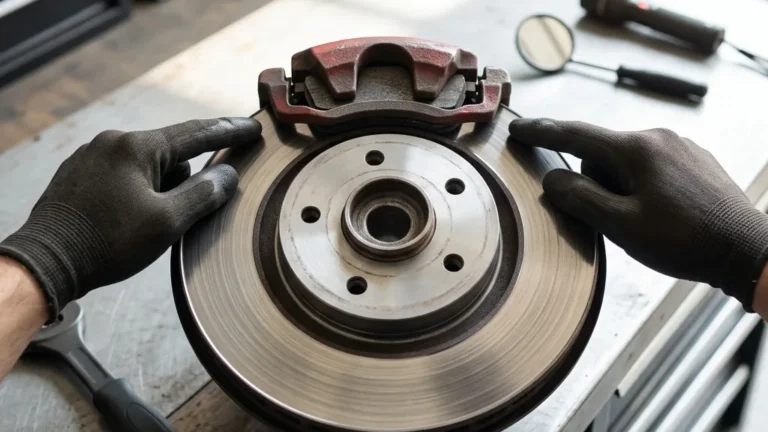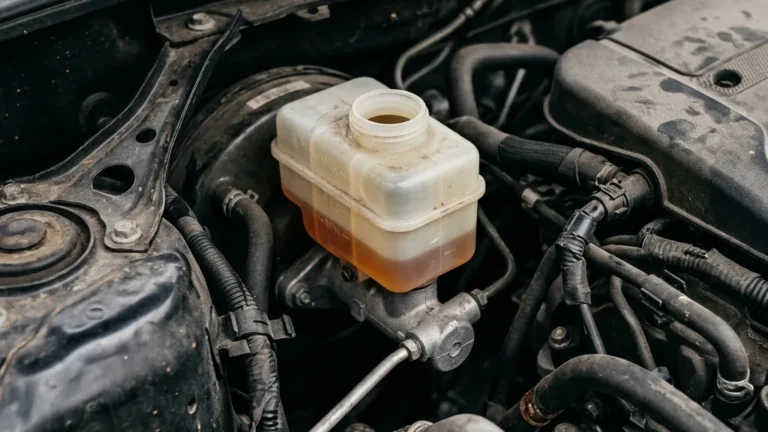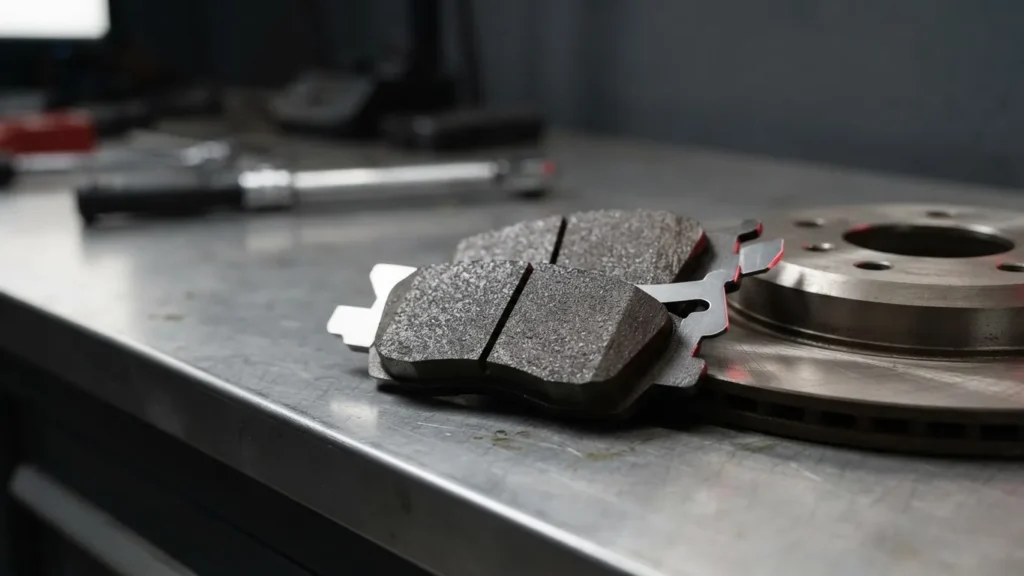
The most divisive fact about brake pad shims is not whether they work – it is whether you put grease on them, and the answer flips depending on whose car you drive. Subaru tells technicians to keep the shim bone-dry. General Motors tells them to apply a measured amount of grease between the shims. Both instructions sit on the same U.S. government database, and both are correct for the vehicles they cover. That single divergence is why so much generic advice about shims is wrong for your specific car: there is no universal rule, only your manufacturer’s rule.
Below, we sort out what a shim actually does, whether your pads even need one, when to reuse versus replace, and why the grease question has two right answers. Brake work is safety-critical, so treat every procedure here as background knowledge, not a substitute for a certified mechanic and your vehicle’s service manual.
Quick answer: A brake pad shim is a thin layer, usually metal and viscoelastic polymer, clipped or bonded to the back of a pad to dampen the high-frequency vibration that causes brake squeal. Not all pads use them, and pads can stop the car without them. Whether to lubricate, reuse, or replace a shim depends entirely on your carmaker’s published procedure, which overrides any generic shop tip. Some makers forbid grease on the shim; others specify a precise amount between shims. Performance titanium shims add heat isolation but can cause problems if stacked too thick.
What a Brake Pad Shim Actually Does Against Squeal
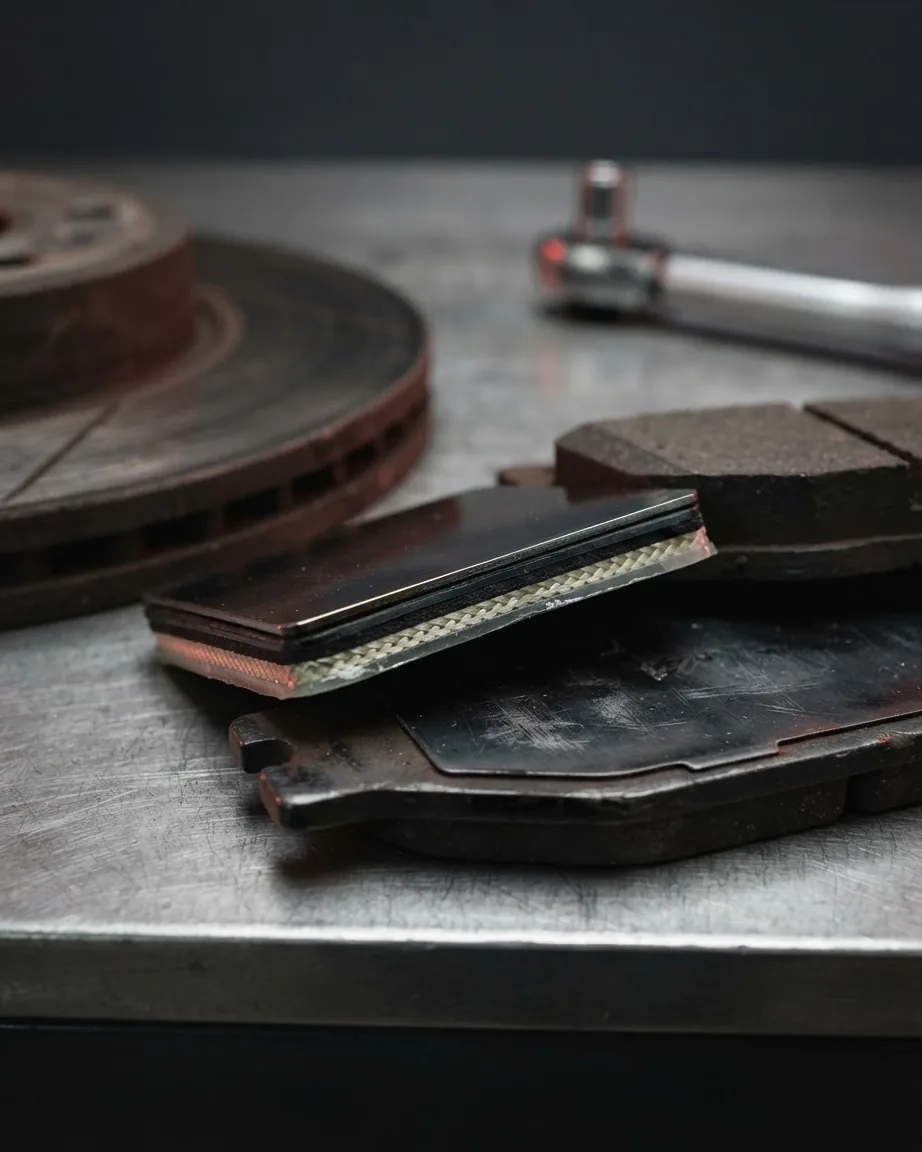
A shim is a damper. When a pad presses against a spinning rotor, the whole assembly can vibrate at frequencies high enough to produce that nails-on-a-chalkboard squeal. The shim sits against the back of the pad’s steel backing plate and absorbs that vibration before it turns into audible noise.
The clever part is the construction. These are not simple sheets of metal. According to Bendix, shims combine varying grades of metal, viscoelastic polymers, elastomeric rubbers, fiberglass, and bonding materials. The insulator maker Rubore describes a comparable recipe for its parts – rubber, carbon steel, stainless steel, fiberglass, cold pressure adhesives, and acrylic or silicone layers. The viscoelastic middle is what does the real work: it flexes and dissipates vibration energy as tiny amounts of heat instead of letting it ring out as sound.
That multi-layer design matters for a practical reason. When you smear grease onto the wrong surface of a shim, you are not just making a mess – you may be interfering with how those bonded layers behave, which is where the next debate starts.
Do Your Pads Even Need Shims? The Necessity Question
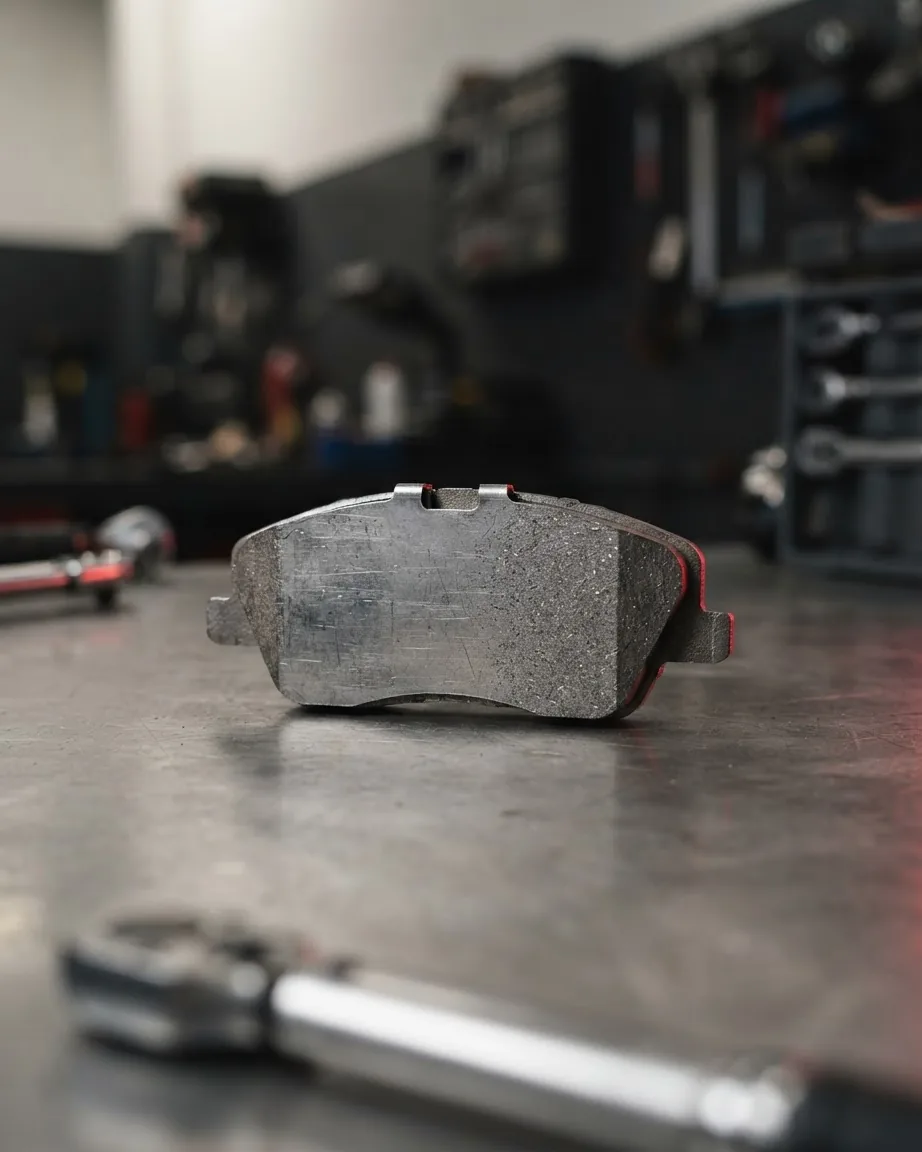
Here the sources genuinely disagree, and the disagreement is instructive. Enthusiast and experienced-tech communities take the practical line: many pads ship with no shims at all, and pads function perfectly without them. One recurring view on BobIsTheOilGuy is blunt – there is no harm whether the shims are on or off. The ClubLexus owner community echoes the same hands-on experience: a pad will clamp and stop the car regardless.
Manufacturers frame it differently. Bendix recommends replacing brake shims at the same time as the pads, treating the shim as a consumable that belongs with the friction material. That is not a safety warning – it is a noise-and-longevity recommendation from a company that sells the part.
So who is right? Both, within their scope. The shim is a comfort and noise-control component, not a stopping-power component. Your brakes will physically work without it. But if your pads came with shims and you drive a car that squeals without them, removing them trades quiet for no benefit. The resolution: shims are optional for function, not optional for refinement, and if your car’s design relies on one, keep it there.
The Grease Debate: Why Subaru Says Dry and GM Says 2-4 Grams
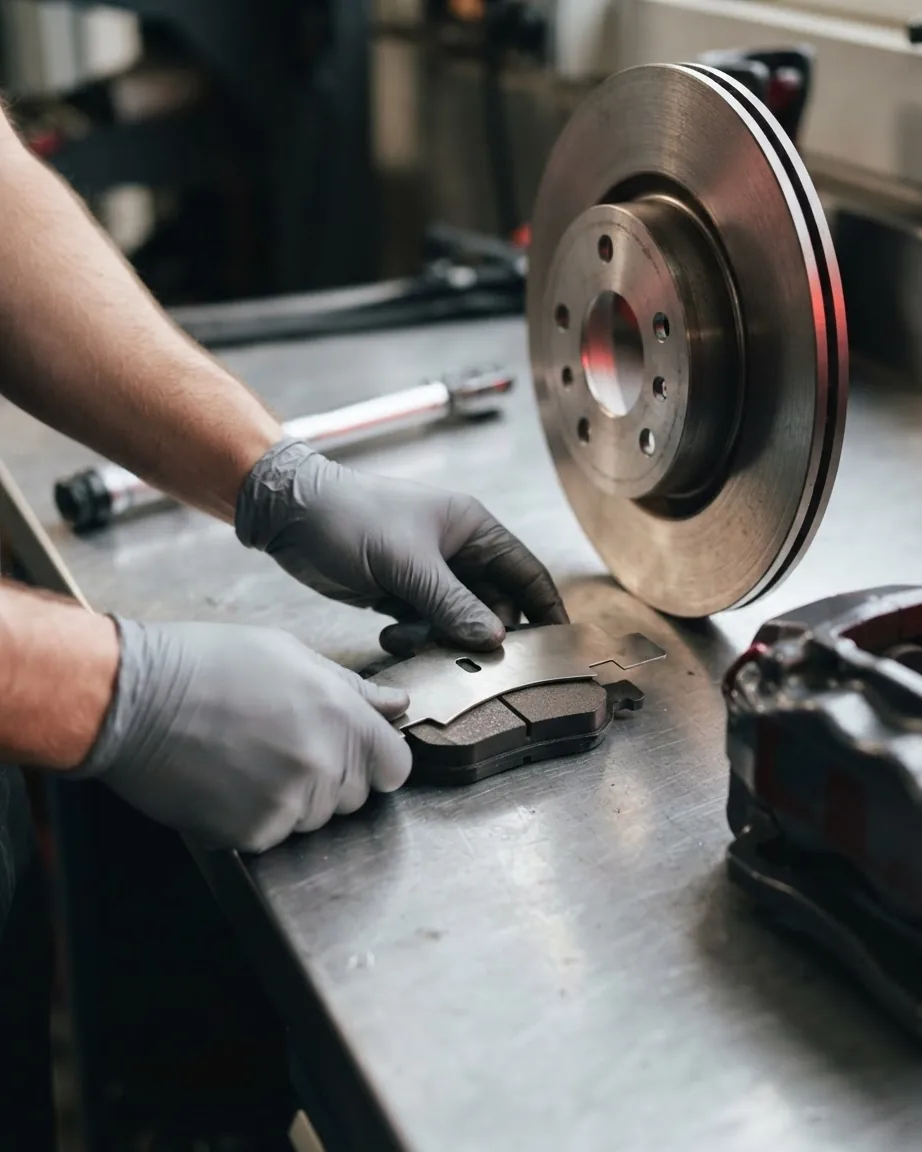
This is the heart of the matter, and it is also where most generic guides fail you by picking one answer. There is no single answer. There are manufacturer-specific procedures that point in opposite directions.
Start with the retailer view. Brake Performance recommends applying a thin layer of brake lube between the backing plate and the shim even when a shim is present, reasoning that it prevents the pad from rattling against the shim and making noise. That advice refers to brake lube as a general anti-rattle measure.
Now the manufacturer of the anti-squeal compound itself. Permatex states that its Disc Brake Quiet is intended for use with brake pads not having anti-squeal shims. In other words, the company that makes the product tells you it is for pads that lack shims, not pads that already have them. A long-running thread on BobIsTheOilGuy explains the mechanism: the compound can cause the shim to separate from the backing plate, which is why both CRC and Permatex warn against using their anti-squeal products on pads that already carry shims.
One wrinkle keeps these from being a clean contradiction: Brake Performance is talking about brake lube as a rattle preventer, while Permatex and the forum are discussing an elastomeric anti-squeal compound. Those may be different products doing different jobs, so the apparent clash is partly a vocabulary problem.
Where the Manufacturers Split: Two Bulletins, Two Rules
Now the part no generic page covers, because it requires reading official service bulletins. Subaru and GM both filed instructions with the National Highway Traffic Safety Administration, and they diverge.
Subaru’s bulletin 06-51-15R is explicit: do not apply any grease to the pad shim, and do not apply grease between the shim and the pad. Dry, and dry on purpose. You can read the Subaru service bulletin on the NHTSA repository.
General Motors goes the other way. Bulletin 17-NA-217 tells technicians to lay down 2-4 grams of lubricant grease, placing it between the shims on both the inboard and the outboard front-caliper pads. The GM service bulletin gives the exact quantity for the vehicles it covers.
These are not errors. They are different carmakers, different vehicle populations, and different shim designs. The only safe takeaway: find your vehicle’s procedure and follow it to the letter. A shop tip that worked on your neighbor’s truck can be exactly wrong for your sedan. When in doubt, a certified mechanic with access to your model’s bulletins settles it – do not average the two numbers or guess a middle path.
Reuse or Replace? When the Old Shim Goes Back On
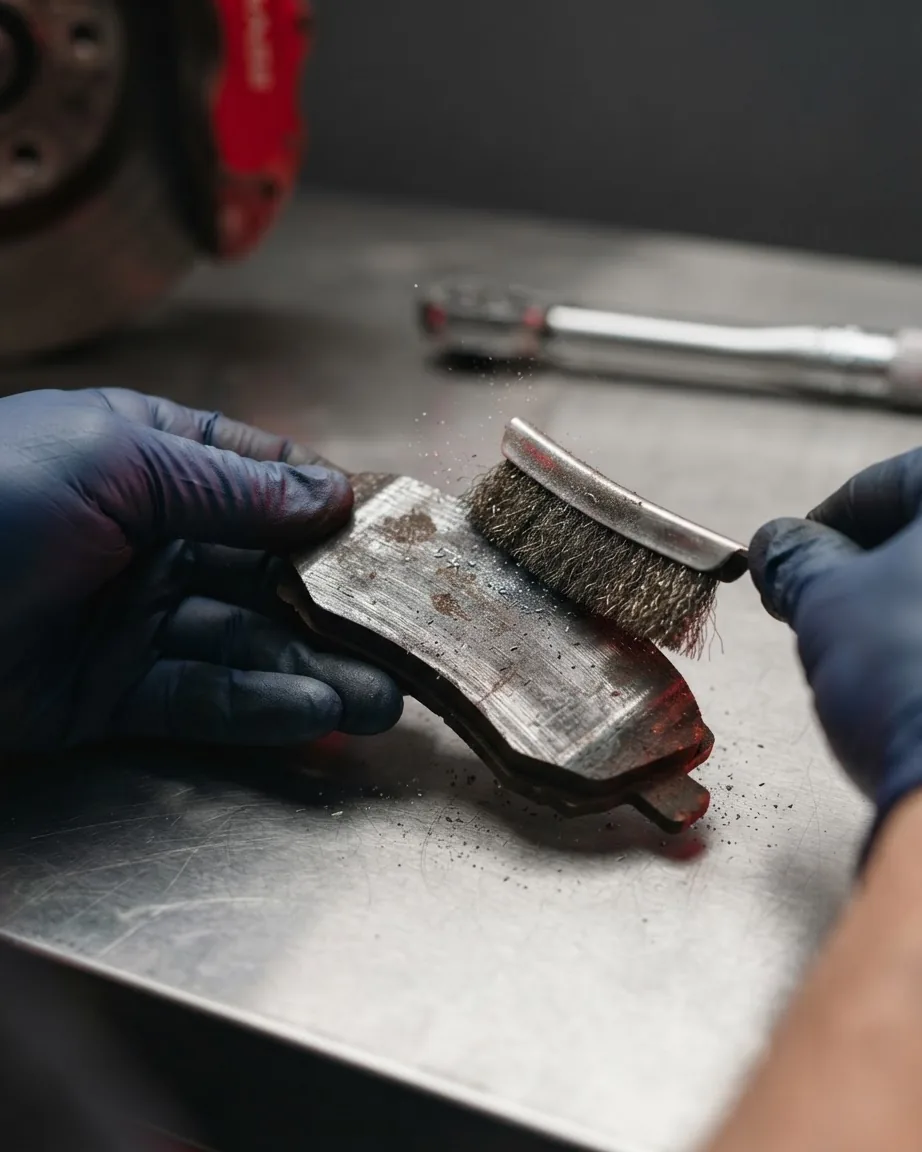
The reuse question, like the grease question, breaks down by source type rather than by a clean right-and-wrong.
Forum consensus leans toward reuse. The practical view on BobIsTheOilGuy is that shims can be cleaned up and reinstalled, and installed dry. Bendix, as a parts maker, recommends replacing the shims when you replace the pads – a tidy, sell-the-set recommendation that also sidesteps the risk of reusing a tired, delaminating shim.
Then there is a primary instruction that settles it for one specific application. For its STI brake-pad sets, Subaru Corporation states plainly that the brake pad shim should be reused. That is not a forum opinion or a retailer’s upsell – it is the carmaker telling you the shim is designed to go back on.
How to decide for your car: if your manufacturer’s procedure names a reuse or replace instruction, that wins. Absent a specific instruction, inspect the shim. If the layers are separating, the metal is corroded, or the anti-rattle clips have lost tension, replace it. A clean, intact shim with good spring tension can generally be reused. When the shim’s condition is borderline, replacing a few-dollar part is cheaper than a repeat brake job.
Installing Shims Dry, and the Torque Spec That Comes With It
When a procedure calls for a dry install, it means exactly that – no grease on the contact faces. Subaru’s own instruction pairs the dry install with a specific finishing step: install the pads into the support, refit the brake caliper, and torque the mounting bolt to 27 Nm (19.9 ft. lbs.).
That torque figure is worth pausing on, because it shows how shim work connects to the rest of the brake service. A shim installed perfectly means nothing if the caliper bolt is under- or over-torqued. Too loose invites vibration – the very noise the shim exists to stop. Too tight risks damaging the hardware. The 27 Nm number is the Subaru spec for that application; your vehicle will have its own figure, and it belongs in your service manual, not in a one-size-fits-all chart.
This is also a good moment to flag the warning signs that should send you to a shop before you ever get to shim details: pads worn thin, a brake pedal that feels soft or sinks under steady pressure, or brake fluid that has turned dark. A soft pedal in particular means inspect now, not later.
Titanium Performance Shims and the Heat Numbers Behind Them
For track driving, shims take on a second job: heat isolation. Hard braking dumps enormous heat into the pads, and that heat migrates back through the backing plate into the caliper, where it can cook the seals and boil the fluid.
EBC Brakes markets perforated titanium shims for this exact problem. The company reports that in laboratory tests, its titanium shims reduced heat transfer through the pads to the caliper by around 90°F. EBC also cites the stakes: most caliper seals are damaged at temperatures over 130°C/270°F. You can read EBC’s write-up on titanium brake pad shims.
A caution on those two numbers: they are not interchangeable and should not be combined. The 90°F figure is a reduction measured at a point in EBC’s own test; the 130°C/270°F figure is an absolute threshold where seal damage sets in. The test’s baseline temperature is not stated, and both numbers come from the same vendor without independent corroboration. Treat the 90°F as a vendor lab result, not a guarantee for your car, and do not do arithmetic to claim a titanium shim keeps you below any specific temperature.
The Over-Thickness Trap
Performance shims carry a failure mode the stock part does not. If you stack shims – adding a titanium shim on top of an existing one, or doubling up for extra isolation – you can make the pad package too thick. An over-thick stack can prevent the caliper from retracting properly, cause the pads to drag on the rotor, and generate heat continuously. The fix that was supposed to reduce heat then creates it. If you fit aftermarket performance shims, remove the original rather than adding to it, and confirm the caliper still moves freely.
When the Shim Design Itself Is the Fix: OEM-Specific Procedures
Sometimes the answer is not how you treat the shim but whether a particular shim belongs there at all. This is where carmaker procedures diverge most sharply from generic advice.
Subaru, in addressing a squeal complaint, published a countermeasure that eliminates a slotted shim rather than adding grease or a damper. The design change – removing a specific shim as part of a squeal-kit update – tells you that shim count and shim geometry can be application-specific and can be superseded by a later service fix. A pad that originally shipped with a particular slotted shim might, after the bulletin, be correct without it. No universal “what is a shim” explanation can capture that; only the bulletin for your model can.
The lesson threads through everything above. Brake Performance, Bendix, Permatex, EBC, the ClubLexus and BobIsTheOilGuy communities, Rubore, Subaru, and GM do not all agree, and they are not supposed to. Retailers and forums give you general principles. Parts makers give you product-level recommendations. Carmakers give you the binding instruction for your exact vehicle. When those conflict, the carmaker’s current procedure wins every time.
Shim work sits inside a larger brake system, and a noise you blame on a shim sometimes traces elsewhere. See also: our How Long Do Brake Rotors Last guide, and for silicone fluid questions, our DOT 5 Brake Fluid guide.
How a Mechanic Handles Shim Work, Tools, and Cost
A technician doing a brake job treats the shim as one step in a sequence, not a standalone task. The tool kit is modest: a socket set and torque wrench to pull the caliper and later torque its mounting bolt to the vehicle’s spec (27 Nm on the Subaru example above), a C-clamp or dedicated caliper tool to retract the piston, a wire brush and brake cleaner to strip old deposits from the shim and backing plate, and – only where the procedure calls for it – a gram scale or the eye of experience to meter the correct amount of lubricant, as GM’s 2-4 grams per shim pair demonstrates.
On cost, shims themselves are inexpensive; most of what you pay is labor and the pads they come with. Many replacement pad sets include shims in the box, so the shim is often not a separate line item at all. If you are chasing a squeal, a shop will usually inspect the pads, shims, and caliper hardware together before pricing a fix, because the cheapest solution – cleaning and reseating an existing shim – is only valid if the rest of the brake is healthy.
Because brakes are the part of your car that stops it, resist the urge to turn a shim question into a full DIY brake job unless you have the service manual, the right torque spec, and the confidence to verify your own work. A certified mechanic following your manufacturer’s bulletin is the safe default for anything beyond a visual inspection.
Reading the Warning Signs Before You Touch a Shim
A shim fixes noise. It does not fix a worn or failing brake, and installing a fresh shim on a brake that needs real attention just hides the symptom. Before any shim decision, look at the whole corner.
- A new pad set often arrives with its own shims.
- Soft or sinking pedal: A pedal that feels spongy or drops under steady foot pressure points to air or moisture in the fluid, not to a shim. Use only the DOT rating your car specifies, and never mix ratings.
- Dark fluid: Clear-to-amber fluid that has turned dark is a signal to inspect and likely flush. Dark fluid plus a soft pedal means inspect now.
- Vibration or uneven wear: Inner and outer pads can wear at different rates when a caliper slide seizes; a shim will not correct a sticking caliper.
If any of these show up, the shim is the last thing to worry about – get the brake inspected first, and let the inspection tell you whether the shim gets cleaned, reused, or replaced.
GM’s 2 – 4 Grams, Scaled to a Full Front Axle
GM bulletin 17-NA-217 specifies 2 – 4 grams of lubricant grease between the shims of both the inboard and outboard pads of the front calipers. Read literally, that is a per-interface figure, and a front axle has four shim interfaces: an inboard and an outboard pad at each of the two front calipers (2 pads x 2 calipers = 4).
- Front-axle shim interfaces: 2 pads per caliper x 2 front calipers = 4.
- Low end: 2 g x 4 = 8 g of grease for the axle.
- High end: 4 g x 4 = 16 g of grease for the axle.
This is exactly why the per-interface number can mislead: the spec is written per shim pair, so plan your grease for all four front interfaces, and still follow your own vehicle’s bulletin to the letter.
Frequently Asked Questions About Brake Pad Shims
Can I drive safely if a shim falls off?
Mechanically, yes – the pad still clamps and stops the car, since the shim handles noise and vibration rather than stopping power. Practically, a loose or missing damper often means a rattle or squeal you will notice fast. Have it checked soon, because the same looseness that shed the shim can point to worn hardware elsewhere in the corner.
Why does my new pad squeal even with a shim fitted?
A fresh shim does not guarantee silence. The caliper bolt may be torqued wrong, the slide pins may be dry or seized, or the pad compound may simply be noisy during break-in. On some models, a carmaker has even superseded the original shim design to cure squeal, so the correct part for your car may differ from what came off.
Is brake lube the same thing as anti-squeal compound?
Not necessarily. Retailers often mean a general-purpose brake lube that prevents rattle at contact points, while the elastomeric anti-squeal compound sold as a shim substitute is a different formulation. One maker states its product is meant for pads without shims, precisely because it can let a bonded shim peel away from the backing plate.
How much grease goes between shims if my car calls for it?
Only follow a figure that comes from your own vehicle’s procedure. As a documented example, one General Motors bulletin specifies 2-4 grams of lubricant grease between the shims of the front pads. A different carmaker, Subaru, forbids any grease on or between its shim and pad. Never apply a number sourced from a car other than yours.
Do titanium shims let me run harder on track?
They help with heat, not stopping force. One maker reports a laboratory reduction of around 90°F in heat reaching the caliper, which matters because caliper seals can fail above 130°C/270°F. That is a vendor result with an unstated baseline, so treat it as a margin, not a license – and never stack shims so thick the caliper cannot retract.