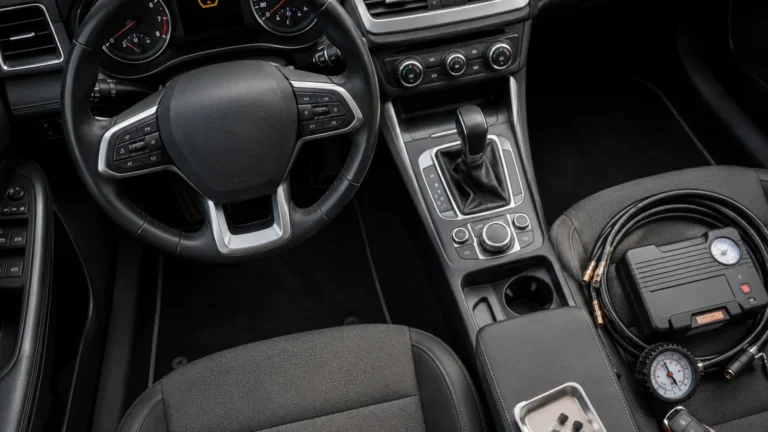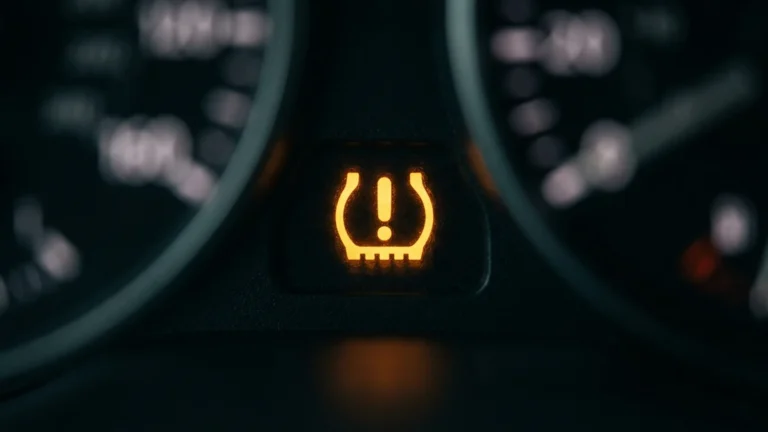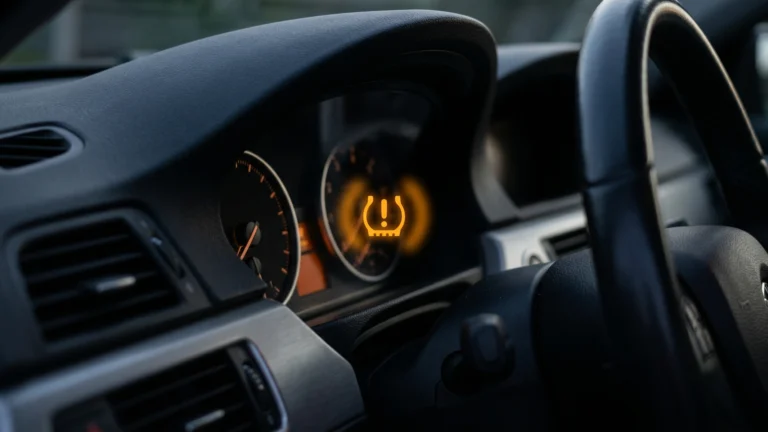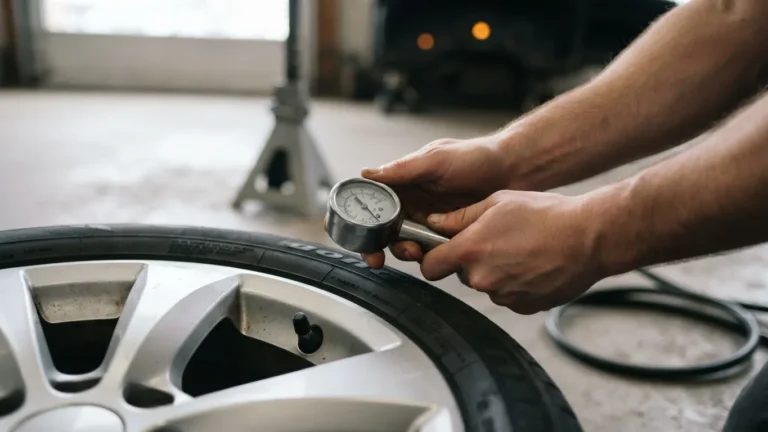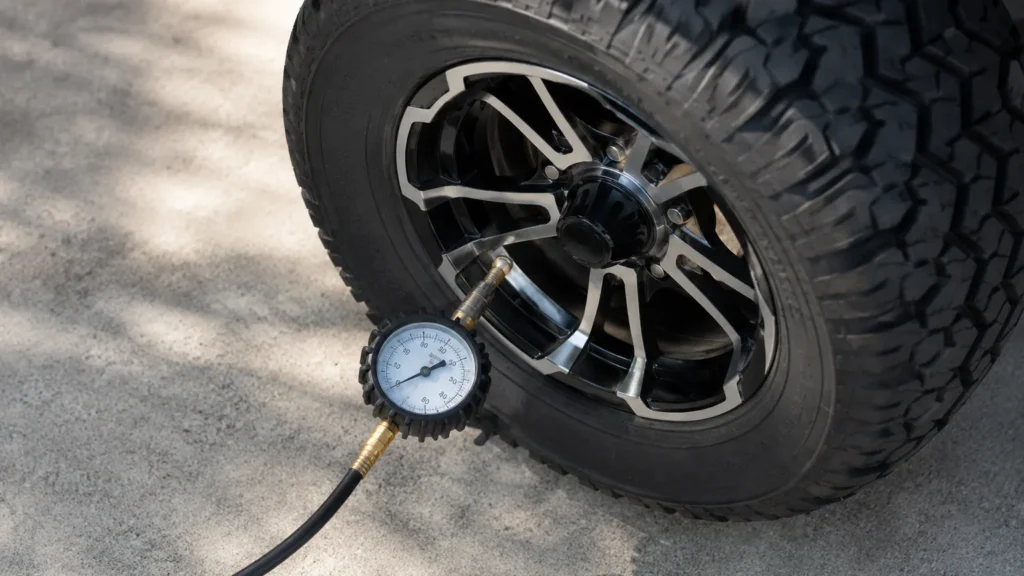
Golf cart tire pressure is the one maintenance number most owners guess at, yet it decides how the cart rides, how the tires wear, how much traction you get on grass, and how hard the motor and batteries have to work. Most golf cart tires run somewhere between 15 and 25 psi, with 18 to 22 psi being the everyday sweet spot for a typical cart, but the right number for your cart depends on the tire type, the load, and where you drive.
This guide from the BrakeTireGuide team, written by our tires and systems lead Garrett Stowe, walks through the real psi ranges, how to read the sidewall maximum against your cart’s spec, the difference between turf and street tires, and how to check pressure the right way. It is educational and is not a substitute for a qualified tire technician or your cart manufacturer’s manual. Golf carts and low-speed vehicles are lighter and slower than cars, and the correct pressure for yours may differ from any general figure here, so always confirm against your own equipment.
Short answer: check the tire sidewall for the maximum cold pressure, check your cart maker’s recommendation, and set the tires to the maker’s target while treating the sidewall number as a ceiling you do not exceed. For most stock carts that lands near 18 to 20 psi. Low-profile street tires often want a few psi more, and dedicated turf tires often want a few psi less.
By Garrett Stowe, tire and wheel systems lead at BrakeTireGuide. Last reviewed July 7, 2026.
Most articles give one psi number. This guide gives the real range by tire type, an original turf-versus-street-versus-low-profile pressure table, the sidewall-maximum-versus-target distinction, and the cold-weather math, so you set the pressure your specific cart and tires actually want.
Why golf cart tire pressure matters
Air, not rubber, carries the load. The tire is just the container; the column of air inside it is what holds the cart up, absorbs bumps, and presses the tread against the ground. When the pressure is right, the tread sits flat on the surface and the whole contact patch shares the work. When it is wrong, the tire deforms in ways that cost you grip, comfort, and tread life all at once.
On a golf cart the stakes are a little different than on a car, but they are real. Too little air and the sidewalls flex and overheat, the steering goes vague, the edges of the tread wear fast, and the motor drags against extra rolling resistance that drains the batteries sooner. Too much air and the ride turns harsh, the center of the tread wears out early, the contact patch shrinks, and traction on wet grass or a loose path drops off. On a course, over-inflated hard tires can also dig and skid in ways that chew up the turf.
Correct inflation is also a safety habit that carries over from the car world. The National Highway Traffic Safety Administration, or NHTSA, treats underinflation as one of the most common and most preventable tire problems on the road, and it recommends checking pressure at least once a month. A golf cart is not a highway vehicle, but the physics of a soft, overheating, poorly gripping tire do not change just because the top speed is lower.
The right PSI range for a golf cart
There is no single universal number, but there is a reliable band. Across the common tire types, most golf cart tires are designed to run between 15 and 25 psi. Within that band, the majority of carts ride and wear best around 18 to 22 psi. If you have lost your paperwork and cannot find a spec, 18 psi is the safest starting point for a standard stock cart, and you adjust from there based on ride, wear, and load.
The reason the band is fairly narrow is that golf cart tires are low-pressure, high-flotation designs to begin with. They are built to spread a light vehicle’s weight over a wide footprint so they float over grass instead of cutting into it. Putting car-level pressure into a golf cart tire would make it ride like a wooden wheel and give up most of its traction.
Here is the honest nuance the quick answers skip: the target moves with the tire. A soft, wide turf tire and a stiff, low-profile street tire can sit on the same cart and want different pressures. That is why the sidewall reading and the cart maker’s recommendation matter more than any round number you find online, including ours.
Sidewall maximum versus the number you actually run
Every tire has a pressure figure molded into the sidewall, and it is easy to misread what that number means. It is the maximum cold inflation pressure the tire is rated for, not the pressure you are supposed to run. Setting a tire to its sidewall maximum is like redlining an engine at every stoplight; the tire can survive it, but it is not how the tire is meant to be used day to day.
Safety warning: The number molded into the sidewall is the maximum cold pressure, not your target. Never inflate above it, and never run a golf cart tire far below the maker’s recommendation. A soft, overheating tire can separate or come off the rim on a turn, and an over-inflated one loses grip on wet grass.
The number you actually run comes from the vehicle, not the tire. On a car that is the door-jamb placard. On a golf cart it is the manufacturer’s recommendation in the owner’s manual or on a label, often near the battery tray or under the seat. The tire’s job is to be capable up to its maximum; the cart’s job is to tell you the target that suits its weight and use. When the two disagree, the cart’s recommended pressure wins, as long as it sits at or below the tire’s stamped maximum.
A concrete example shows why this matters. A low-profile 205/50-10 street tire may list something like 22 to 24 psi as its maximum. On a light two-passenger cart, inflating it all the way to that ceiling usually makes the ride worse and shrinks the contact patch, so a lower set pressure often handles and grips better. If you are not sure how to find and read these markings, our guide to reading tire sidewalls breaks down every code stamped on the rubber. Standardized markings like these trace back to engineering conventions maintained by bodies such as SAE International, which is why tires across brands label pressure and size the same way.
Turf tires, all-terrain, and low-profile street tires
The single biggest factor in your target pressure is which kind of tire you have. Golf cart tires fall into three broad families, and each one has its own comfort zone.
- Turf tires. These are the smooth or lightly grooved tires built to float over grass without tearing it. They run on the softer side, often around 15 to 20 psi. Keeping a turf tire near 18 to 20 psi on a course spreads the load so the cart does not leave ruts in the fairway.
- All-terrain and knobby tires. Taller, more aggressive tread for gravel, dirt, and mixed use. They usually live in the middle of the range, commonly around 18 to 22 psi, firm enough to resist punctures on rough ground but soft enough to keep bite.
- Low-profile street tires. The DOT-marked tires you see on street-legal carts, with a shorter, stiffer sidewall and a road tread. They typically want more air, often 20 to 24 psi, to minimize squirm and rolling resistance at road speed. Even so, many 10-inch and 12-inch low-profile tires still start near 18 psi, so do not assume higher is automatically correct.
Notice that the ranges overlap. A stock cart on all-terrain tires and a neighborhood cart on low-profile street tires can both be right at 20 psi, while a course cart on turf tires might be happiest at 18 psi. The tire family points you at the right neighborhood; the sidewall maximum and cart spec pin down the exact number.
Street-legal LSV carts versus course carts
Course carts on turf tires favor the lower half of the range. Softer tires give a bigger footprint, gentler ride, and less turf damage, and the low speeds mean heat buildup is not a concern. If you never leave grass and short paved paths, 18 psi on turf tires is a reasonable home base.
Street-legal LSVs usually run low-profile DOT tires and benefit from a bit more pressure, commonly 20 to 24 psi depending on the tire. At road speed a slightly firmer tire steers more crisply, resists sidewall flex, and rolls with less drag, which matters for both range and heat. LSVs are also heavier once you add lights, a windshield, seat belts, and passengers, and that extra load is another reason the pressure trends upward. Whatever the use, the sidewall maximum is still the ceiling and the cart maker’s figure is still the target.
Golf cart tire pressure chart
The table below gives typical starting pressures by tire type and use. Treat these as general starting points from the BrakeTireGuide team, not a substitute for your cart maker’s spec or the sidewall maximum, which always come first.
| Tire type / use | Typical size example | Common cold psi | Notes |
|---|---|---|---|
| Stock turf tire (course) | 18×8.50-8 | 15 to 20 psi | Lower end floats on grass and avoids ruts; 18 psi is a safe default |
| Stock sawtooth (neighborhood) | 18×8.50-8 | 18 to 20 psi | Balanced ride and even wear on paved paths |
| All-terrain / knobby | 20×10-10 | 18 to 22 psi | Firm enough to resist punctures on gravel and dirt |
| Low-profile street (10 in) | 205/50-10 | 20 to 24 psi | Higher psi cuts squirm at road speed; check sidewall max |
| Low-profile street (12 in) | 215/40-12 | 20 to 24 psi | Heavier LSVs trend toward the top of the range |
| Loaded / hauling | Any | Toward upper end | Add a few psi within the sidewall limit for extra load |
If your exact size or brand is not here, the pattern still holds: start at the cart maker’s recommended pressure, keep it at or below the sidewall maximum, lean lower for turf and comfort, and lean higher for street speed and heavier loads.
How load and terrain change the number
Two carts with identical tires can want different pressures because of what they carry and where they drive. Load and terrain both shift the target, and knowing which way to nudge it keeps the cart safe and comfortable.
Load is the straightforward one. More weight, whether it is passengers, a rear cargo box, coolers, or tools, pushes the tire down harder and flattens the contact patch. Adding a few psi within the sidewall limit restores the tire’s shape and keeps the sidewalls from flexing and overheating. A cart that spends its life carrying four adults and gear should sit nearer the top of its range than the same cart running empty.
Terrain pulls in two directions. On soft ground like sand or wet grass, a slightly lower pressure widens the footprint so the cart floats instead of digging in, which also protects the turf. A wider tire at lower psi floats better than a narrow tire at the same psi, which is the whole idea behind flotation tires. On hard, rough surfaces like gravel or broken pavement, a slightly higher pressure protects against pinch flats and punctures because the tire is less likely to bottom out against the rim. The trick is to make small changes, a psi or two at a time, and to always come back within the sidewall maximum and the cart maker’s range.
How to check golf cart tire pressure step by step
Checking pressure on a cart takes only a couple of minutes and needs just a low-range gauge. A car gauge that starts at 0 works, but a low-pressure gauge marked in single psi is easier to read accurately down in the teens. Follow these steps.
- Check the tires cold. A cold reading is the standard all pressure specs are written against, because driving heats the air and raises the number.
- Find your target pressure. Look up the cart maker’s recommended psi in the manual or on a label, and read the maximum cold pressure molded into each tire sidewall. Your target is the maker’s figure, capped at the sidewall maximum.
- Remove the valve cap and seat the gauge. Press the gauge squarely onto the valve stem so you hear no hiss. A leaking seal gives a false low reading and wastes air.
- Read and compare. Note the psi and compare it to your target. Because cart tires run low, even a 2 psi error is a large percentage of the total, so read carefully.
- Add or release air in small steps. Add air in short bursts and recheck, or press the valve pin to bleed a little out if you are over. Cart tires fill fast, so go slowly to avoid overshooting.
- Do all four and match sides. Set every tire to its target, and keep the two fronts equal to each other and the two rears equal to each other. Uneven pressure side to side makes the cart pull and wear unevenly.
- Replace the caps and log it. Refit the valve caps to keep out dirt and moisture, and jot down the readings so you can spot a slow leak next month.
Make this a monthly habit, the same cadence NHTSA advises for road tires, and add a check before any long outing or after the cart has sat unused for weeks. Tires lose a little air on their own over time even with no leak.
Check them cold: temperature and the 1 psi per 10 F rule
Air pressure moves with temperature, and cart tires are small enough that the swing matters. The rule of thumb, confirmed across tire-industry sources, is that pressure changes about 1 psi for every 10 degrees Fahrenheit change in ambient temperature. Cool the air and the pressure drops; warm it and the pressure climbs.
The same tire baking in a summer garage can read a few psi high. That is why the number you set in spring is not the number you have in winter, and why a seasonal recheck is worth the two minutes. Expect roughly a 1 to 2 psi shift between mild and cold weather, and reset to your target as the seasons turn.
Pro tip: Because a golf cart tire holds so little air, a small leak or a cold snap shows up fast. Keep a pencil gauge in the cart and check all four cold every couple of weeks in season. Setting them first thing in the morning, before the sun heats one side of the cart, gives you the truest cold reading.
This is also the reason every spec is a cold spec. If you check a tire right after a drive on a hot day, the reading is inflated by heat and you will under-fill it, leaving it low once it cools. The U.S. Tire Manufacturers Association, the trade body that publishes tire care guidance, defines a cold tire as one that has been sitting or barely driven, and it advises setting pressure in that state for exactly this reason. Wait for the tire to cool, then set it.
Signs of over-inflation and under-inflation
You do not always need a gauge to suspect a pressure problem; the cart and the tread will tell you. Learning the symptoms helps you catch a slow leak or a bad setting before it costs you a tire. Here is what each fault looks like.
- Over-inflation: harsh, bouncy ride. Too much air makes the tire rigid, so every seam and pebble comes through the seat. The cart may feel skittish and slow to settle.
- Over-inflation: center tread wear. The middle of the tread bulges out and carries too much load, so it wears down faster than the edges. A tire worn bald in the center but fine at the shoulders was run too hard.
- Over-inflation: lost traction. A smaller contact patch means less grip, most noticeable as sliding on wet grass or spinning on loose ground. Impact punctures also become more likely because a hard tire cannot absorb a hit.
- Under-inflation: heavy, sluggish steering. A soft tire flexes and resists turning, so the wheel feels vague and slow. The cart may wander or pull.
- Under-inflation: shoulder wear. With the center caved in, the two outer edges press hardest and wear first. Worn shoulders with a healthy center point straight at low pressure.
- Under-inflation: heat, drag, and dead batteries. Flexing sidewalls build heat, and rolling resistance climbs, which strains the motor and drains the battery pack faster. Severe under-inflation can pinch a tube or unseat the bead and cause a sudden flat.
The fix for most of these is simply resetting to the correct cold pressure and then watching the wear pattern over the next few weeks. If a tire keeps losing air after you set it, you have a leak to chase rather than a setting to change. Measuring tread as it wears helps you tell normal aging from a pressure problem, and a simple tire tread gauge makes that easy to track month to month.
How golf carts differ from federally regulated cars
It helps to understand why you will not find a federal tire-pressure sticker on a pure golf cart the way you do on a car. Passenger cars sold in the United States must meet federal motor vehicle safety standards, including tire and pressure-monitoring rules that NHTSA enforces. A golf cart used only on a course or private property is generally outside that framework, which is why the tire and cart maker, not a federal placard, are your source of truth.
Street-legal carts are a middle case. A cart built and registered as a low-speed vehicle, or LSV, must meet a federal standard for that class and typically runs DOT-marked tires, but the everyday inflation target still comes from the cart and tire manufacturers rather than a tire-pressure monitoring mandate. The organizations that shape tire safety and engineering more broadly, including NHTSA, the U.S. Tire Manufacturers Association, and the standards work of SAE International, still inform how these tires are built and labeled.
The practical takeaway is that the absence of a regulation does not mean the absence of a right answer. The load, speed, and terrain physics that make correct inflation matter on a car matter on a cart too. The wet-braking research that groups like AAA have published on worn car tires is a reminder that small changes in a tire’s condition and setup produce real changes in how a vehicle stops and handles. Treat your cart’s tires with the same monthly discipline you would give a car, scaled to the lower pressures involved.
When to see a professional
Most pressure care you can do yourself, but some findings call for a shop. See a qualified golf cart technician or tire professional when any of these come up.
- A tire will not hold pressure. If you set the correct psi and it drops again within days, there is a leak at the valve, bead, or a puncture that needs to be found and repaired or the tire replaced.
- You see uneven wear you cannot explain. Center or shoulder wear usually traces to pressure, but one-sided or feathered wear can mean an alignment or axle problem a shop should diagnose.
- The bead looks unseated or the sidewall is damaged. Cracks, bulges, cuts, or a tire that has been run flat should be inspected before you trust it again.
- You are switching tire types. Moving from turf to low-profile street tires, or adding load capacity for an LSV, is a good moment to have a pro confirm the right size, load rating, and pressure for the new setup.
- You are simply not sure. On anything tied to safety, a second opinion is cheap. A technician can set pressures, check the wheels, and confirm the tires suit how you use the cart.
None of that replaces the routine you can handle at home. A monthly cold check, pressures matched to your tire type and load, and an eye on the wear pattern will keep most carts rolling safely for years. The professional is there for the diagnosis and the repair; your gauge is what tells you when to go.
Sources and further reading
The safety framing, figures, and standards referenced above draw on the following authorities. Each link points to the organization’s current homepage so it stays valid over time.
- National Highway Traffic Safety Administration (NHTSA), federal tire and vehicle safety standards and recalls: https://www.nhtsa.gov/
- U.S. Tire Manufacturers Association (USTMA), industry tire safety and maintenance guidance: https://www.ustires.org/
- SAE International, engineering standards and test methods behind tire and vehicle systems: https://www.sae.org
Frequently asked questions
What is the correct golf cart tire pressure?
Most golf cart tires run between 15 and 25 psi, and 18 to 22 psi suits the majority of carts. There is no single universal number, so set the pressure to your cart maker’s recommendation, keep it at or below the maximum cold pressure stamped on the tire sidewall, and lean lower for turf tires or higher for low-profile street tires.
How many psi should a stock golf cart tire have?
A standard stock tire, such as the common 18×8.50-8 size, is usually happy at about 18 to 20 psi. If you cannot find a spec, 18 psi is a safe default for a typical stock cart on paved paths or a course. Adjust from there based on ride comfort, load, and how the tread is wearing.
Can you overinflate golf cart tires?
Yes. Running above the tire’s maximum cold pressure, or setting a light cart to that maximum, makes the ride harsh, wears the center of the tread early, shrinks the contact patch, and raises the risk of an impact puncture. The sidewall number is a ceiling, not a target. Set to the cart maker’s figure instead.
Why do low-profile street tires need more pressure?
Turf tires, by contrast, run softer, often 15 to 20 psi, to float over grass without leaving ruts.
Should I check golf cart tires when they are cold?
Driving heats the air and inflates the reading, so a hot check leaves the tire under-filled once it cools. Set your pressure cold, the same way NHTSA advises for car tires.
How does temperature affect golf cart tire pressure?
Pressure changes about 1 psi for every 10 degrees Fahrenheit change in ambient temperature. A cart tire set in warm weather can read 1 to 2 psi low after a cold snap, dropping it toward the bottom of the safe range. Recheck and reset as the seasons change, and always measure the tires cold for a true number.
Are golf cart tires regulated like car tires?
Not the same way. Cars must meet federal tire and pressure-monitoring standards enforced by NHTSA, while a course-only golf cart falls outside that framework, so the cart and tire makers set the target pressure. Street-legal low-speed vehicles meet a federal LSV standard and use DOT tires, but the inflation figure still comes from the manufacturers, informed by bodies like the U.S. Tire Manufacturers Association and SAE International.
Correct pressure is the cheapest, highest-return maintenance you can do on a golf cart. Set the tires to your maker’s spec within the sidewall limit, match the number to your tire type and load, check them cold once a month, and reset with the seasons. Do that and the cart rides better, the tires last longer, the batteries go farther, and the turf stays intact.