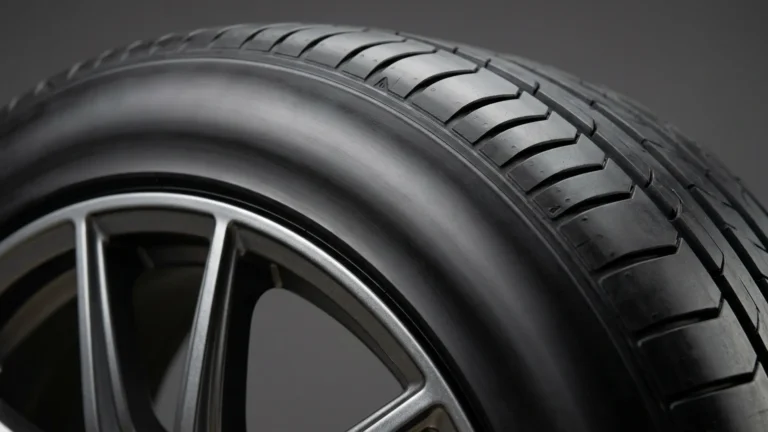
The number stamped on your tire that matters most for safety is not the width or the diameter everyone reads first. It is the load index, and in at least one case that number quietly lies to you: two tires printed with the same index across different standards can carry different maximum weights. That single catch is why it helps to explain tire size measurements as a verification tool, not a label. Get the string right against your vehicle’s door label, and a replacement matches on size, weight capacity, and top-speed capability. Match the number but miss the standard, and you can fit a tire that looks correct and still under-provides what the car needs.
This guide walks the full sidewall string segment by segment, then covers the markings outside the size string that change a buying decision: the age code, the quality grades, and the winter stamp. For the wider subject, see our tire care section.
Quick answer: A tire size such as P215/65R16 95H reads as five parts plus two. “P” is the type (passenger). “215” is the section width in millimeters. “65” is the aspect ratio, meaning the sidewall is 65 percent as tall as the tire is wide. “R” is radial construction. “16” is the rim diameter in inches. The trailing “95H” is the service description: load index 95, speed symbol H. Always confirm these tire size measurements against the vehicle’s door-jamb Tire and Loading Information label, not against whatever tire happens to be fitted now.
Decoding P215/65R16 95H: Each Segment on the Sidewall
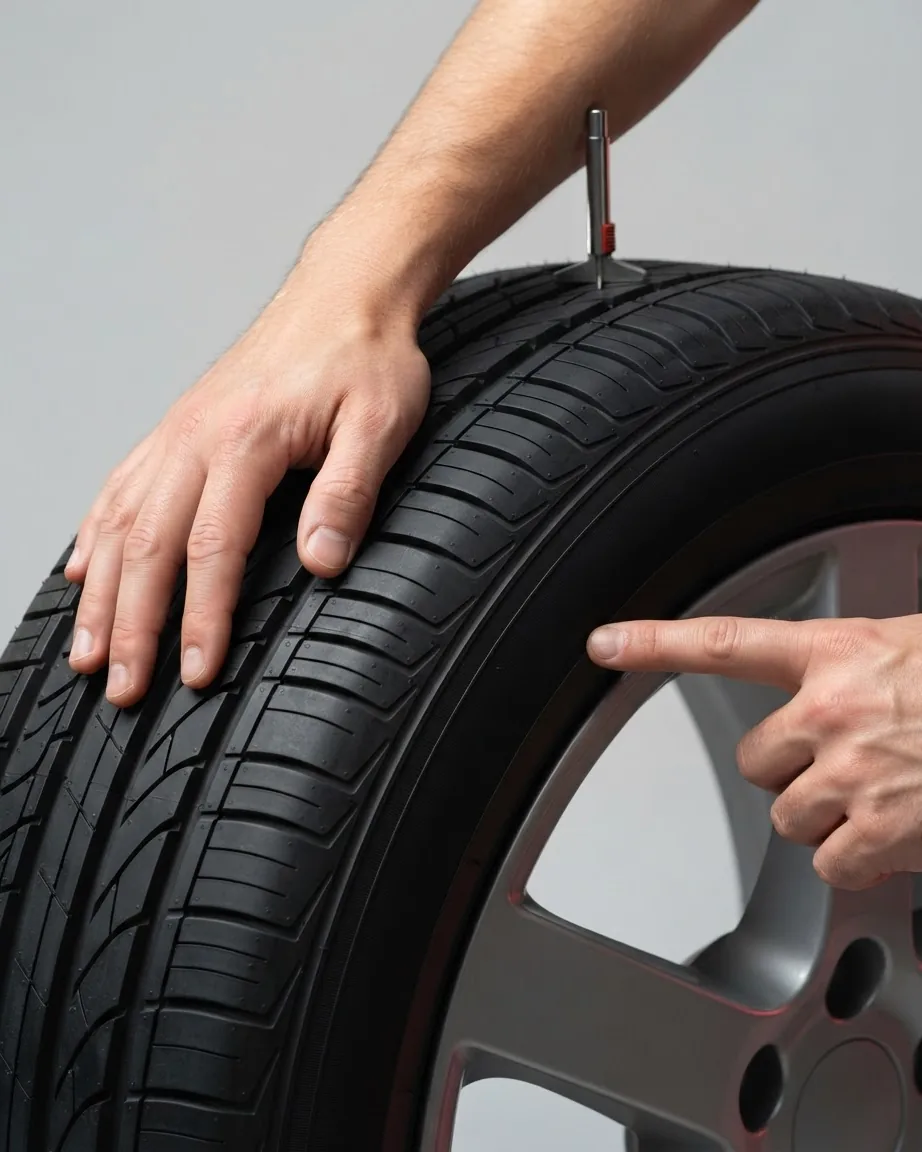
Take the common size P215/65R16 95H, the worked example used by both Walser and Les Schwab. Each block answers a different question, and skipping one is how mismatches slip through.
- Type prefix (P): “P” marks a P-Metric passenger tire. Bridgestone Americas notes that a Euro-Metric tire of the same intent carries no preceding letter at all – 225/70R16 98H rather than P225/70R16 97H. An “LT” prefix means light truck; a “C” placed right after the rim size (as in 235/65R16C) marks a Euro-Metric Commercial tire. The letter, or its absence, is not decoration.
- Section width (215): the nominal width of the tire in millimeters, measured across the tread – here 215 mm. A tire marked P225 is a passenger tire with a nominal width of 225 millimeters.
- Aspect ratio (65): sidewall height as a percentage of width. Les Schwab and Walser agree: 65 means the sidewall is 65 percent as tall as the tire is wide. The Tire Industry Association works the same math on a 60-series tire, where the sidewall height on a 225-width tire is 60% of 225, or roughly 135 millimeters.
- Construction (R): “R” is radial, the layout on nearly every modern passenger car. A “B,” an “X,” or a dash would indicate bias-ply construction instead.
- Rim diameter (16): the wheel diameter the tire is built to seat on, in inches. Per the Tire Industry Association, this tire is designed to fit a rim with a 16-inch diameter.
Convert the sidewall height to inches if you are comparing overall diameter: Les Schwab’s own worked example on a different size lands at 5.5 inches of sidewall height. The point of reading all five blocks is that a replacement has to match every one – a 16-inch tire will not seat on a 17-inch wheel no matter how close the other numbers look.
Load Index and Why the Same Number Can Mean Different Pounds
The two or three digits after the rim size are the load index – the maximum weight one tire carries at the speed its symbol allows. This is the figure drivers most often ignore, and the one with a trap built in.
The pound values are not evenly documented across the industry, and that is the useful part. Les Schwab states that a load index of 89 means a load capacity of 1,279 pounds per tire. Walser puts load index 95 at about 1,521 pounds per tire. Bridgestone Americas describes the full range of its scale running from 99 to 7385 lbs of carrying capacity. Those are different index values from different publishers, so do not read them as points on one line you can interpolate between.
Here is the warning that matters most, and only one publisher states it plainly. Bridgestone Americas notes that two tires in two different standards – a P-Metric and a Euro-Metric, say – can show the same load index number yet have different maximum load capacities. The index is not a universal absolute weight. If you are replacing a tire, confirm the actual rated load in pounds, not just that the index digits match. A matching string is necessary; it is not proof the new tire carries what the vehicle needs.
The Tire Industry Association frames the index itself cleanly: a load index – 97 in its example – is a two- or three-digit code for the maximum load carried at the speed indicated by the speed symbol. Load and speed are linked, which is why the next segment is not optional either.
Speed Rating Letters: Matching or Exceeding the Factory Spec
The letter at the end of the service description is the speed symbol, and each letter maps to a tested maximum speed. Bridgestone Americas gives two neighbors on the low end: a tire rated S is good for up to 112 mph, while a tire rated R is rated up to 106 mph. Walser places an “H” rating at up to 130 mph. For the fastest tires, Les Schwab notes that above 149 mph a “ZR” may appear in the size designation itself.
The rule that protects you is simple and worth stating once clearly: a replacement’s speed rating should equal or exceed the original equipment rating your vehicle was built around. Fit a lower-rated tire and the vehicle’s safe top-speed capability drops to the lowest-rated tire on the car – mix ratings across the four corners, and the weakest one governs the set. This is not about how fast you drive; the rating also reflects heat tolerance and construction, which matter at highway speed in summer whether or not you ever reach triple digits.
| Speed symbol | Rated up to | Source |
|---|---|---|
| R | 106 mph | Bridgestone Americas |
| S | 112 mph | Bridgestone Americas |
| H | 130 mph | Walser |
| ZR | above 149 mph | Les Schwab |
P-Metric vs LT and Euro-Metric: When “The Same Size” Still Falls Short
A number string can match and the tire can still be wrong for the job. This is where the type prefix stops being trivia. P-Metric and LT tires at nominally similar sizes are built to different load standards; an LT tire is engineered for the higher loads of trucks and vans, while a P-Metric tire is not. Swapping a P-Metric onto a vehicle that left the factory on LT rubber can under-provide load capacity even when the width, ratio, and diameter all read the same.
The Euro-Metric versus P-Metric difference is subtler because the strings look almost identical – the Euro-Metric simply drops the leading “P.” But as noted above, the same load-index digits across those two standards do not guarantee the same pounds. The practical move is to stop trusting the number string alone and verify three things on any replacement: the type prefix, the actual rated load in pounds, and the speed symbol. All three have to clear the factory spec.
Two related markings fall here. An “XL” after the size marks an Extra Load tire, built to carry more at higher inflation. Flotation sizing – a format like 33X12.50R17 – states the overall diameter and the section width in inches rather than the metric string, and these LT and flotation tires are exempt from the quality grading covered below.
Reading the DOT Code to Decode a Tire’s True Age
Tread depth tells you how worn a tire is. It does not tell you how old it is, and age matters on its own. The DOT Tire Identification Number ends in a four-digit date code read as week-then-year (WWYY).
Issuers disagree on the deadline, and the disagreement is worth keeping straight rather than averaging away. Michelin recommends a close inspection after five years and replacement by ten years from the date of manufacture, regardless of tread depth, while some manufacturers cite a service-life window in the roughly six-to-ten-year range. Same direction, different thresholds – so treat the 10-year mark as a hard outer limit and start inspecting well before it. This matters most for a low-mileage car or a spare that has sat for years: the tread can look nearly new while the rubber has aged past its service life.
If you are tracking the calendar on wear items generally, the logic of reading a date code pairs with knowing how often to replace brake pads.
UTQG Grades: What Treadwear, Traction, and Temperature Actually Promise
The Uniform Tire Quality Grading marks – a treadwear number plus traction and temperature letters – are a federal system, and each grade promises something narrower than drivers assume.
Treadwear is a relative grade from a controlled test, not a mileage guarantee. Bridgestone Americas explains it comes from running a tire on a specified government test course for 6,000 miles, with higher grades indicating longer relative wear on that course. The comparison holds within one manufacturer’s own line. It is not a cross-brand mileage promise, so a 500 from one maker and a 500 from another are not an apples-to-apples claim of equal life.
Traction covers less than its name suggests. The grade reflects straight-ahead wet braking only and explicitly excludes cornering traction – an “AA” tire is not graded for how it holds a curve. Temperature grades a tire’s resistance to heat. Both are set against government standards, and the top grades are not universal: a large share of tires land at the top “A” grade, which is useful context for how much a mid grade actually tells you.
M+S vs 3PMSF: The Winter Stamp That Means a Passed Test
Two winter-looking markings are not equal, and conflating them is a genuine safety gap. An “M+S” (mud and snow) stamp describes a tread pattern; it is not a certification of winter grip. Michelin is direct about the line between them: only tires carrying the 3PMSF symbol – the three-peak mountain snowflake – have verified winter performance from a passed snow-traction test.
The Tire Industry Association describes what the certified tires are actually built to do: special tread designs and rubber compounds engineered to perform better in temperatures below 40 degrees F, with or without snow or ice. That temperature figure is the real trigger – a dedicated winter tire earns its keep on cold dry pavement, not only in snow. If you need true cold-weather capability, look for the 3PMSF symbol, not the M+S letters alone.
OE Codes Like MO, AO, and T0: Why “Same Model” Isn’t the Same Tire
A short letter code near the size – MO, AO, T0 – is an original-equipment designation, and it changes the buying decision more than its size suggests. Michelin explains the shorthand: MO for Mercedes-Benz, AO for Audi, and T0 and T1 for Tesla. These mark a version of the tire tuned to one automaker’s engineering – a specific compound, construction, or acoustic foam liner developed for that car.
Buy the same tire model without the OE code and you may get a tire that performs well in general but shifts the ride comfort, noise, or handling the vehicle was calibrated for. For many drivers that trade-off is acceptable; for an EV tuned for range and quiet, or a luxury car tuned for a particular ride, it is a real change. Know whether your vehicle came on an OE-coded tire before you treat the unmarked version as identical.
Where the Correct Tire Size Measurements Actually Come From
The authoritative source for the size your vehicle requires is not the tire currently bolted on – it is the Tire and Loading Information label on the driver’s door edge or in the owner’s manual. A previous owner or shop may have fitted the wrong size; the door label is the factory specification that outranks whatever is mounted now. Match the replacement to the label on size, load index, and speed rating together.
Tire pressure belongs to that same label, and it is where most drivers slip. Only a small minority of consumers properly inflate their tires – a striking gap given how directly underinflation drives uneven wear and blowout risk. Correct size on the sidewall buys you nothing if the pressure is wrong.
Two findings on the sidewall always mean stop and call a tire professional rather than reading another number: visible sidewall damage – a bulge, a cut, or a crack into the cord – and uneven wear with a cause you cannot identify. Both can point to internal damage or an alignment or mechanical fault no size string will reveal. When you are reading the sidewall to confirm a match, that is routine; when you are reading it because something looks wrong, that is a mechanic’s job.
Measuring Tread Depth and the 4/32-Inch Threshold
Built-in tread wear bars sit flush with the surrounding tread once a tire is worn to its limit, and wet-weather stopping distance lengthens as tread drops because the tire can no longer clear water fast enough to keep the rubber on the road.
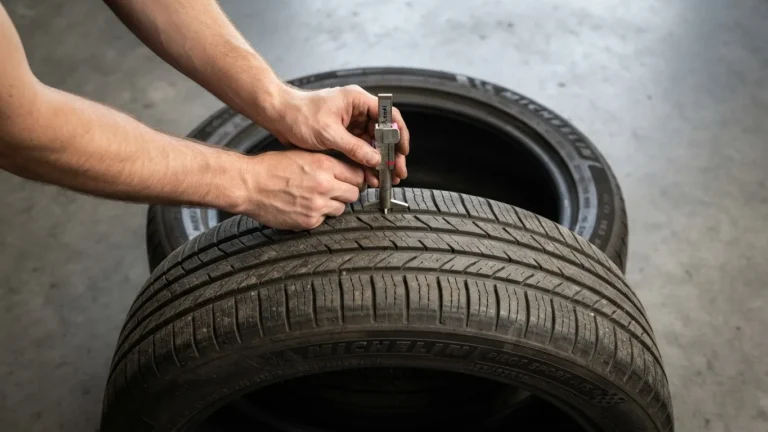
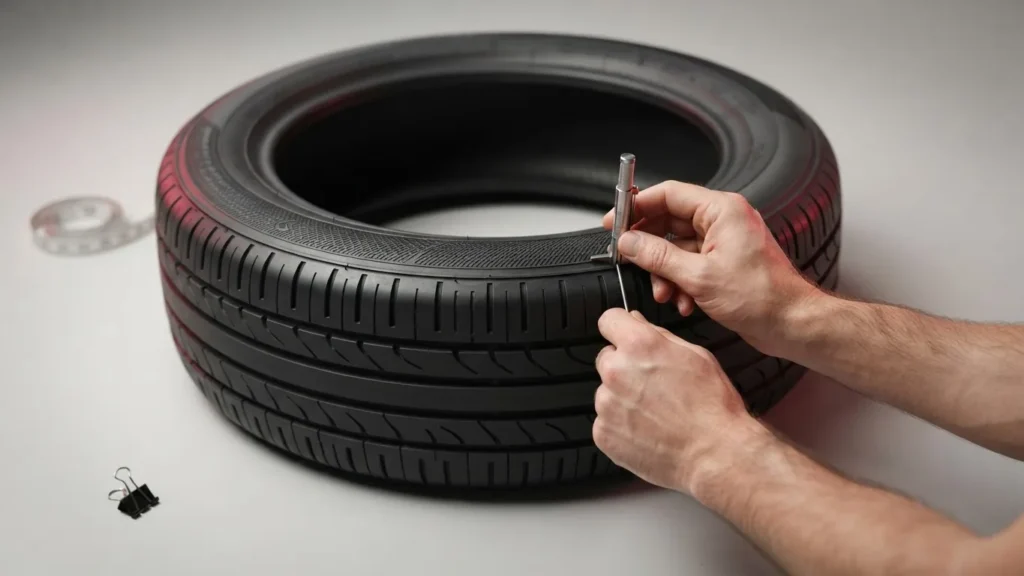
You can check tread without a gauge using a penny or a quarter at several points across each tire, but a dedicated tread-depth gauge gives you the actual number. Measure in more than one groove and at the inner, center, and outer ribs: a reading that differs a lot across the tread face is itself a wear sign. Shoulders worn faster than the center suggest underinflation; a worn center suggests overinflation; one edge worn alone points toward alignment. When the pattern is uneven and you do not know why, that is the moment to hand it to a professional rather than simply buying matching tires and repeating the fault.
Rotation Pattern and Interval by Drivetrain
Rotation moves wear around the set so the four tires age closer together, and the correct pattern depends on your drivetrain and whether the tires are directional. Your owner’s manual specifies the pattern for your vehicle.
A widely cited interval is every 6,000 miles, and many owners simply rotate at each 6,000-mile service to keep it on the calendar. Your owner’s manual may specify a different figure, and the manual’s number wins. The payoff is even wear across the set, which is also what lets you read tread depth as a meaningful whole-vehicle health check rather than four separate numbers drifting apart.
Rotation does nothing for a wheel that is out of alignment – if one tire wears faster despite a correct rotation schedule, alignment or suspension is the likely cause, and that is diagnostic work for a shop. Drivers who track service intervals this way often apply the same habit to brake wear, as in our guide to the brake pad gauge and measuring thickness.
What You Lose in MPH When You Drop One Speed Rating
The rule is “equal or exceed the factory rating,” and because the weakest tire on the car governs the whole set, a single downgrade quietly caps the entire vehicle. Working the differences between the rated speeds in the table above shows what each step actually costs, so you can judge how far a cheaper replacement really pulls your safe capability down.
- H down to S: 130 mph − 112 mph = 18 mph of rated capability gone.
- S down to R: 112 mph − 106 mph = 6 mph lost in the smallest common step.
- H down to R (two steps): 130 mph − 106 mph = 24 mph, the largest drop among these common ratings.
- ZR floor down to H: 149 mph − 130 mph = at least 19 mph, since ZR is rated above 149 mph.
These gaps are capability figures, not speed-limit advice: a lower rating also means less heat tolerance at sustained highway speed in summer, which is why matching the factory symbol matters even if you never approach these numbers.
FAQ
Does a higher speed rating mean I should drive faster?
No. The symbol marks a tested ceiling tied to heat tolerance and construction, not a target. Its value shows up at summer highway speeds and under load, where a well-rated tire sheds heat better. Pick a replacement that equals or exceeds the factory letter and ignore the headline mph number as a driving goal.
My new tires match the old size string exactly. Can I still have a problem?
Yes. A matching width, ratio, and diameter say nothing about the type standard behind them. A P-Metric fitted where an LT belongs, or identical load-index digits across two standards, can under-provide carrying capacity. Verify the prefix letter and the rated load in pounds, not just that the printed string lines up.
Is an M+S tire enough for real winter driving?
Often not. The M+S letters describe a tread pattern, not a passed test. For verified cold-weather grip, look for the three-peak mountain snowflake symbol, which marks compounds built to work below roughly 40 degrees F. On genuinely icy or snowy routes, that distinction can decide whether the tire grips when you need it.
How old is too old if the tread still looks fine?
Read the four-digit DOT date code as week-then-year. Guidance varies: Michelin advises close inspection at five years and replacement by ten, while some makers cite a six-to-ten window. Treat ten years as the outer wall, and inspect a low-mileage car or an aging spare sooner, since rubber degrades on the shelf regardless of remaining tread.