Front wheel drive tire rotation has one correct pattern, the forward cross, and getting it right is the difference between four tires that wear evenly and a front pair that is bald while the rears still look new. On a front-wheel-drive car the front tires do almost all the hard work, so they wear far faster, and rotation is what spreads that wear around. This guide shows the exact pattern, how often to do it, the handful of exceptions, and how to do it yourself safely.
If you only remember one thing, make it this: on a front-wheel-drive vehicle, the fronts move straight back, and the rears cross over to the opposite front corners. That single move, done on schedule, can add thousands of miles to a set of tires.
The forward cross pattern
For a front-wheel-drive vehicle with four non-directional tires of the same size, the recommended pattern is the forward cross. It works like this:
- Front tires move straight back. The left front goes to the left rear, and the right front goes to the right rear. They stay on the same side.
- Rear tires cross to the opposite front. The left rear goes to the right front, and the right rear goes to the left front.
The logic is that the worn front tires get a rest on the rear axle, where they wear slowly, while the less-worn rears move up front and cross sides to even out any side-to-side differences. This is the pattern recommended by tire testers such as Tire Rack and by tire makers like Michelin for FWD cars, and it is the one to use unless your tires fall into one of the exceptions below.
Why FWD front tires wear faster
On a front-wheel-drive car, the front tires carry three jobs at once, and that is the whole reason rotation matters so much.
- They put the power down. All of the engine’s drive torque goes through the front wheels during acceleration.
- They do most of the braking. Weight shifts forward when you brake, so the front tires handle the majority of stopping force.
- They do all of the steering. Every turn scrubs the front tires across the road, and the front tires also carry the weight of the engine and transaxle.
Pile acceleration, braking, steering, and extra weight onto the same axle and the fronts simply wear out much faster than the rears. Without rotation, the front tires on a typical FWD car can wear out 10,000 to 15,000 miles before the rears. Rotation moves that wear around so all four tires reach the end of their life at roughly the same time.
How often to rotate
The standard interval is every 5,000 to 7,500 miles, and many sources give a broader 5,000 to 8,000 mile window. The easiest way to remember it is to rotate at every oil change, since modern oil-change intervals often land in the same range.
It is worth setting a reminder rather than relying on memory, because rotation is the kind of maintenance that is easy to postpone and never come back to. A note in your phone tied to mileage, or simply telling the shop to rotate every time you get an oil change, turns it into an automatic habit. The cars that develop the worst front-to-rear wear gaps are almost always the ones whose owners meant to rotate and never quite got around to it.
If you drive hard, carry heavy loads, or notice the fronts wearing quickly, lean toward the shorter end of that range. Your owner’s manual gives the manufacturer’s specific recommendation, and following it also keeps you compliant with many tire warranties, which can require documented rotation every so many miles. Federal safety guidance from the NHTSA also stresses regular rotation as part of basic tire maintenance for safe handling and longer tread life.
What skipping rotation costs you
Skipping rotation does not feel like a problem until it is an expensive one. Because the fronts wear so much faster, you end up in one of two bad spots.
Either the front tires wear out while the rears still have plenty of tread, leaving you to replace just the front pair and live with a tread-depth mismatch front to rear, or you replace all four at once and throw away the unused life left in the rear tires. Both waste money. On many cars the gap is that 10,000 to 15,000 mile head start the fronts get, which is a large fraction of a tire’s total life. A rotation that costs little or nothing if you do it yourself protects a set of tires that can cost several hundred dollars.
There is a safety angle too. Tires that wear unevenly can hurt handling and traction, especially in the wet, and a big tread mismatch front to rear changes how a car behaves at the limit. Even wear keeps the car predictable.
There is also the matter of buying tires in pairs. Many tire shops recommend, and some insist, that new tires go on the rear axle for stability, even on a front-wheel-drive car, because rear grip is what keeps the back end from sliding out in the wet. If you let your fronts wear out in isolation and buy just two, you can end up shuffling tires around to satisfy that rule, or buying four when you did not need to. Consistent rotation sidesteps the whole dilemma by keeping all four tires close in tread depth, so when replacement time comes you simply replace the full set, having used every tire to its fullest.
Exceptions: directional and staggered tires
The forward cross is the default, but two setups change the rules.
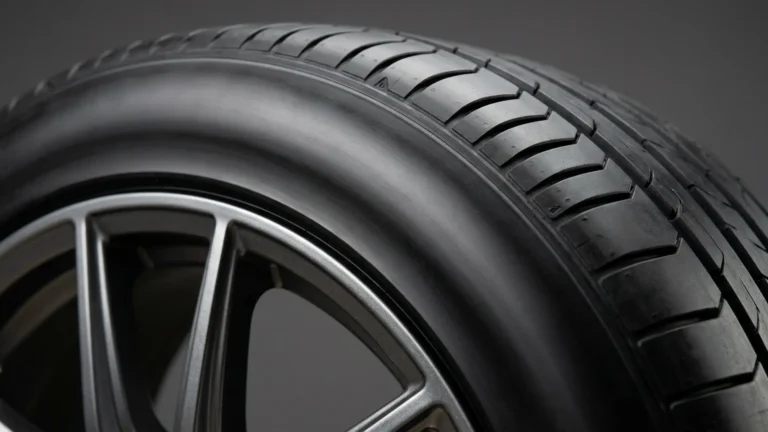
- Directional tires. These have a tread designed to roll in one direction only, marked by an arrow on the sidewall. They must stay on the same side, so you rotate front to back on the same side, left front to left rear and right front to right rear, with no crossing.
- Staggered or different-size setups. Some performance cars run wider tires on one axle. If the front and rear tires are different sizes, you cannot rotate front to back at all; you can only swap side to side on the same axle, and only if the tires are not also directional.
Run-flat tires follow the same patterns as regular tires based on whether they are directional. When in doubt, check the sidewall for a direction arrow and check your tire sizes front and rear before you start.
Tools you need for a home rotation
You do not need a shop full of equipment to rotate tires safely, but you do need the right basics. Trying to do it with just the emergency scissor jack from the trunk is where people get into trouble.
- A floor jack rated comfortably above your vehicle’s weight, which is faster and more stable than the spare-tire jack.
- Two to four jack stands, also properly rated. These hold the car; the jack only lifts it.
- Wheel chocks to block the tires that stay on the ground.
- A breaker bar or lug wrench to loosen the nuts, and a torque wrench to tighten them to spec.
- A marker or chalk to label each tire’s current position before you start, so you do not lose track of the pattern.
Marking the tires is a small trick that prevents the most common mistake, mixing up which tire goes where halfway through. Chalk a quick “LF,” “RF,” “LR,” and “RR” on the tread before you lift anything.
How FWD rotation differs from RWD and AWD
It helps to know why the FWD pattern is specific, because other drivetrains use different ones.
- Front-wheel drive uses the forward cross: drive wheels move straight back, rear wheels cross to the front.
- Rear-wheel drive uses the rearward cross, essentially the mirror image: the rear drive tires move straight forward, and the fronts cross to the rear.
- All-wheel drive typically uses the X-pattern, where every tire crosses to the opposite corner, because all four wheels share the drive load.
The common thread is that the drive wheels, which wear faster, get moved to the non-drive axle to even out wear, and at least one pair crosses sides. For your front-wheel-drive car, that means the forward cross, every time, unless the tire type forces an exception. Using the wrong drivetrain’s pattern will not destroy your tires, but it will not even out wear as effectively as the right one.
How to do it yourself safely
Rotating tires at home is straightforward with basic tools, but safety comes first because you are working under a lifted car. Never rely on a jack alone.
- Park on level ground and engage the parking brake. Chock the wheels you are not lifting.
- Loosen the lug nuts slightly while the tires are still on the ground, just to break them free.
- Lift the car and support it on jack stands rated for the weight. Never work under a car held only by a jack.
- Move each tire to its new position following the forward cross pattern.
- Hand-thread the lug nuts first to avoid cross-threading, then snug them.
- Lower the car and do the final tightening with the tires back on the ground.
Take your time, and if you are not comfortable working under a vehicle, a shop will rotate tires quickly and cheaply. If you are already doing brake work, it pairs naturally with steps like learning how to check your brake pads while the wheels are off. With all four wheels removed at once, a rotation is the ideal moment to glance at your pads, rotors, and brake lines, since you will not have a better view of them until the next time the wheels come off. Doing both jobs together saves you a second round of jacking the car up.
Lug nut torque and re-torque
This is the step most DIYers skip, and it matters for safety. Lug nuts must be tightened to the manufacturer’s specification, commonly in the range of 80 to 100 lb-ft for many passenger cars, though you should always check your manual for the exact figure.
- Use a torque wrench, not an impact gun by feel. Over-tightening can warp brake rotors and stretch studs; under-tightening can let a wheel loosen.
- Tighten in a star or crisscross pattern, not in a circle, so the wheel seats evenly against the hub.
- Re-torque after about 50 to 100 miles of driving, since lug nuts can settle slightly after a wheel is remounted.
Checking the sidewall and your manual takes a minute and protects both your wheels and your brakes. If you want to understand the markings you are reading, our guide to tire sidewalls breaks them down.
Signs you are overdue for a rotation
Mileage is the best guide, but your tires also send signals when a rotation is overdue. Watch for these:
- Visibly shallower tread up front. Compare a front tire to a rear by eye or with the tread; on a neglected FWD car the difference is obvious.
- A new hum or roar that rises with speed, often from rear tires that have developed irregular wear from sitting in one position too long.
- A pull or vague steering that was not there before, which can follow uneven front wear.
- You cannot remember the last rotation. If it has been more than 7,500 miles or you have no record, it is time.
Catching it at the first sign protects the rear tires from picking up their own wear pattern, which rotation cannot fully reverse once it sets in. The cheapest rotation is the one you do on schedule before any of these symptoms appear.
Rotation and your tire pressure sensors
Most cars built in recent years have a tire pressure monitoring system, or TPMS, with a sensor inside each wheel. Rotating the tires moves those sensors to new positions, and it is worth knowing how your system handles that.
Many vehicles simply relearn the positions automatically after a short drive, so the system keeps working without any action. Some, however, need a relearn procedure or a scan tool to reassign which sensor is at which corner, and on those cars you may see a TPMS warning light after a rotation until the relearn is done. Check your owner’s manual for your vehicle’s method. After any rotation it is also good practice to set each tire to the correct pressure for its new position, since front and rear pressures sometimes differ. None of this is a reason to skip rotation; it is just a step to finish the job cleanly so your pressure warnings stay accurate.
Reading uneven wear
Rotation evens out normal wear, but it will not fix a mechanical problem, and the wear pattern itself is a diagnostic clue.
- Both edges worn, center fine: chronic under-inflation. Check and set your tire pressure.
- Center worn, edges fine: over-inflation.
- One edge or a feathered pattern: an alignment problem. Rotation alone will not cure it; you need an alignment.
- Cupping or scalloping: often worn suspension parts such as shocks or struts.
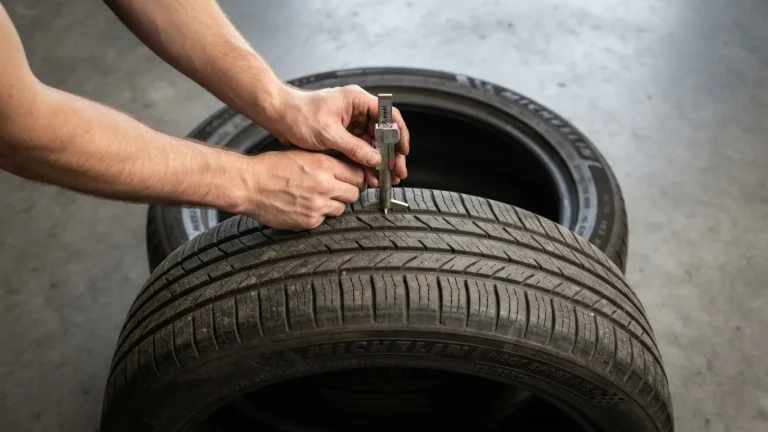
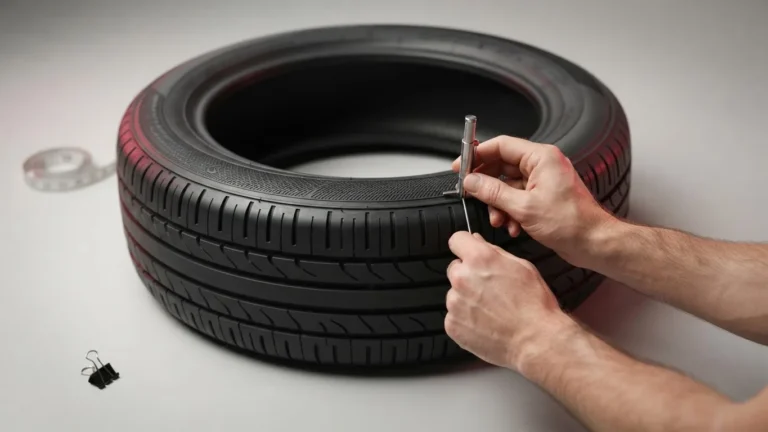
If you see these patterns, rotating will spread the symptom but not solve the cause. Tires wear out at the legal minimum tread depth of 2/32 inch, and even wear is what gets all four there at the same time, so address alignment or suspension issues so your freshly rotated tires do not wear unevenly all over again.
Frequently asked questions
What is the correct tire rotation pattern for front wheel drive?
The forward cross. The front tires move straight back to the same side, and the rear tires cross over to the opposite front corners. It is the recommended pattern for front-wheel-drive cars with four matching, non-directional tires.
How often should I rotate tires on a FWD car?
Every 5,000 to 7,500 miles, or roughly at every oil change. Check your owner’s manual for the exact interval, and rotate more often if you drive hard or notice fast front wear.
Why do front tires wear faster on front wheel drive?
The front tires handle acceleration, most of the braking, and all of the steering, plus they carry the engine’s weight. That combined load wears them out far faster than the rears, sometimes 10,000 to 15,000 miles sooner without rotation.
Can I rotate directional tires front to back only?
Yes. Directional tires must stay on the same side, so you rotate them straight front to back, never crossing sides. Look for a direction arrow on the sidewall to identify them.
Does tire rotation fix uneven wear from alignment?
No. Rotation spreads wear around but does not correct an alignment or suspension problem. If you see feathered or one-sided wear, get an alignment first, then rotate as normal so your freshly aligned tires start wearing evenly from a clean slate.
What torque should lug nuts be after rotation?
Commonly 80 to 100 lb-ft for many passenger cars, but always use the figure in your owner’s manual. Tighten in a star pattern with a torque wrench, and re-torque after about 50 to 100 miles.
Should I include the spare tire in the rotation?
Only if you have a full-size matching spare and your manufacturer recommends a five-tire rotation. Compact or temporary spares are not designed for regular use and should never be rotated into service; keep them strictly for emergencies.
Will rotating my tires reset the TPMS light?
It depends on the car. Many vehicles relearn sensor positions automatically after a short drive, while others need a relearn procedure or a scan tool. If a TPMS light comes on after rotation, check your owner’s manual for the relearn steps, and set each tire to the correct pressure for its new position.