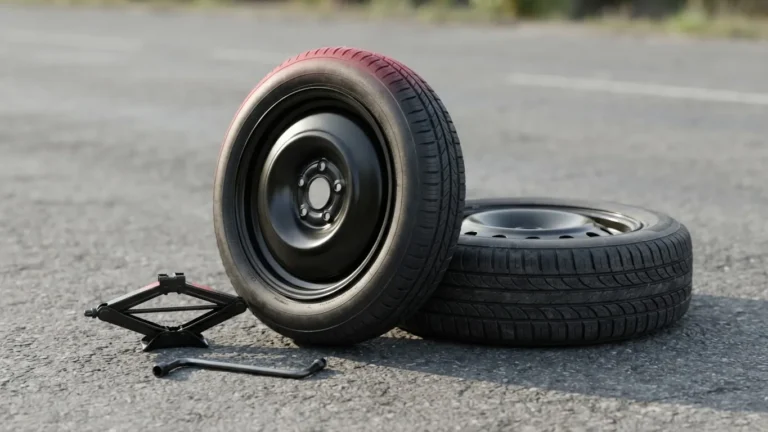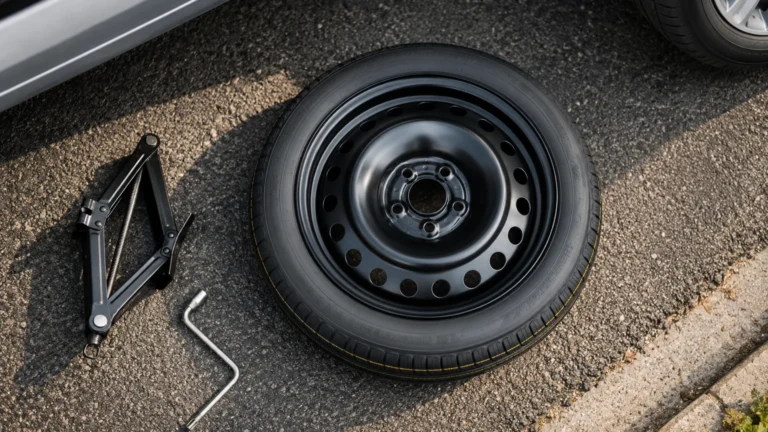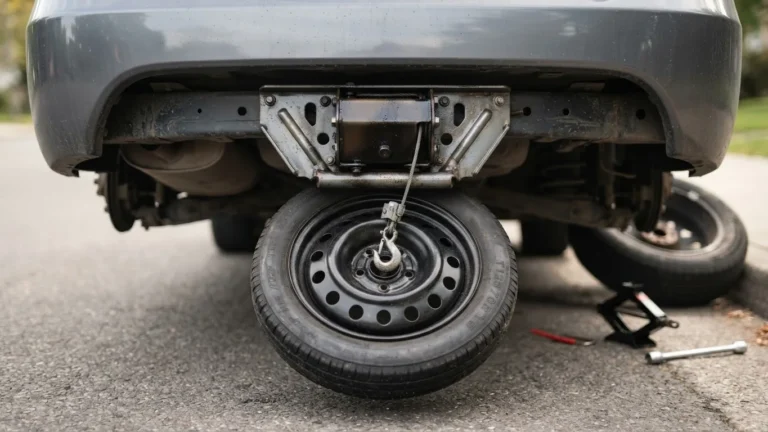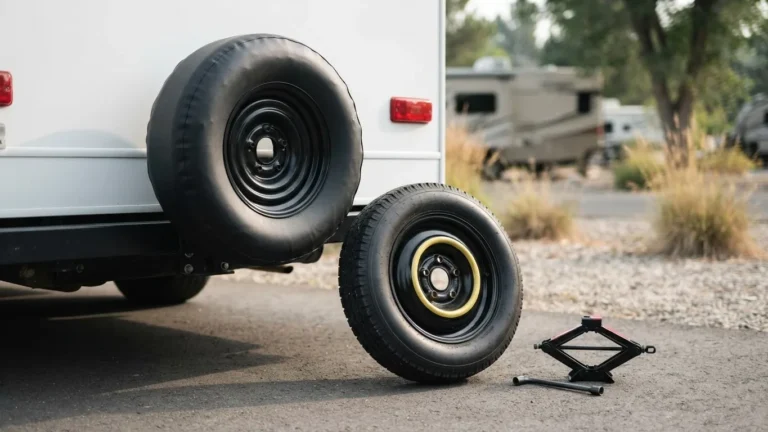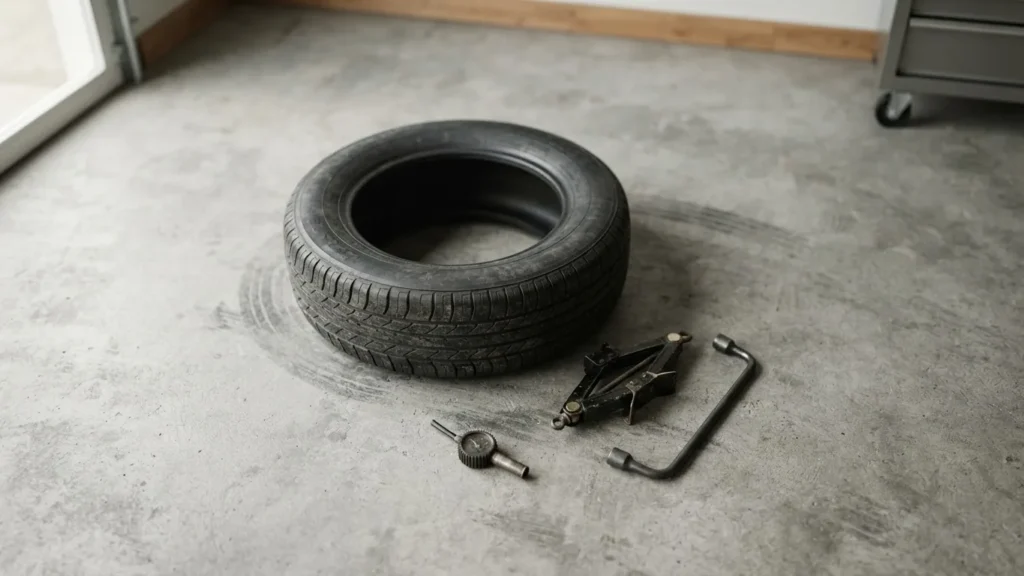
The thing most drivers get wrong about a spare is that they check the tread when they should be checking the date. A spare that has never touched pavement can still be unsafe, because rubber ages whether it rolls or not. So how long does a spare tire last? Most spares, compact “donut” and full-size alike, hold up roughly six to 10 years even if they sit untouched in the trunk, and at 10 years the recommendation across major tire makers is to replace it regardless of how it looks. The tread will fool you. The manufacture date won’t.
Quick answer: A spare tire generally lasts six to 10 years, and most tire manufacturers advise replacing any tire at 10 years from its build date, spares included. A donut has far tighter use limits once it’s on the car: keep speed at or below 50 mph and plan to drive no more than about 50 to 70 miles before swapping to a proper tire. Compact spares often need around 60 psi, much higher than a regular tire. Read the last four digits of the DOT code on the sidewall to find the week and year it was made, then count forward from there.
How many years a spare tire lasts, and the 10-year replacement point
The age window is wider than you’d think, and the sources behind it don’t line up perfectly. Discount Tire puts the lifespan of most spares, compact and full-size, at six to 10 years even when they’ve never been used, per its spare tire lifespan guide. AAA frames it a little differently: today’s tires carry a general life expectancy of about six years, with spare tires lasting up to 10, according to its advice on a bad spare.
Those aren’t the same measurement. One describes when a tire typically reaches the end of its service life; the other describes when you should stop trusting it no matter what. Treat six years as the point to start inspecting closely and 10 years as the hard stop.
On the hard stop, the tire makers are unusually direct. Michelin recommends replacing tires 10 years after the date of manufacture regardless of remaining tread depth or apparent condition, and it says plainly that this includes spare tires, in its tire buying guide. Continental gives the same ceiling: any tire, spare included, made more than 10 years ago should be removed from service, per its guidance on replacing tires.
Consumer Reports lands in the same place with a line worth keeping in mind. “Unless specified, you should get a new spare tire at 10 years to ensure it is safe to use,” says Ryan Pszczolkowski, the magazine’s tire program manager. That “unless specified” matters, because your own vehicle or tire paperwork can set a shorter limit, and the paperwork wins.
The 10-year rule is a manufacturer recommendation, not a legal mandate
Here’s where a widely repeated “fact” needs correcting. There is no single federal law that forces you to replace a spare at a fixed age. The National Highway Traffic Safety Administration, part of the U.S. Department of Transportation, describes the industry picture rather than imposing one number: some vehicle and tire manufacturers recommend replacing tires that are six to 10 years old, regardless of treadwear, per its tire safety page.
So the “10 years” you see everywhere is a manufacturer recommendation that Michelin and Continental happen to state specifically, not a federal cutoff. The federal role is to tell you the recommendations exist and to urge you to read the sidewall. When your carmaker’s manual gives its own age limit, follow that figure first.
How to read the DOT date code on your spare
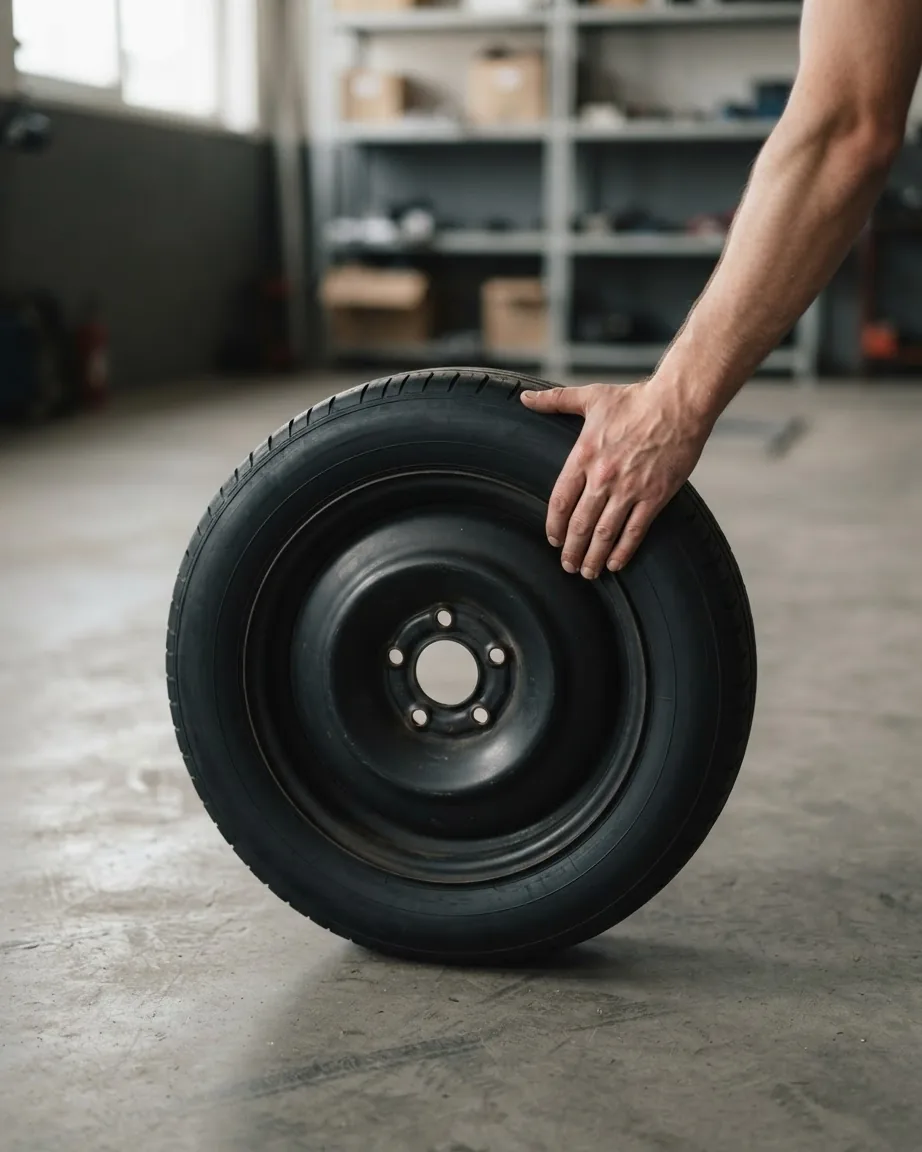
Since you can’t judge age by looking at the rubber, the date code is the number to trust. The last four digits of the DOT code on the sidewall give the week and year the tire was built. Discount Tire reads it this way: 2521 means week 25 of 2021. AAA gives a parallel example on the DOT code, where 2523 points to the 25th week of 2023.
So the method is simple: find the four-digit block, split it into two pairs, and the first pair is the week while the second is the year. A tire stamped with a low year is old no matter how glossy it looks. One caution from NHTSA’s own guidance: the full identification number may appear on only one side of the tire, so check both.
If you want the broader picture of how dating, storage, and age limits play together, our overview of spare tires is the place to start.
Why an externally mounted spare ages faster, and the yearly access check
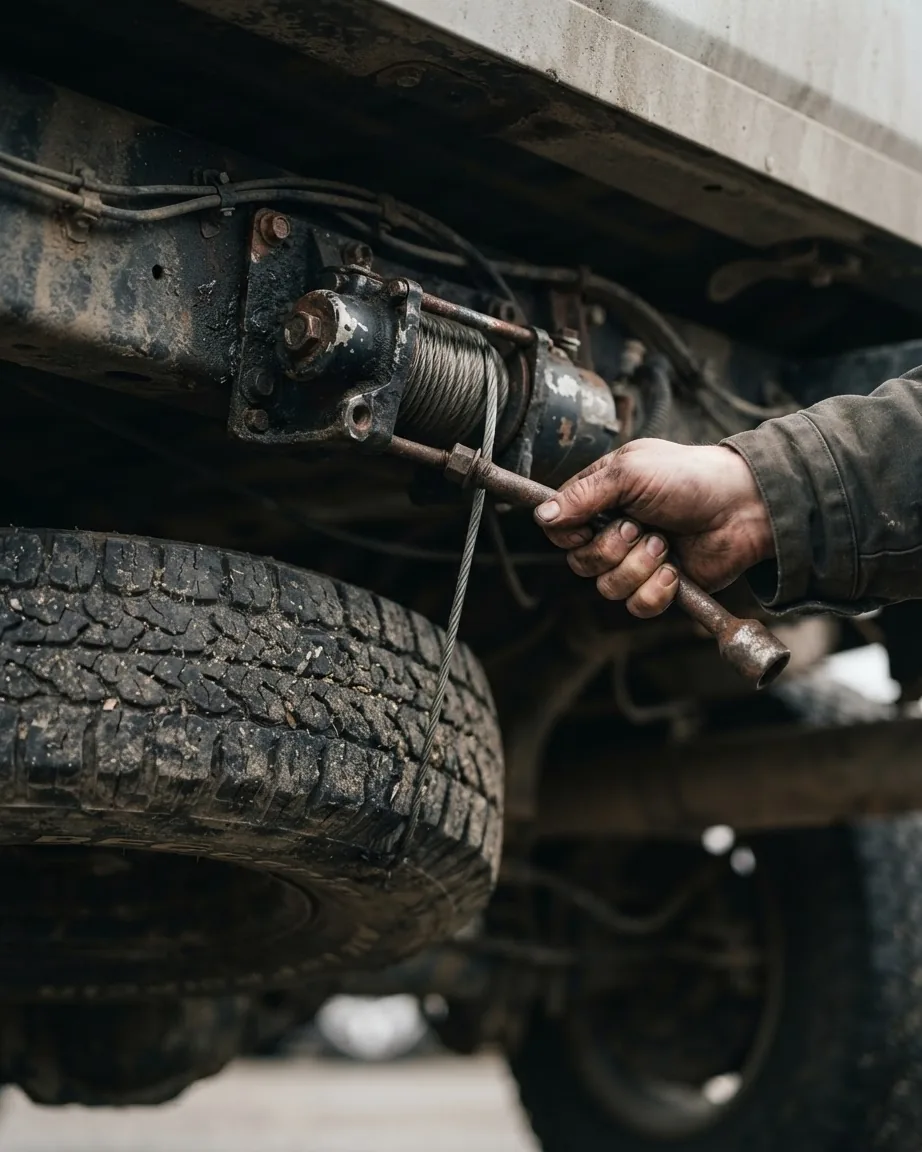
Where the spare lives changes how fast it dies. A tire tucked inside the trunk, shielded from sun and weather, sits at the long end of the range. One hung on the back of an SUV, under a truck bed, or strapped to a camper takes a beating from UV light, heat, and ozone that a trunk never sees. Discount Tire pegs an externally mounted spare at a shorter five to seven years and flags it for frequent inspection, compared with the six to eight years its comparison table lists for a compact or donut spare kept in normal storage.
That same source shows an internal wrinkle worth naming: its prose cites six to nine years for compact spares under normal storage, while its own comparison table says six to eight. The practical takeaway isn’t the exact edge of the range; it’s that an exposed spare loses years, so inspect it more often and replace it sooner.
There’s a second failure mode with mounted and underslung spares that has nothing to do with the rubber itself. Consumer Reports recommends pulling the spare out once a year simply to confirm you can still get to it. Winches seize, cables rust, and fasteners corrode in place. A perfectly good spare you can’t lower is no spare at all.
Driving on a donut: the 50 mph limit and the 50-to-70-mile question
Once a donut is bolted on, the clock and the speedometer both matter. On speed, the sources agree: keep it at or below 50 mph. Discount Tire states a donut should not exceed 50 mph, Meineke puts the limit below 50 mph in its guide to driving on a spare, and United Tires reports the usual 50 mph limit as well. A small, narrow tire builds heat fast; push past 50 and you raise the risk of a blowout.
Distance is where the numbers split, and you deserve the honest version. Discount Tire says don’t drive a compact spare more than 50 miles. Meineke says no more than 50 to 70 miles. United Tires cites the same 50-to-70-mile range in its guide to driving on a donut. So which do you trust? Use the more conservative figure, 50 miles, as your working budget, and treat 70 as an outer edge you’d only approach if nothing closer exists. The real answer lives on your spare, the rim, or in the owner’s manual, which may state a specific limit for your vehicle. Check there first; that number overrides any general range.
Why a spread at all? Because “how far” depends on the vehicle and the spare, which is exactly why no single official distance limit exists. The safe reading is to go as short a distance as you can and head straight for help.
The spare’s PSI: why a donut wants around 60
A spare does not share your regular tires’ pressure, and this trips people up. Many compact spares call for far more air than a standard tire, around 60 psi, per Discount Tire. That’s roughly double a typical passenger-tire figure, so don’t just eyeball it against your other four. The exact number is printed on the spare’s own sidewall; use that.
Pressure also drifts with the weather, and a spare that’s been ignored for a year can be well short. Consumer Reports notes a tire drops about 1 psi for every 10 degrees, so the swing between seasons matters. Its worked example: a car tire reading 30 psi at 80-degree temperatures will show 25 psi once the outside air falls to 30 degrees. A donut that was fine in summer can be noticeably soft by the first cold snap.
NHTSA ties this into a routine: check the pressure of all tires, including your spare, at least once a month, when the tires are “cold,” meaning the car hasn’t been driven for at least three hours. Fold the spare into that monthly check and it won’t surprise you at the roadside.
AWD and the donut: a mismatch that can cost you a transmission
If you drive all-wheel or four-wheel drive, a donut is more than a comfort compromise. A compact spare has a different diameter than your other tires, which means it spins at a different rate. On an AWD driveline, that mismatch forces the differentials and transmission to fight each other. United Tires warns that driving on a mismatched tire can damage your transmission and trigger the AWD failure lamp.
The fix is urgency, not avoidance. If an AWD car comes with a donut, get off it as fast as safely possible, and don’t treat 50 miles as a goal to reach. Where a front-wheel-drive car might tolerate a short limp, an AWD system turns every mile into wear on expensive parts. When in doubt, call for a tow rather than risk the driveline.
Can a full-size spare just become your fourth tire?
A full-size spare is far more forgiving than a donut. It doesn’t carry the 50 mph or 50-to-70-mile ceilings, because it’s essentially a normal tire. That tempts drivers to treat it as a permanent replacement when another tire wears out. Don’t.
NHTSA is explicit: if your vehicle has a full-size spare, don’t use it as a replacement for worn tires except in emergencies such as replacing a flat. Two reasons sit behind that. First, a spare that’s been stored for years won’t match the tread depth of the tires it’s joining, which affects handling. Second, age overrides condition. Meineke notes that a full-size spare more than six years old should be inspected closely, and most manufacturers recommend replacement, used or not, at 10 years. A pristine-looking full-size spare from a decade ago is still a 10-year-old tire.
For the related question of what the spare rides in and how a cover affects aging, see our cover for spare tire guide.
Plugs, patches, and the combo repair: what buys you more than a spare
A spare gets you moving; a proper repair gets you home. If the puncture is small and sits in the tread, a shop can often fix it rather than replace the tire. There are three approaches, and they aren’t equal.
A plug is pushed into the puncture from the outside, often without removing the tire. It’s fast and cheap, but it’s the weakest of the three and should be viewed as temporary rather than a lasting fix. A patch is applied to the inside of the tire after it’s dismounted, sealing the inner liner. The method most tire professionals favor is the combination repair, a patch-plug unit installed from the inside: the plug fills the hole through the tread while the patch seals the liner around it. That combo is the industry-preferred permanent repair for a qualifying tread puncture.
“Qualifying” is the catch worth stating plainly. None of these apply to sidewall damage, and they don’t apply to run-flat tires the way they do to conventional ones. A puncture in the sidewall, a large hole, or any run-flat that’s been driven while deflated belongs in the hands of a professional who can judge whether the tire can be saved at all. For how long a repaired puncture realistically holds, our piece on how long a tire plug lasts goes deeper.
What to do the moment you spot the flat
The single most damaging move is to keep driving on a fully flat tire. Rolling on a deflated tire shreds the sidewall, can ruin the wheel, and leaves you with scrap instead of a repairable tire. If the tire is flat, stop as soon as you can do so safely and change it or call for help rather than nursing the car along.
Once the spare is on, the plan is the same regardless of spare type: drive gently, keep below the spare’s limits, and get to a tire shop as soon as possible. A donut is a tool for reaching help, not a solution. Smooth acceleration, easy braking, and surface streets over highways all reduce the strain while you cover those first miles. Then let a professional inspect the flat, decide between repair and replacement, and put you back on four matched tires. The faster you make that handoff, the less a roadside flat ends up costing you.
Does a spare tire expire if it has never been used?
Yes. Rubber oxidizes from heat, sunlight, ozone, and ordinary air exposure whether the tire rolls or sits, so an unused spare still degrades. That’s why the age check beats the tread check. Find the four-digit build code on the sidewall and count forward; at the 10-year mark, retire it even if it appears flawless.
My donut reads 60 psi but feels soft after winter arrived. Why?
Cold air shrinks, dropping roughly 1 psi for each 10-degree fall in temperature. A donut inflated in warm weather can read several pounds low once the thermometer drops, and because it may sit unchecked for months, the loss compounds. Set it to the pressure stamped on that spare, then confirm it during your monthly cold check.
Can I take the highway on a donut if I stay in the slow lane?
No. The ceiling is the tire’s structure, not the lane. A compact spare is rated to roughly 50 mph, and sustained highway speed heats a small tire quickly, raising blowout risk even at a steady pace. Stick to surface roads where 50 mph or less is natural, and aim for the nearest shop rather than a distant one.
Is a plug ever a permanent repair?
Treat a standalone plug as a stopgap, not a lasting fix. The repair professionals rely on is the internal patch-plug combination, installed after dismounting the tire, which seals both the hole and the inner liner. Even then, it only applies to tread punctures. Sidewall cuts, oversized holes, and driven-flat run-flats need a professional’s judgment, often replacement.
The Forgotten-Donut Pressure Math: What a 50-Degree Swing Costs You
Consumer Reports gives the rule (a tire drops about 1 psi for every 10 degrees) and a worked car-tire example (30 psi at 80°F falls to 25 psi at 30°F). Run that same 50-degree swing against the roughly 60 psi a compact spare actually wants, and the stakes change. The temperature falls 80 − 30 = 50 degrees, which at 1 psi per 10 degrees means a loss of 50 ÷ 10 = 5 psi. A donut topped to 60 psi in summer would therefore read about 60 − 5 = 55 psi by deep winter.
Five psi sounds small, but on a donut it is 5 ÷ 60 ≈ 8.3% of its target pressure gone before you’ve driven a single mile, and that’s only the drift from cold weather, on top of any slow seepage from a tire that’s sat untouched for a year. This is why a spare that felt fine in July can be meaningfully underinflated when you finally need it, and why the monthly cold-pressure check matters more for a donut than for your regular four:
- Swing in CR’s example: 80°F − 30°F = 50 degrees of drop.
- Pressure lost: 50 ÷ 10 = 5 psi at the 1-psi-per-10-degrees rate.
- A 60-psi donut in that swing: 60 − 5 = 55 psi, about 8.3% below target.
Always confirm against the exact number printed on your spare’s own sidewall, and check it cold.