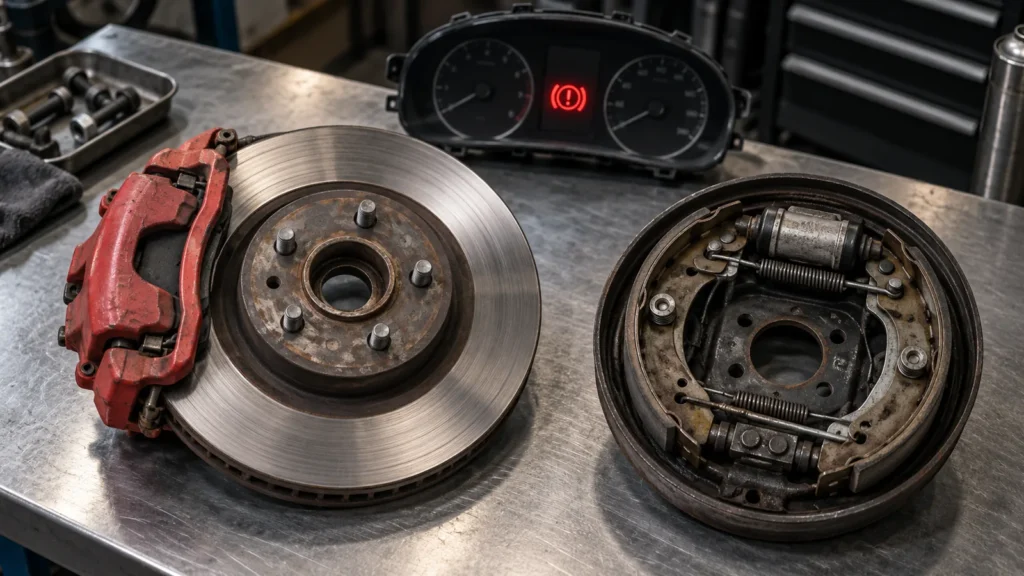
Drafted with AI language models. How this page was made
A red brake light on dashboard runs on a deliberately simple circuit tied to usually just one or two inputs: the brake fluid level sensor and the parking brake switch. So before anything else, confirm the parking brake is fully released. If the red light stays on with the brake off, treat it as a fluid or hydraulic problem, not a nuisance bulb. An amber light with “ABS” is a separate system and a separate decision.
Quick answer: A red “BRAKE” or circle-“!” light means the base braking system needs attention; most often low fluid, an applied parking brake, or worn pads pulling the fluid level down. A soft pedal, a leak, grinding, pulling, or a burning smell with that red light means stop safely and call a mechanic. An amber ABS light means anti-lock is offline but normal braking usually still works; drive gently and get it scanned. Topping off fluid clears the symptom, not the cause. Follow your owner’s manual for the exact icon color.
Understanding the Red BRAKE Telltale and Its Inputs
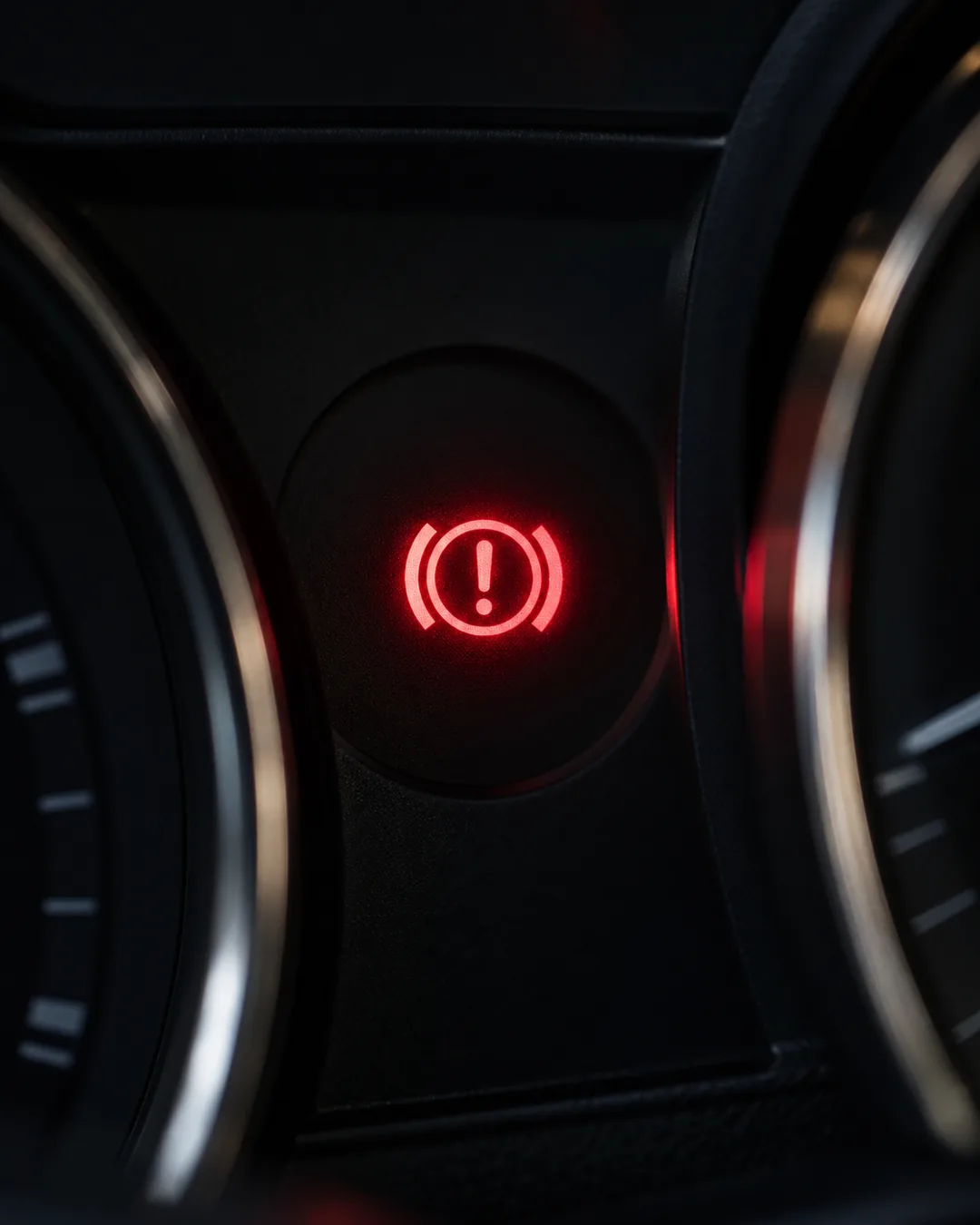
The red brake warning uses a deliberately simple circuit. According to Great Bear Auto Repair, the fluid level sensor and the parking brake switch are typically the only two items wired to it: Great Bear Auto Repair explains that a change in bulb resistance can also false-trigger it. That is why the light flashes during the startup self-test and then clears: the car is proving the bulb works. If it stays lit after you drive off, the system is reporting a real state, not a glitch.
Why Is My Brake Light On Right Now
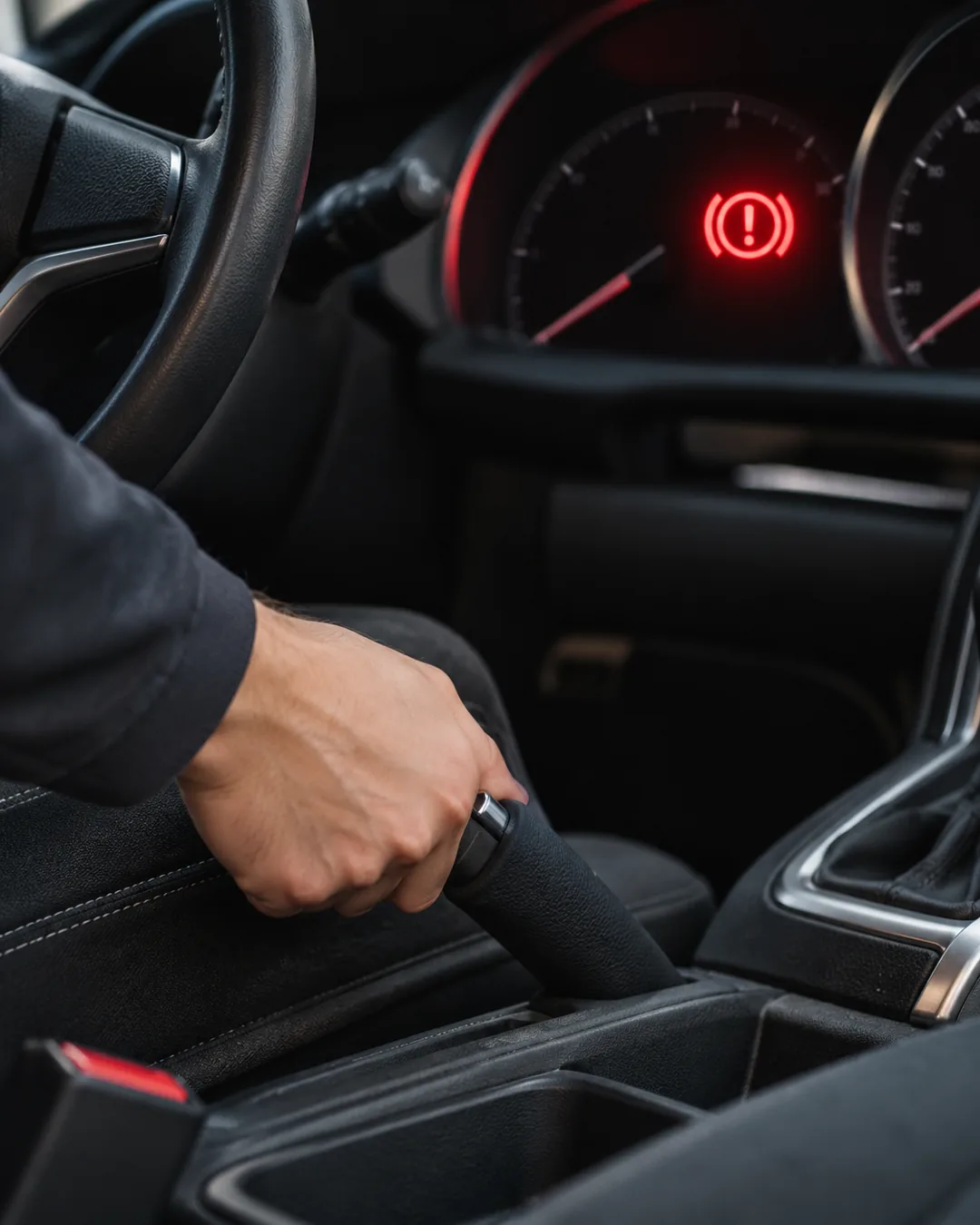
Four triggers account for most cases. Work them in this order:
- Parking brake engaged. Even a half-click on a lever or a stuck electronic actuator keeps the red light on.
- Low fluid. Meineke Car Care lists a dropping reservoir as a top reason the red light appears, often alongside a softer pedal.
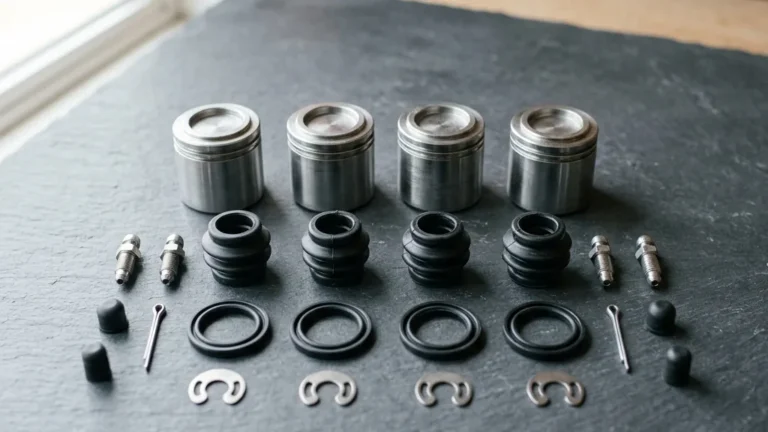
- Worn pads. As pads thin, caliper pistons extend and fluid redistributes, lowering the reservoir level without any leak.
- A leak or hydraulic fault. This is the dangerous one and the reason you never just refill and move on.
Where the Warning Lives and What It Looks Like
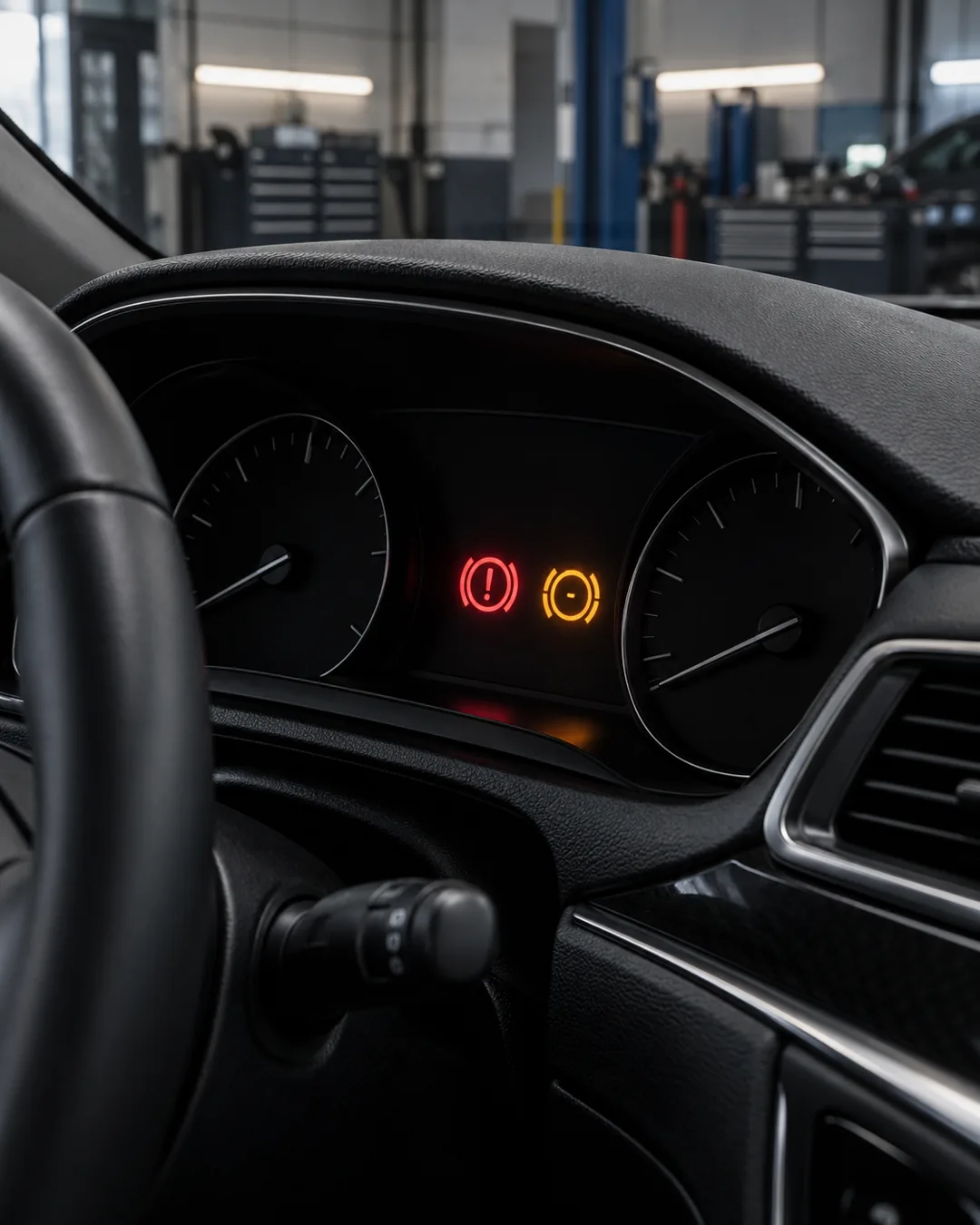
The red brake telltale sits in the instrument cluster, usually as the word “BRAKE” or a circle with an exclamation point inside parentheses. Federal rules shape exactly how that wording appears. Under FMVSS 135, the regulator specifies that “the words shall have letters not less than 3.2 mm (⅛ inch) high and the letters and background shall be of contrasting colors, one of which is red”: language from the National Highway Traffic Safety Administration. The amber ABS telltale is a different, required identifier for anti-lock malfunction on vehicles subject to FMVSS 105 or 135.
Color for a low-fluid warning is not universal. Some makers route low fluid to the red main light; others use a separate amber symbol. PowerStop and Les Schwab Tire Centers treat low fluid as a red-light trigger, while Great Bear describes a distinct amber fluid warning on some cars. The resolution: the icon color for low fluid is manufacturer-dependent, so check your manual rather than assuming red means one thing.
A Lit Brake Telltale Means a Base-System Fault
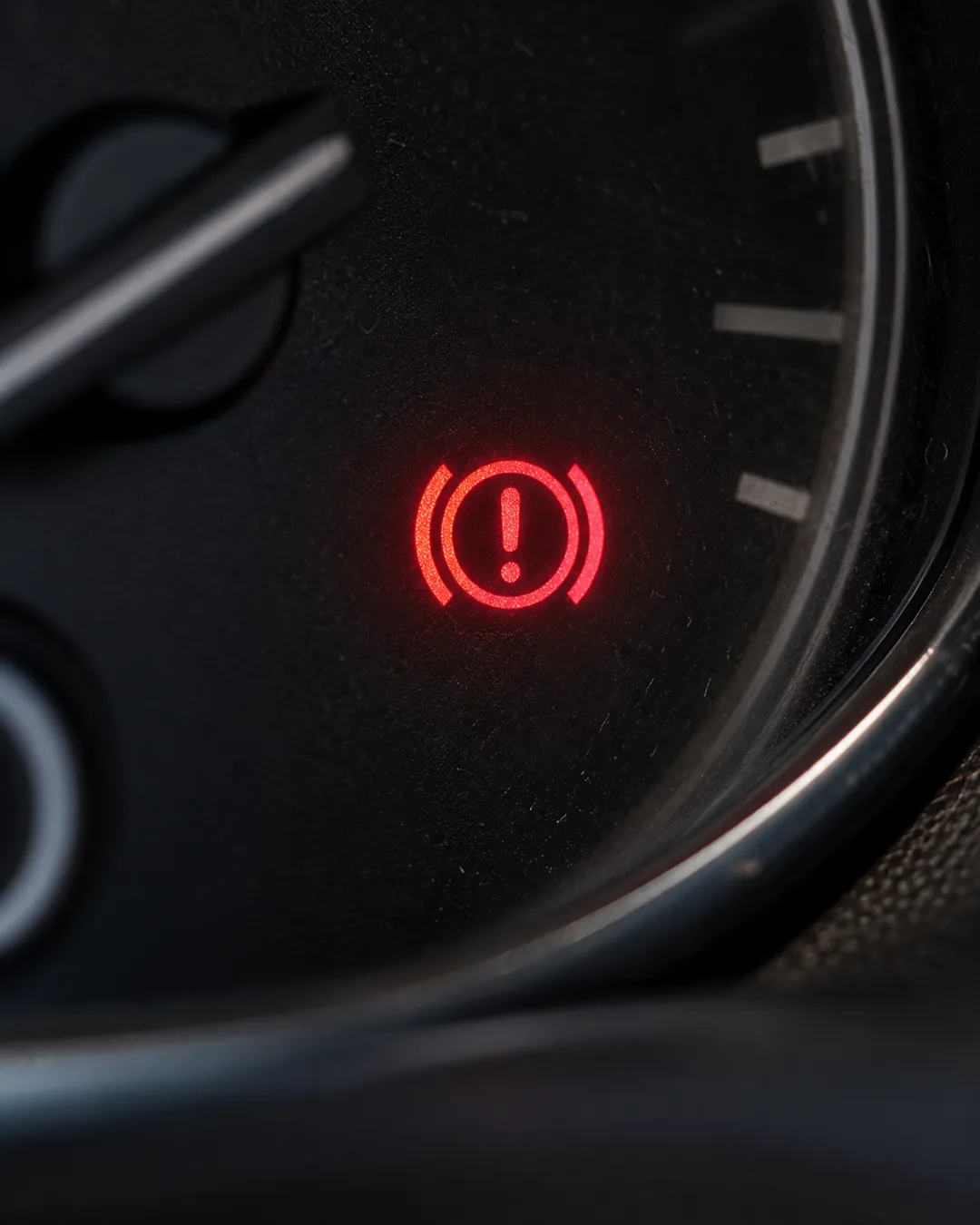
The red light is not a maintenance reminder. NHTSA’s reading of Standard No. 135 requires the telltale to activate under two specified conditions: the parking brake is applied, and the brake system has a fault such as low fluid. One telltale, two jobs. That dual role is why identifying the exact cause matters more than the fact that a light is simply on.
What Can Turn On the Red Brake Warning Light
Here is where topping off fluid becomes a trap. The fluid sensor reports a symptom, not a diagnosis. PowerStop notes the level can fall for a harmless reason (pad wear displacing fluid into the calipers), or a dangerous one, a leak. Refilling resets the reading either way, which is exactly the problem: if a line or caliper is weeping, you have hidden a developing failure.
Low fluid: wear or leak
When pads wear, pistons sit further out and draw fluid from the reservoir; add fresh pads and the level returns. A leak does not return. Because the fluid sensor reports a symptom and not a diagnosis, a level that keeps dropping should be treated as a leak until a shop proves otherwise. Our brake pad wear sensor guide sits in the same corner of the dash.
The fluid chemistry the symptom hides
Brake fluid is hygroscopic: it pulls in water. AMSOIL states DOT 3 can absorb up to 2% water every year. Water lowers the boiling point, and under hard braking the fluid can flash to vapor, which compresses. That is vapor lock: a spongy pedal or outright fade. ADVICS Aftermarket defines the wet boiling point as the temperature at which fluid boils after absorbing 3.7% water by volume. The numbers behind that margin:
| Fluid | Dry boiling point | Wet boiling point |
|---|---|---|
| DOT 3 | 205°C / 401°F | 140°C / 284°F |
| DOT 4 | 230°C / 446°F | 155°C / 311°F |
DOT 4 holds a higher wet boiling point (311°F vs. 284°F), which is why service intervals differ: ADVICS cites roughly two years for DOT 4 and one year for DOT 3, and AMSOIL’s rule of thumb is a change every other year in passenger vehicles. The source values come from AMSOIL’s fluid comparison.
A manufacturer escalation rule
Vehicle-specific guidance makes this concrete. Ford Motor Company, in its owner guidance for the 2026 Mustang Mach-E, treats a low-fluid or brake-system fault as a trip to an authorized dealer, warning that braking performance may significantly decrease and stopping distance may increase. That is the escalation a generic cause list skips.
When Driving Must Stop After the Brake Warning Light Comes On
It depends on which light. Covert CDJR Bee Cave frames an amber ABS-type light as often safe to drive carefully, short term, because the base brakes still work. A red main brake light is the opposite: Great Bear’s position is that a red brake warning means you should not keep driving normally. These are not contradictory: they describe different lights. Red with any of these symptoms means pull over safely and get help: a pedal sinking toward the floor, a visible puddle, grinding, the car pulling to one side, or a burning smell.
Immediate Actions While the Light Is Lit
- Confirm the parking brake is fully released.
- Test the pedal gently at low speed, firm or spongy?
- If the pedal feels soft or drops, ease off the road and stop.
- Check the reservoir level against the min line, but do not rely on a refill to fix it.
- If the red brake light stays on, stop driving normally and arrange an inspection; if the pedal is bad, call for a tow.
A pedal that goes to the floor is never a wait-and-see item. That is a certified-mechanic call, towed if needed. For the wider topic, see our brake system section.
Reading the Amber ABS Warning Light
The ABS light is a separate circuit, usually run by a computer module rather than the simple two-wire brake telltale. Holstein Parts lists low fluid, worn pads, and a set parking brake as BRAKE-light triggers, and separates ABS faults from those, noting that “most ABS codes can be read by OBDII-based diagnostic tools on ’96+ vehicles” via Holstein Parts; older vehicles need a make-specific tool.
Why both lights together is different
ABS alone usually means anti-lock is offline while normal braking continues. ABS and the red BRAKE light together can point to a shared fault, often low fluid affecting both systems: a stop-and-have-it-scanned situation, not a drive-it-all-week one.
Warning signs, the action, and who to see
- Red light plus spongy or sinking pedal: stop safely; certified mechanic or tow. Possible leak or vapor lock.
- Visible fluid puddle under the car: do not drive; tow to a shop. Hydraulic leak.
- Grinding or burning smell with red light: stop and inspect; mechanic. Metal-on-metal or overheated brakes.
- Amber ABS light only, firm pedal: drive gently; shop scan for codes.
- Red and ABS lit together: stop driving normally; mechanic. Shared fault, often fluid.
When the pedal is compromised, this calls for a certified brake inspection at a shop or dealer.
How to Turn Off the Brake Light on the Dashboard
You do not “turn off” the light: you clear the condition it reports. Release the parking brake fully and the light should drop out. If low fluid triggered it and pad wear caused the drop, fresh pads restore the level. The red brake telltale runs on just one or two inputs, so once both read normal and the startup self-test passes, the light goes out on its own. An ABS light stays until the module stops logging a fault, which usually needs a scan. Forcing a light off without fixing the cause hides a safety problem.
How to Reset the Brake Light on the Dashboard
For the red brake telltale, there is no reset button, resolve the input. Fully cycle the parking brake off, then restart; the self-test will reconfirm. If fluid was low, correct the underlying cause and top up with the exact fluid your manual lists. Do not mix silicone DOT 5 with glycol DOT 3 or DOT 4: AMSOIL notes DOT 5 is not compatible with glycol fluids. For an amber ABS light, a reset means clearing stored codes with an OBD-II tool on 1996-and-newer vehicles, and a make-specific tool on older ones: after the fault is fixed.
How Much Boiling-Point Margin Old Brake Fluid Loses
The dry and wet boiling points in the table above aren’t just spec-sheet trivia: the gap between them is the heat protection you lose as the fluid pulls in water over the years. Doing the subtraction shows why a soft pedal under hard braking is a fluid-age problem, not bad luck:
- DOT 4 vs.
So a fully saturated system has already surrendered nearly a third of its boiling resistance before the warning light ever comes on.
Frequently Asked Questions
can brakes cause check engine light to come on
The brake warning runs on a simple one-or-two-input circuit. Brake faults drive the red brake telltale and the amber ABS light, a required malfunction identifier for anti-lock on vehicles subject to FMVSS 105 or 135. If other dashboard lights appear at the same time, treat them as separate faults and have each scanned.
can worn brake pads cause brake light to come on
Yes. As pads thin, caliper pistons extend and pull fluid from the reservoir, which can drop the level enough to trip the red light with no leak present. New pads return the fluid. A level that keeps falling after a top-up points to a leak, not wear, and should be inspected by a shop.
is it safe to drive with brake light on
An amber ABS-only light with a firm pedal is often drivable short term and carefully. A red brake light is not safe to ignore, especially with a soft pedal, a leak, or grinding. Aging fluid compounds the risk: DOT 3 wet boiling point falls to 284°F, inviting fade. When the pedal is bad, tow it.
what does a yellow brake light mean
An amber or yellow symbol usually flags anti-lock, a required malfunction identifier under FMVSS 105 or 135, or on some cars a low-fluid warning kept separate from the red telltale. Because color for low fluid is manufacturer-dependent, match the exact icon to your owner’s manual before assuming anti-lock.
why does my brake light come on in cold weather
A bulb-resistance change can false-trigger the simple brake circuit. If it recurs, have the level and sensor checked rather than ignoring an intermittent warning.