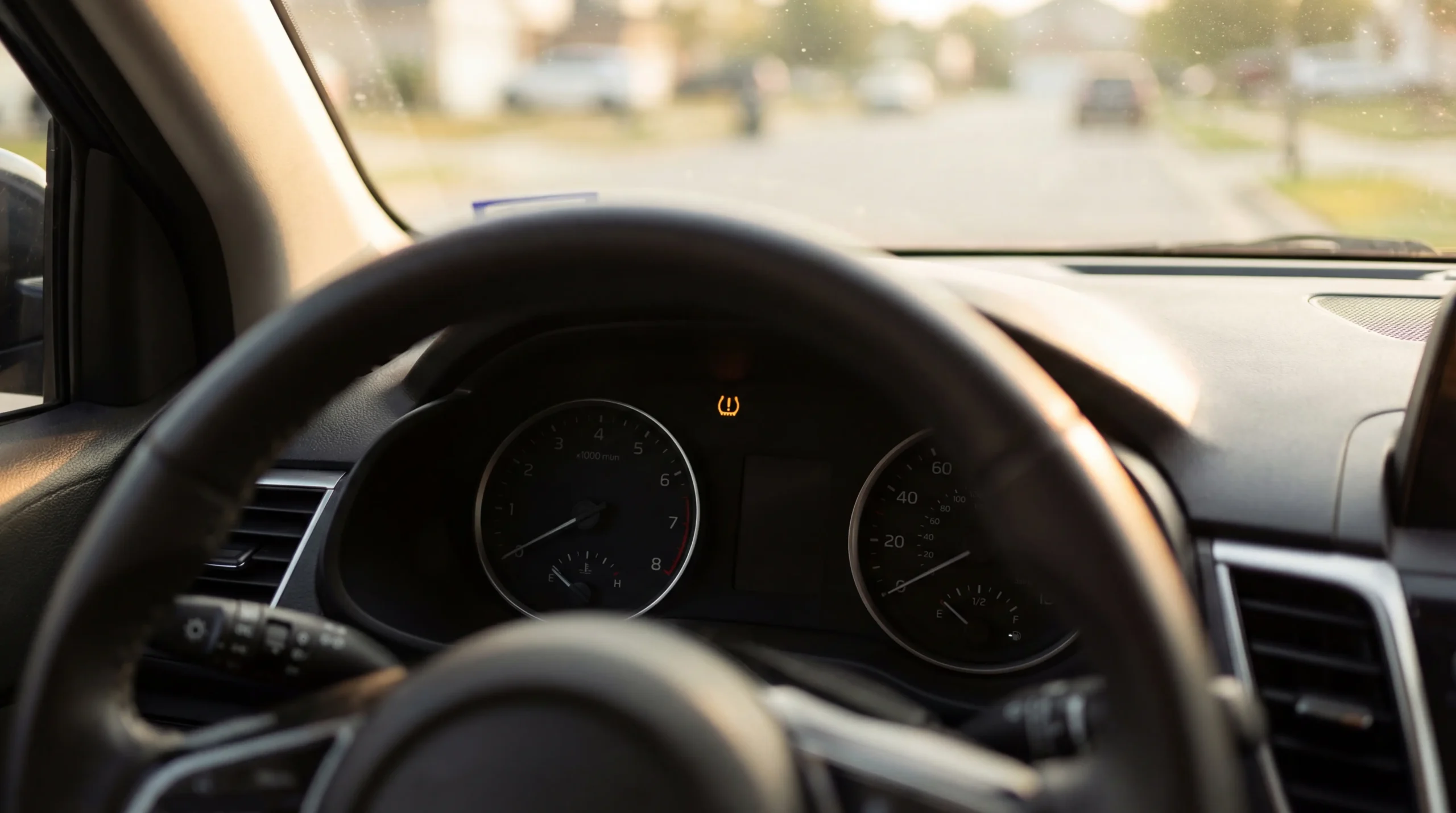

Can we talk about that blinking tire pressure light for a second? I was pulling into my driveway last winter when mine started going off. Not the steady glow I’d seen before. This thing was flashing at me like it had something urgent to say. I did what most people do: got out, walked around the car, and stared at tires that looked completely fine. Turns out, the light wasn’t telling me my tires were low. It was telling me something else entirely.
A blinking tire pressure light typically signals a problem with your TPMS sensors, not your actual tire pressure. If the light blinks for about 60 to 90 seconds when you start your car and then stays solid, one or more sensors aren’t communicating with your vehicle’s computer. Think of it as a startup diagnostic: your car runs a quick sensor roll call, and when one doesn’t answer, the light lets you know. The good news? This is usually fixable without a huge repair bill.
This guide covers what different blinking patterns mean, why your light might flash even when your tires are perfectly inflated, and what you can actually do about it. For the full picture on how your tire monitoring system works, check out the complete service tire monitor system guide.
A quick note before we dive in: The information here reflects my personal experience troubleshooting TPMS issues across several vehicles. It’s not professional mechanical advice. TPMS systems vary by vehicle, and your situation may differ. For safety-critical concerns or if you’re unsure about any diagnosis, consult a qualified automotive technician. When checking tires, always work on level ground in a safe location away from traffic.
What Is TPMS and Why Does It Matter
Your Tire Pressure Monitoring System (TPMS) is a federally mandated safety feature that alerts you when tire pressure drops below safe levels. The TREAD Act of 2007 required all vehicles sold in the US to include this system after studies linked underinflated tires to accidents and blowouts.
There are actually two types of TPMS, and knowing which one you have helps with troubleshooting. Direct TPMS uses physical sensors mounted inside each tire that measure actual air pressure and transmit readings to your car’s computer. Indirect TPMS doesn’t use pressure sensors at all. Instead, it monitors wheel speed through your ABS system and flags a warning when one wheel spins differently than the others (which happens when pressure drops and the tire diameter changes).
Most vehicles on the road today use direct TPMS, and that’s what causes the blinking light issue we’re talking about here. Indirect systems don’t have sensor batteries to die, so their warning patterns work differently.
Blinking vs Solid Tire Pressure Light
Here’s where things get a little tricky (but stick with me). Your TPMS light communicates two very different messages depending on whether it blinks or stays solid. Mix them up and you’ll be solving the wrong problem.
| Light Behavior | What It Means | What to Do | Urgency |
|---|---|---|---|
| Solid light (stays on) | At least one tire has low pressure | Check all tires with a gauge and inflate to door jamb PSI | Medium |
| Blinks 60-90 seconds, then solid | TPMS sensor malfunction or dead battery | Schedule diagnostic; sensor likely needs replacement | Low |
| Blinks on and off randomly | Borderline pressure or weak sensor signal | Top off tires; if it continues, have sensors tested | Low |
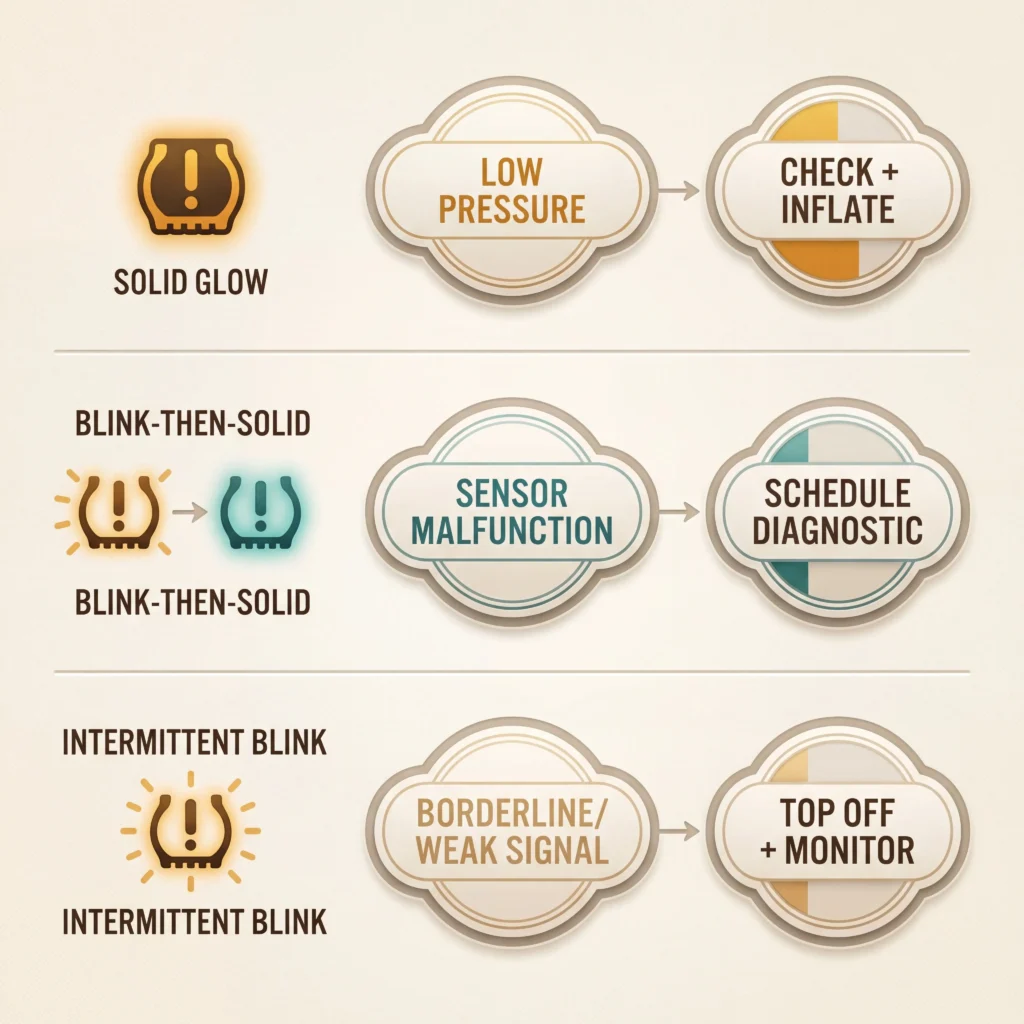
The solid light is your car doing exactly what it should: warning you that pressure dropped below the threshold (usually around 25% under recommended PSI). The blinking light? That’s your car saying “I can’t even check the pressure properly because something’s wrong with the system itself.”
I learned this the hard way when I kept adding air to tires that didn’t need it. The blinking stopped eventually, but only because I got lucky with a temporary connection. It came back two weeks later.
Related: If your light won’t stop flashing constantly, there’s more detail in the TPMS light flashing guide.
Why Does My Tire Pressure Light Blink Then Stay On
This specific pattern (blinks for a minute or so, then goes solid) is the most common complaint I hear about. And honestly, it’s also the most straightforward to diagnose.
When you start your car, the TPMS module runs a quick check on all the sensors. If one doesn’t respond, the light flashes during that check. Once the check finishes and the system logs the failure, the light switches to solid to let you know there’s an ongoing issue.
The usual suspects here are a dead sensor battery (they typically last 5 to 10 years, according to TPMS industry data), a damaged sensor from a pothole or curb hit, or a sensor that got knocked loose during a tire change. I had a sensor die on my car at around the 8-year mark, which apparently is pretty normal based on what I’ve read.
Quick heads up: if you recently had new tires installed or a rotation done, the shop might not have synced the sensors back to your car. That can trigger this exact pattern until the relearn procedure gets done.
Top Causes of a Blinking Tire Pressure Light
So your light is blinking and you want to narrow down why. From what I’ve seen, these are the most common reasons:
Dead TPMS sensor battery. Each sensor has a small lithium battery sealed inside. You can’t replace just the battery (annoying, I know). Once it dies, the whole sensor needs replacing. Most last 7 to 10 years depending on how much you drive and your climate conditions. This is the number one cause of blinking lights on vehicles older than 7 years.
Cold weather pressure swings. Air contracts when it’s cold. Tire pressure drops roughly 1 to 2 PSI for every 10-degree Fahrenheit temperature change (that’s basic physics from the Ideal Gas Law). If your sensors are already borderline weak, that pressure fluctuation can cause intermittent signal issues that make the light blink on and off.
Sensor damage or corrosion. Road salt, debris, and general wear can corrode the valve stem portion of the sensor. I’ve also seen sensors get damaged during tire mounting if the tech isn’t careful with the bead breaker. A bent or corroded valve stem is often visible during a visual inspection.
Aftermarket wheels without proper sensors. If you’ve upgraded your wheels and the new ones don’t have compatible sensors (or any sensors at all), your system will absolutely let you know. Aftermarket sensors can work, but they need to be programmed to match your vehicle.
Radio frequency interference. This one’s random but real. Certain electronics or even driving near specific buildings can temporarily mess with the signal between sensors and receiver. If your light blinks occasionally but not consistently, interference might be the culprit.
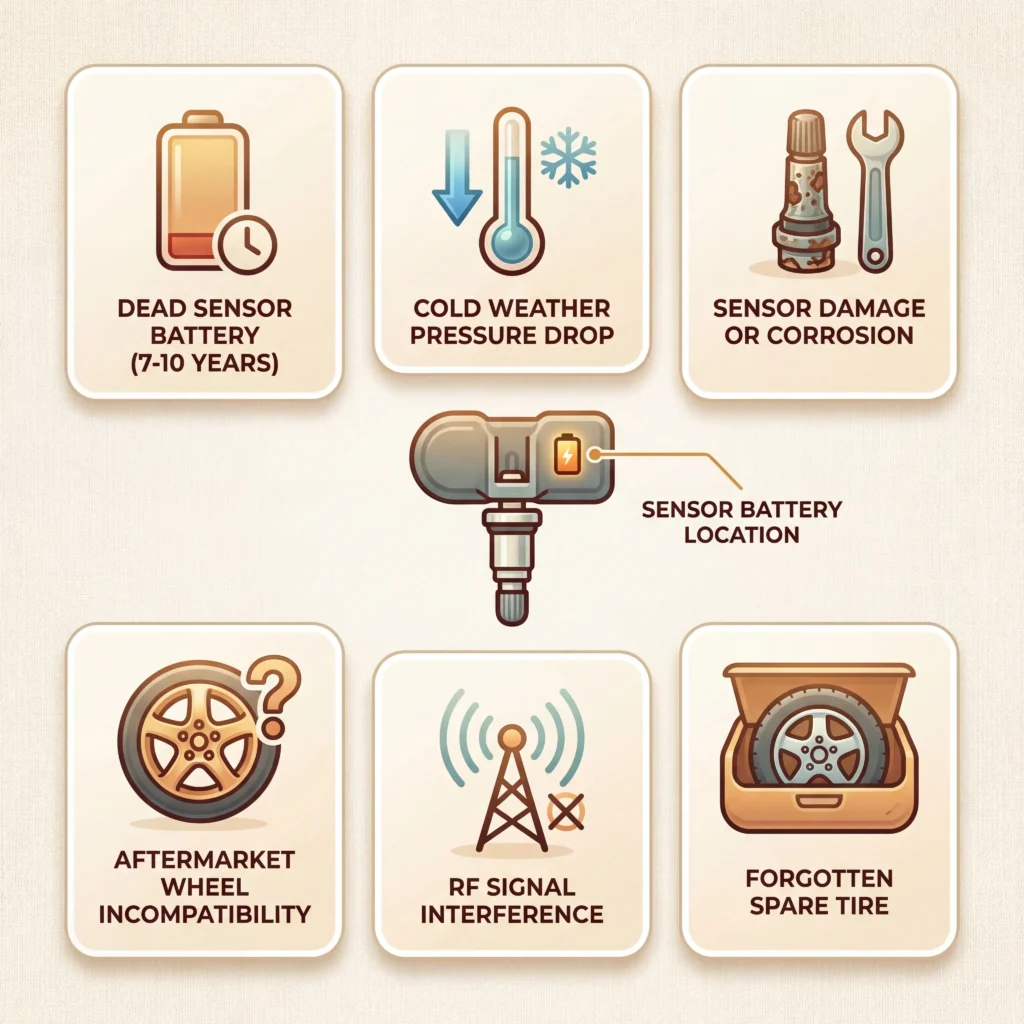
Don’t forget your spare. Many vehicles monitor the spare tire too. If your spare has a sensor and it’s sitting at 20 PSI because nobody’s checked it in years, that can trigger the same blinking pattern as a failed sensor.
Can a Dead TPMS Battery Cause a Blinking Light
Yes, and it’s actually the number one reason for a blinking tire pressure light on vehicles older than 7 years.
Here’s the thing about TPMS sensor batteries: they’re sealed inside the sensor housing, which means when the battery dies, you replace the whole unit. The battery itself isn’t serviceable. A single sensor typically costs between $50 and $150 for the part, plus another $20 to $50 for installation since the tire has to come off the rim. (These are approximate ranges as of early 2026; prices vary by vehicle, location, and whether you choose OEM or aftermarket sensors.)
You can sometimes get a few extra months out of a dying sensor during warmer weather (heat helps battery performance), but once you’re seeing that blinking light consistently, the battery is basically done. I tried to stretch mine for another winter and ended up with zero warning when I actually did get a slow leak. Not worth it.
If you’re handy and already have the tire off for another reason, some shops offer TPMS service packages when you buy new tires that can save you money on labor. Aftermarket sensors can also cut costs by 30 to 50%, but they require programming to match your specific vehicle.
Does Tire Rotation Cause a Blinking TPMS Light
It can, and this catches a lot of people off guard.
When you rotate your tires, the sensors move to different wheel positions. Your car’s TPMS module expects specific sensors at specific locations (front left, front right, etc.). If the system doesn’t know the sensors have moved, it might register a communication error and trigger the blinking light.
Most modern vehicles handle this automatically after you drive for a few miles. The system recognizes the sensors in their new positions and updates itself. But some vehicles (especially older ones or certain brands like some GM and Ford models) need a manual relearn procedure.
The relearn process varies by manufacturer. Some require a special TPMS tool that the shop uses to tell the car where each sensor now lives. Others have a button under the dash you hold until the horn beeps. Toyota vehicles often have a reset button near the steering column. Your owner’s manual has the specific steps for your vehicle.
Garrett’s piece on tire rotation covers how different rotation patterns affect tire wear, which matters because uneven wear can also throw off TPMS readings.
If you just had a rotation and the light started blinking, give it 20 to 30 miles of driving before panicking. Still blinking after that? Call the shop and ask if they did the relearn.
How to Fix a Blinking Tire Pressure Light
Alright, let’s get into what you can actually do about this. Before you start, make sure you’re parked on level ground in a safe location, ideally your driveway or a well-lit parking lot away from traffic.
Step 1: Check your tire pressure first. Even though a blinking light usually means sensor issues, rule out the simple stuff. Grab a pressure gauge (I keep a digital one in my glove box for around $15 to $30) and check all four tires plus the spare. Compare to the PSI listed on your driver’s door jamb sticker, not the number on the tire sidewall. That door jamb number is what your vehicle is designed for.
Step 2: Look for obvious damage. Walk around the car and inspect each tire for nails, screws, cuts, or bulges. Check the valve stems too. If a stem looks corroded, bent, or has visible damage, that sensor might be compromised. This visual check takes two minutes and can save you a diagnostic fee.
Step 3: Try a drive cycle. Sometimes the system just needs a reset. Drive at highway speeds (50+ mph) for 10 to 15 minutes and see if the light resolves itself. This works surprisingly often after a tire change or rotation because it gives the system time to relearn sensor positions.
Step 4: Check for a reset button. Many vehicles have a TPMS reset button, usually under the dash near the steering column or accessible through the infotainment menu. The process varies by brand:
- Toyota/Lexus: Button under dash, hold until light blinks three times
- Honda/Acura: Often through the touchscreen settings menu
- GM/Chevy: May require a TPMS tool or specific button sequence
- Ford: Check owner’s manual for your specific model year
Turn the key to “on” without starting the engine, hold the button until the light blinks three times, then release. Start the car and drive for a few minutes.
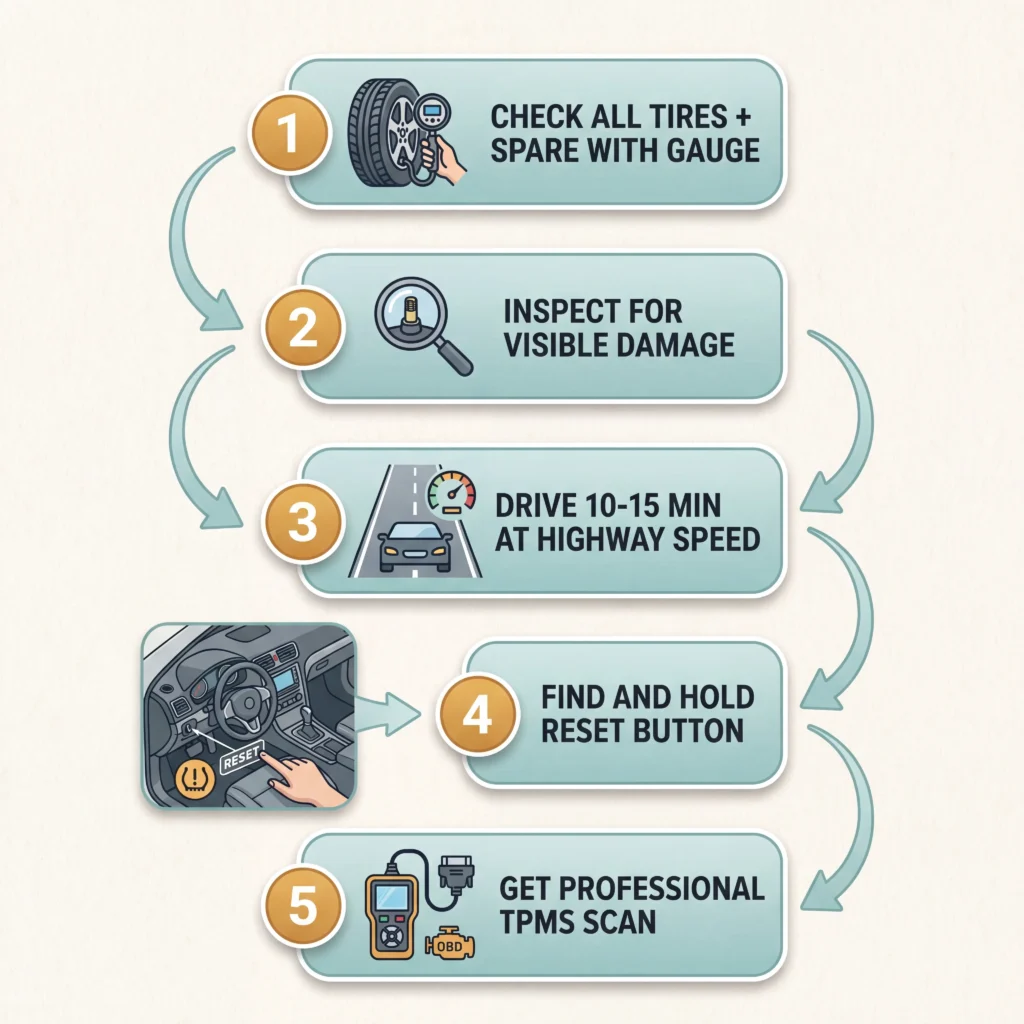
Step 5: If nothing works, get a diagnostic. A shop with a TPMS scan tool (not just an OBD2 code reader) can check each sensor individually and tell you exactly which one isn’t communicating. This takes the guesswork out of it and typically costs $20 to $50. A dedicated TPMS diagnostic tool for home use runs $30 to $100 if you want to do this yourself.
When to see a mechanic immediately: If you notice visible tire damage, hear unusual noises while driving, feel vibration or pulling, or if the light comes on with a sudden pressure drop, get professional help right away. These could indicate a more serious issue than a sensor problem.
For the full reset process with all the different methods, the tire pressure light reset guide has everything broken down by vehicle type.
Frequently Asked Questions
Is it safe to drive with a blinking tire pressure light?
You can drive short distances if your tires look and feel normal. The real risk is that a blinking light means your TPMS isn’t monitoring anything, so you won’t get a warning if you actually develop low pressure or a leak. I drove with mine blinking for about a week before getting it fixed, but I was checking my tires manually every morning with a gauge. Not ideal, but sometimes you can’t get to the shop right away. Just don’t ignore it indefinitely.
Why is my tire pressure light blinking but my tires are fine?
Because the light isn’t actually about your tire pressure when it’s blinking. A blinking light signals a sensor communication problem, not a pressure problem. Your tires can be perfectly inflated and the light will still blink if a sensor battery died, a sensor got damaged, or there’s interference with the signal. I remember being so confused by this the first time it happened to me (I must have checked my pressure five times before figuring it out).
What is the difference between solid and flashing tire pressure light?
A solid light means at least one tire has low pressure and needs air. A flashing light (especially one that blinks for 60 to 90 seconds then goes solid) means the TPMS system itself has a problem and can’t properly monitor your tires. Think of it this way: solid equals “your tires need attention,” flashing equals “your sensors need attention.” The fix for each is completely different.
What is the tire pressure for a Toyota Highlander?
Most Toyota Highlanders call for 36 PSI in both front and rear tires, but this can vary by model year and tire size. The exact number for your specific vehicle is on the sticker inside your driver’s door jamb. Don’t go by what’s printed on the tire sidewall (that’s the maximum, not the recommended). If your Highlander’s TPMS light is blinking, verify you’re at the correct pressure first before assuming it’s a sensor failure.
How much does it cost to fix a blinking tire pressure light?
Depends on the cause. If it just needs a relearn procedure after a rotation, some shops do that for free or under $30. If a sensor needs replacing, expect $50 to $150 per sensor for the part plus $20 to $50 labor per wheel (prices as of early 2026 and vary by location and vehicle). Replacing all four sensors at once usually gets you a package discount and makes sense if your car is over 7 years old since the other sensors are likely near end of life too.
Can I ignore the blinking tire pressure light?
You can, but I wouldn’t recommend it for long. The system exists to warn you about dangerous pressure drops, and a blinking light means that warning system isn’t working. I’ve known people who ignored it and then didn’t notice a slow leak until the tire was nearly flat. If you’re going to put off the repair, at least check your tires manually every few days with a gauge until you can get it fixed.
What to Do Next
A blinking tire pressure light is annoying, but it’s rarely an emergency. The most common fix is a sensor replacement, which is a pretty routine job at any tire shop.
Here’s what I’d suggest based on your situation:
- If you’re comfortable with DIY: Grab a TPMS diagnostic tool ($30 to $100) to identify which sensor is failing before you visit a shop. This saves diagnostic fees and lets you price out the exact sensor you need.
- If you’re short on time: Book a TPMS diagnostic at your local tire shop. They can scan all sensors in 10 minutes and give you a quote.
- If your car is 10+ years old: Budget for replacing all four sensors soon. If one died, the others are likely close behind.
If you’re dealing with a specific dashboard message like “sensor fault,” there’s more targeted help in the tire pressure sensor fault guide.
For everything else about how your tire monitoring system works and when to worry, the main service tire monitor system guide has you covered.
You’ve got this, and your car will thank you for paying attention.
— Corinne Desai
