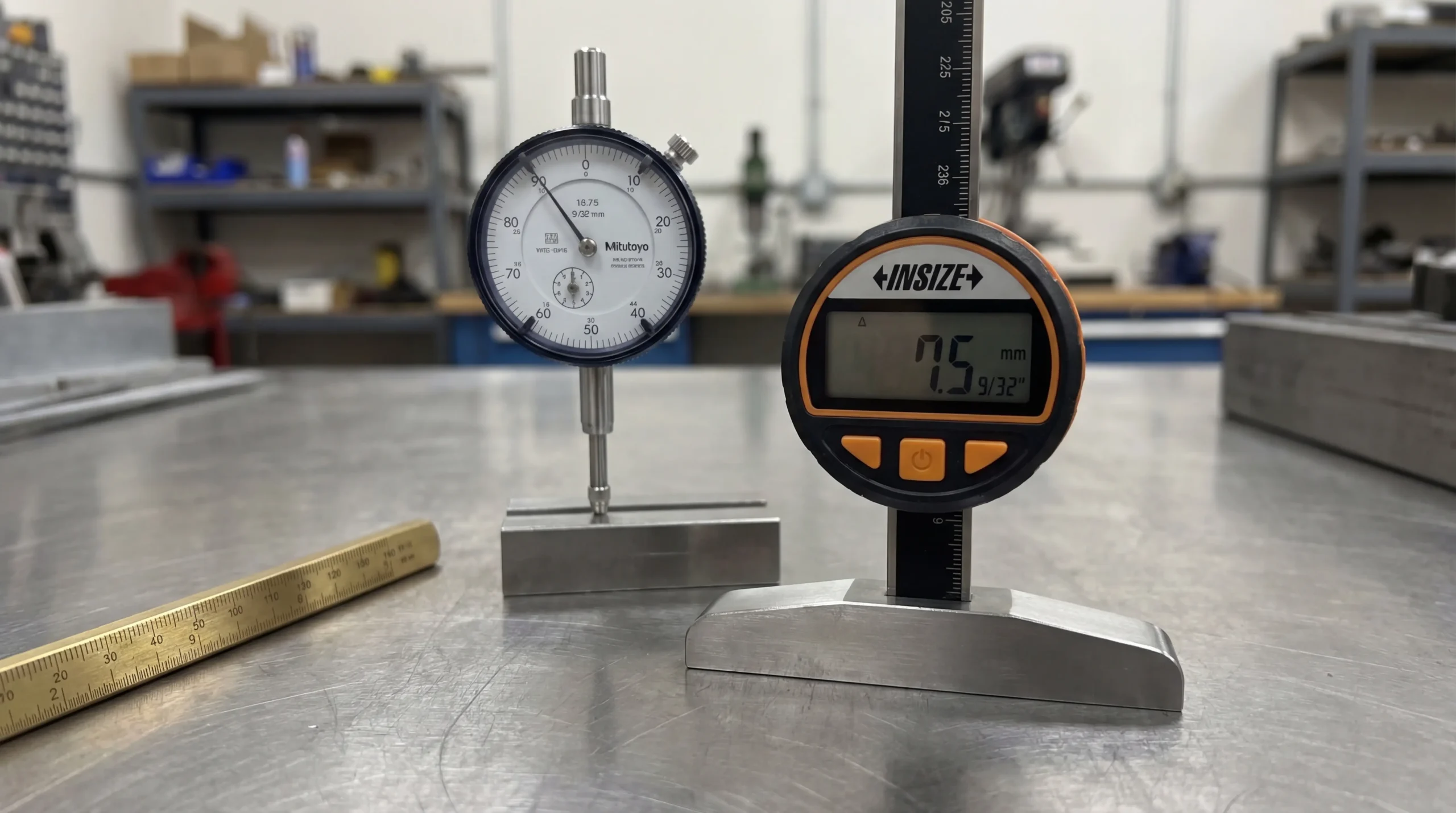

A tire tread gauge measures remaining tread depth in 32nds of an inch. That number tells you whether your tires are safe, borderline, or done. New passenger tires typically start at 10/32″ to 11/32″, though summer performance tires may ship with shallower tread around 8/32″. The federal minimum sits at 2/32″ per NHTSA guidelines. Everything between those two numbers determines how your tires perform in rain, how they grip on turns, and when they need replacing.
After years of shop work, I’ve measured tread on hundreds of tires. The penny test gets mentioned constantly, but it only tells you one thing: whether you’ve hit rock bottom. A proper gauge gives you the full picture. You can track wear over time, spot uneven patterns that signal alignment issues, and plan replacements before you’re stuck on the side of the road.
A note on safety: Tire condition directly affects stopping distance and wet weather handling. The guidance here reflects personal experience and industry standards. For decisions about your specific vehicle or driving conditions, consult your owner’s manual or a qualified tire professional.
This guide covers the three main gauge types, how to use each one correctly, and what those 32nds numbers actually mean. If you’re looking for the bigger picture on tire measurements and what all those sidewall numbers mean, start with our complete guide to tire size measurements explained.
What Is a Tire Tread Gauge
A tire tread gauge is a measuring tool designed for one job: determining how much rubber remains between your tire’s surface and its base. The measurement reads in 32nds of an inch in the US, or millimeters elsewhere. No complexity, no calibration required, no batteries on most models.
The tool works by inserting a probe into the tread groove. The probe touches the bottom of the groove while a reference point sits against the top of the tread block. The difference between those two positions gives you the depth reading.
Why 32nds? The scale exists because tire wear happens in small increments. A tire losing 1/32″ over a few thousand miles looks insignificant on a ruler but represents measurable performance loss. At 4/32″, wet weather braking distance increases noticeably. At 2/32″, you’re at the legal limit and the tire has lost most of its water-channeling ability.
Tread wear bars molded into every tire provide a visual check at the 2/32″ mark. When the tread surface is level with those bars, you’re at minimum depth. But waiting until you can see those bars means you’ve been driving on compromised tires for thousands of miles. A gauge catches the decline earlier.
Types of Tire Tread Gauges: Probe, Dial, and Digital
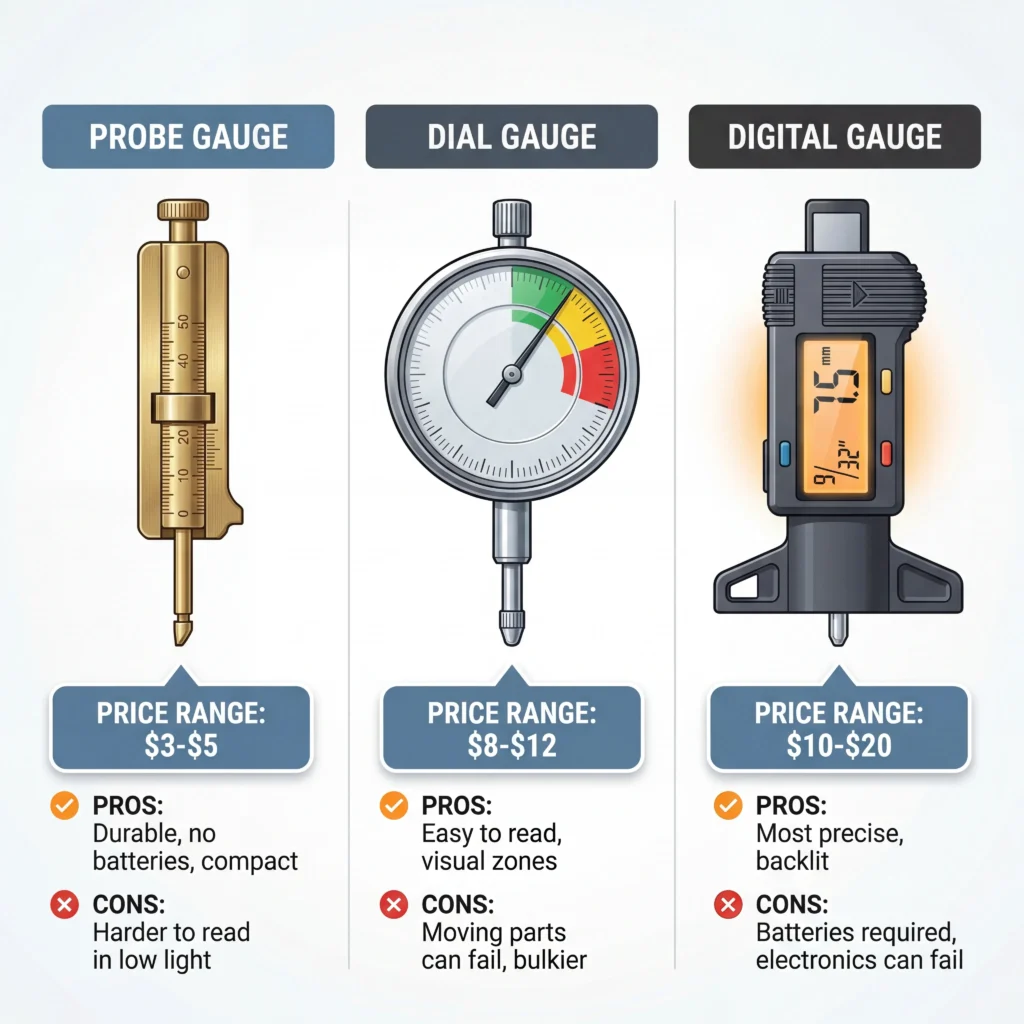
Three gauge types dominate the market. Each measures the same thing. The differences come down to readability, durability, and price. You’ll find all three at any auto parts store or online, typically ranging from $3 to $20.
Probe-Style Gauges (Graduated Stick)
The simplest design. A metal or plastic probe slides through a barrel with depth markings etched on the probe. Push the probe into the groove, read the number where the barrel meets the probe. Done.
Brands like Slime and Milton make reliable versions in this category. The Milton S-448 is a shop standard that costs under $5 and lasts for years.
What works: Cheap, no batteries, fits in a glove box, nearly impossible to break. I’ve had the same brass probe gauge for over a decade.
What doesn’t: Harder to read in low light. The graduated markings can wear off on cheap plastic versions. Requires decent eyesight to catch the exact line.
Dial-Style Gauges
A probe connects to a dial mechanism that displays the measurement on a round face, similar to a pressure gauge. Insert the probe, read the needle position on the dial.
What works: Easier to read than probe gauges. The dial face typically shows color-coded zones (green, yellow, red) for quick assessment. More precise visual feedback.
What doesn’t: Moving parts can fail. Drop it hard enough and the calibration shifts. Costs more than probe gauges. Bulkier for pocket storage.
Digital Gauges
Electronic measurement with LCD display. Press a button, insert the probe, read the number on the screen. Some models switch between inches and millimeters. Godeson makes popular options in this category.
What works: Easiest to read. Precise to hundredths of an inch on better models. Backlit screens work in any lighting, which matters when you’re checking tires in a dim garage or at a roadside stop after dark. For a deeper look at electronic options, see our breakdown of digital tire tread depth gauges.
What doesn’t: Batteries die. Electronics fail. More expensive than mechanical options. Overkill for occasional home use.
Pro Tip from Garrett: For most drivers, a quality probe gauge delivers accurate readings at minimal cost. Professionals checking dozens of tires daily benefit from digital speed and readability. Dial gauges split the difference but add failure points. My recommendation: start with a brass probe gauge and upgrade only if you find yourself measuring frequently enough to justify digital convenience.
How to Use a Tire Tread Gauge Step by Step
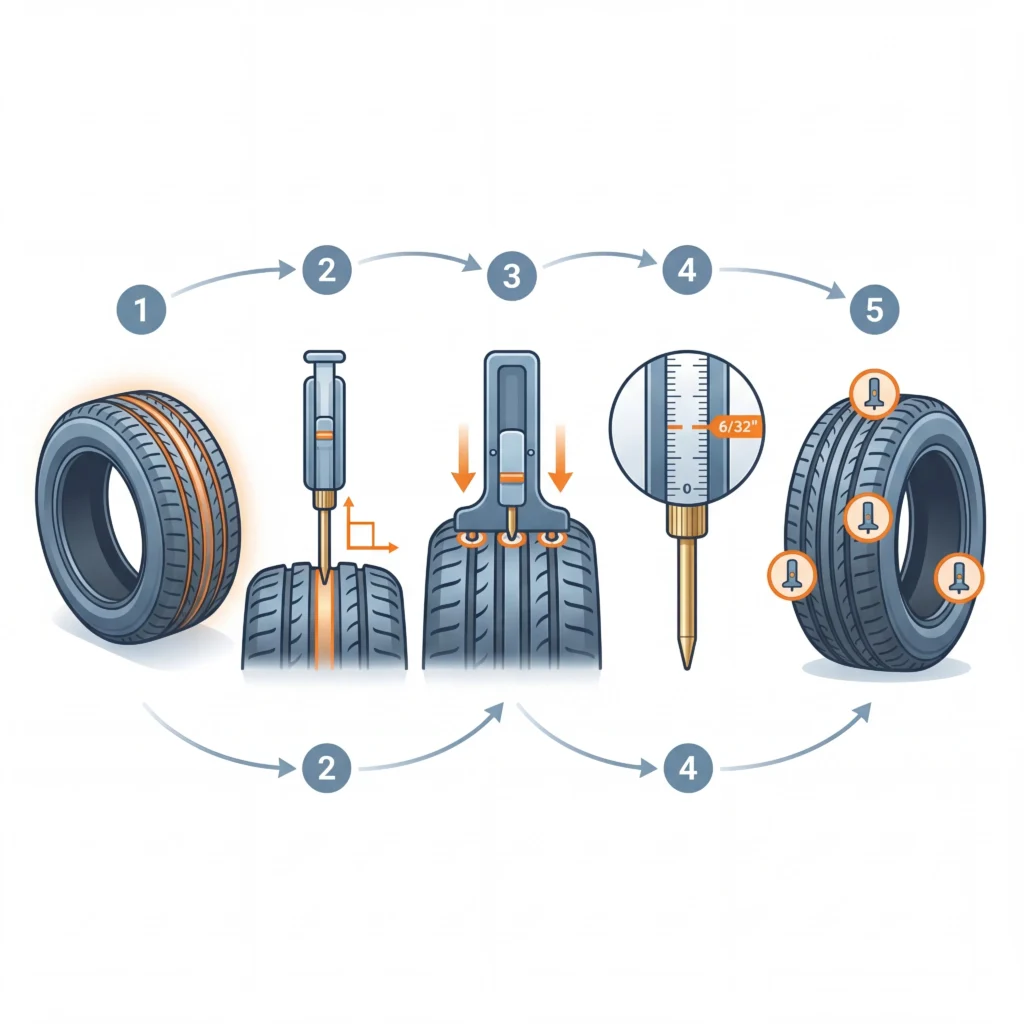
The measurement process takes about thirty seconds per tire once you know what you’re doing. Here’s the sequence:
Step 1: Locate the primary tread grooves. These run circumferentially around the tire. Measure in the deepest grooves, not the smaller lateral channels.
Step 2: Insert the gauge probe straight down into the groove until it contacts the bottom. The probe must sit perpendicular to the tire surface. Angling it gives a false reading.
Step 3: Press the gauge body flat against the top of the tread block. On probe gauges, slide the barrel down until it touches the tread surface. On dial and digital gauges, the reference foot handles this automatically.
Step 4: Read the measurement. For probe gauges, note where the barrel meets the graduated scale. For dial gauges, read the needle. For digital, read the display.
Step 5: Repeat at multiple points. Check the inner groove, center groove, and outer groove. Take readings at a minimum of three spots around the tire’s circumference, spaced roughly 120 degrees apart. Tread rarely wears evenly.
Key Point: The lowest reading matters most. If your center reads 6/32″ but your inner edge reads 3/32″, you have an alignment or inflation problem and a tire approaching replacement. That thin spot determines your safety margin, not the thicker areas.
Uneven wear patterns deserve attention. Inner edge wear often points to negative camber or worn suspension components. Our guide on inside tire wear breaks down the causes and fixes. This is also why regular tire rotation matters: it helps wear stay even across all four tires. Check our rear wheel drive tire rotation guide if you’re running a RWD vehicle.
Common Measurement Mistakes to Avoid
Measuring in the wrong groove: Use the primary circumferential grooves, not the shallow sipes or lateral slots. Those secondary channels are shallower by design.
Angling the probe: Even a 10-degree tilt can add or subtract a full 32nd from your reading. Keep the probe perpendicular.
Checking only one spot: Wear varies around the tire and across the tread face. One measurement tells you nothing about overall condition.
Ignoring the inner edge: The inside of the tire is hardest to see but often wears fastest on misaligned vehicles. Get down and check it.
Tread Depth Numbers and What They Mean
The 32nds system confuses people who expect straightforward fractions. Find your measurement in the left column to see where you stand:
| Depth (32nds) | Depth (inches) | Depth (mm) | Status |
|---|---|---|---|
| 10/32″ – 11/32″ | 0.31″ – 0.34″ | 8-9mm | New tire |
| 8/32″ | 0.25″ | 6.4mm | Light wear |
| 6/32″ | 0.19″ | 4.8mm | Moderate wear, still performing well |
| 5/32″ | 0.16″ | 4mm | Replace soon if you drive in snow |
| 4/32″ | 0.125″ | 3.2mm | Replace soon for wet conditions |
| 3/32″ | 0.09″ | 2.4mm | Borderline, plan replacement now |
| 2/32″ | 0.06″ | 1.6mm | Legal minimum, replace immediately |
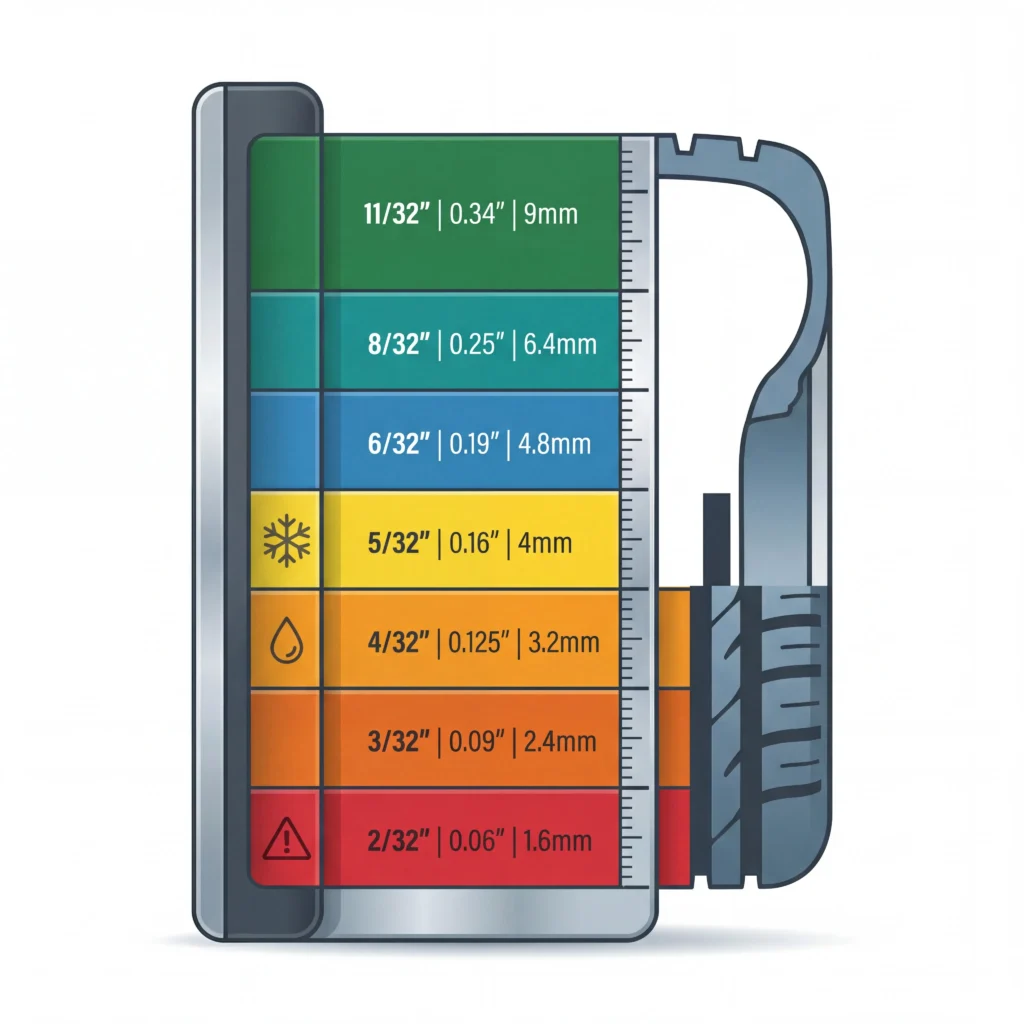
The NHTSA sets 2/32″ as the federal minimum across most US states. That number represents the point where tread can no longer effectively channel water, making hydroplaning likely in rain.
Here’s the part nobody mentions: legal doesn’t mean safe. Stopping distance tests conducted by Tire Rack and other independent testers show meaningful performance degradation starting around 4/32″. Tires at that depth can take 100 feet or more of additional stopping distance from 70 mph on wet pavement compared to new tires. The exact number varies by tire model, vehicle weight, and road surface, but the trend is consistent.
Winter driving demands even more. Snow traction drops significantly below 5/32″. If you drive in states with real winters, treat 5/32″ as your replacement threshold for cold-weather months. Some tire manufacturers specify this in their warranty documentation, so check your tire’s specific recommendations.
The Penny Test vs a Tire Tread Gauge
The penny test uses Lincoln’s head as a reference point. Insert a penny into the groove with Lincoln’s head pointing down. If you can see all of his head, your tread is at or below 2/32″. That’s it.
What the penny test tells you: Whether you’ve reached the absolute minimum legal depth.
What it doesn’t tell you: Anything else. Not 3/32″, not 5/32″, not whether your inner edge wears faster than your outer edge. The penny gives a binary answer: done or not done.
The quarter test offers slightly more information. Using Washington’s head measures roughly 4/32″, which at least catches tires before they hit rock bottom. But it’s still imprecise, and it still can’t tell you about wear patterns across the tire.
This gets repeated wrong across half the internet. People treat the penny test as a complete tire inspection. It’s not. It’s a pass/fail check for rock bottom.
A tread gauge provides actual numbers. Numbers you can track. Numbers that tell you a tire went from 7/32″ to 5/32″ over 15,000 miles, giving you data to project replacement timing. Numbers that reveal one tire wearing twice as fast as its opposite, signaling a problem worth investigating.
Pro Tip from Garrett: Keep a penny in your glove box for emergencies. Use a gauge for real maintenance. A five-dollar tool beats guessing every time.
When Your Tread Depth Says Replace
Replacement decisions depend on your driving conditions, not just a single number. Here’s how I break it down:
The 4/32″ threshold applies if you regularly drive in rain, commute on highways at speed, or carry heavy loads. At this depth, wet braking performance has degraded enough to notice, and you’re one heavy storm away from a problem.
The 5/32″ threshold matters for anyone dealing with snow, ice, or unpredictable weather. Winter traction depends heavily on tread depth and sipe count. If your tires are your only set for year-round use, this is your signal to start shopping.
The 2/32″ threshold is non-negotiable. This is the legal floor. Wet traction is essentially gone. The risk of sudden failure climbs. Replace the tires now, not next month.
Uneven wear changes the calculation entirely. A tire measuring 6/32″ on the outer edge but 3/32″ on the inner edge needs investigation first, then likely replacement. The thin spot determines safety, not the thick spot. And that wear pattern points to an underlying issue (alignment, suspension, inflation) that will chew through your next set just as fast if you don’t address it.
Check the spec. Then check it again. Tread depth measurements tell you where you stand. What you do with that information determines whether you’re maintaining your tires or just hoping they hold up.
Tire Tread Gauge FAQ
Which tire gauge is the most accurate?
Digital gauges with LCD displays typically offer the highest precision, reading to hundredths of an inch on quality models. That said, a basic probe gauge from a reputable brand like Milton or Slime reads accurately enough for any home user. The accuracy difference matters less than consistent technique. I’ve used both for years and the readings match within acceptable tolerance when the probe sits properly in the groove.
Is the penny test for tires accurate?
The penny test accurately identifies tires at or below 2/32″ tread depth. It does that one job well. Where it fails is everything else: you can’t tell the difference between 3/32″ and 6/32″ with a penny. For tracking wear over time or catching uneven patterns, a gauge is the only practical option.
How do you read a tire tread gauge?
Insert the probe fully into the tread groove, keeping it perpendicular to the tire. For probe gauges, read where the barrel meets the scale. For dial gauges, read the needle. For digital, read the screen. The number shows depth in 32nds of an inch. Higher numbers mean more tread remaining.
Is 7/32 tread depth good or bad?
At 7/32″, your tires have plenty of life remaining. New tires start around 10/32″ to 11/32″, so you’ve used roughly a third of the usable tread. You’re nowhere near the 4/32″ threshold where wet performance starts declining. Keep monitoring, but no action needed yet.
How often should I check tire tread depth?
Once a month works for most drivers. Check more frequently if you drive high miles, notice handling changes, or spot any uneven wear patterns. I check whenever I rotate tires or adjust pressure. Takes thirty seconds and catches problems before they become expensive.
The Bottom Line on Tire Tread Depth
A tire tread gauge costing less than a fast food meal tells you more about your tire safety than any visual inspection or coin test ever will. The 2/32″ legal minimum exists for a reason, but waiting until you hit that number means you’ve been driving on compromised tires for thousands of miles. Track your numbers, catch the decline early, and replace before conditions force the decision.
Your next steps:
- If you’re seeing uneven wear across your tread, our guide on inside tire wear covers the causes
- Want to compare electronic gauge options? Check our digital tire tread depth gauge breakdown
- For understanding all the numbers on your tires (not just tread depth), see the complete tire size measurements guide
Know your tread depth, check it monthly, and don’t wait for the penny to tell you it’s too late.
— Garrett Stowe
