By Corinne Desai | Car Care Contributor with hands-on experience in tire pressure and roadside emergencies | Published: March 7, 2026 | 14 min read
Quick Answer: How long can you drive on a spare tire? You can drive up to 50 miles on a donut spare tire at speeds under 50 mph. Full-size spares give you more flexibility, typically 70-100 miles. The exact distance depends on your spare type, your vehicle’s drivetrain, and road conditions. Keep reading for the breakdown that could save you from a costly mistake.
Quick heads up: I’m not a certified mechanic. The information here reflects personal experience and research. Your specific situation may vary, and when in doubt, consult a qualified professional. Repair costs mentioned are estimates that vary significantly by vehicle, location, and current market conditions.
Table of Contents
Introduction
I’ll never forget the time my tire went flat in a grocery store parking lot. I popped open the trunk, stared at that tiny donut spare, and immediately started Googling on my phone. How far could I actually drive on this thing? Could I make it home? What about work tomorrow?
If you’re reading this right now, you’re probably in a similar spot. Maybe you just swapped in your spare and you’re wondering if you can push it a little further than the sticker says. Or maybe you’re planning ahead and want to know what you’re working with before an emergency hits.
Here’s the thing: most guides just throw “50 miles at 50 mph” at you and call it a day. But real life is messier than that. What if the tire shop is 60 miles away? What if you need to commute for a few days before payday? I’ve been in both situations, and I’ve learned there’s more nuance here than people realize.
This guide covers everything I wish someone had told me back then. You’ll learn the actual limits for different spare types, what happens when you push past those limits (ask me how I know), and the specific scenarios where the rules bend a little. I’ve also included a comparison table because honestly, I couldn’t find one anywhere when I needed it most.
Whether you’re dealing with a donut spare tire or a full-size backup, you’ll walk away knowing exactly what’s safe for your situation.
Donut Spare vs Full-Size Spare Tire Limits
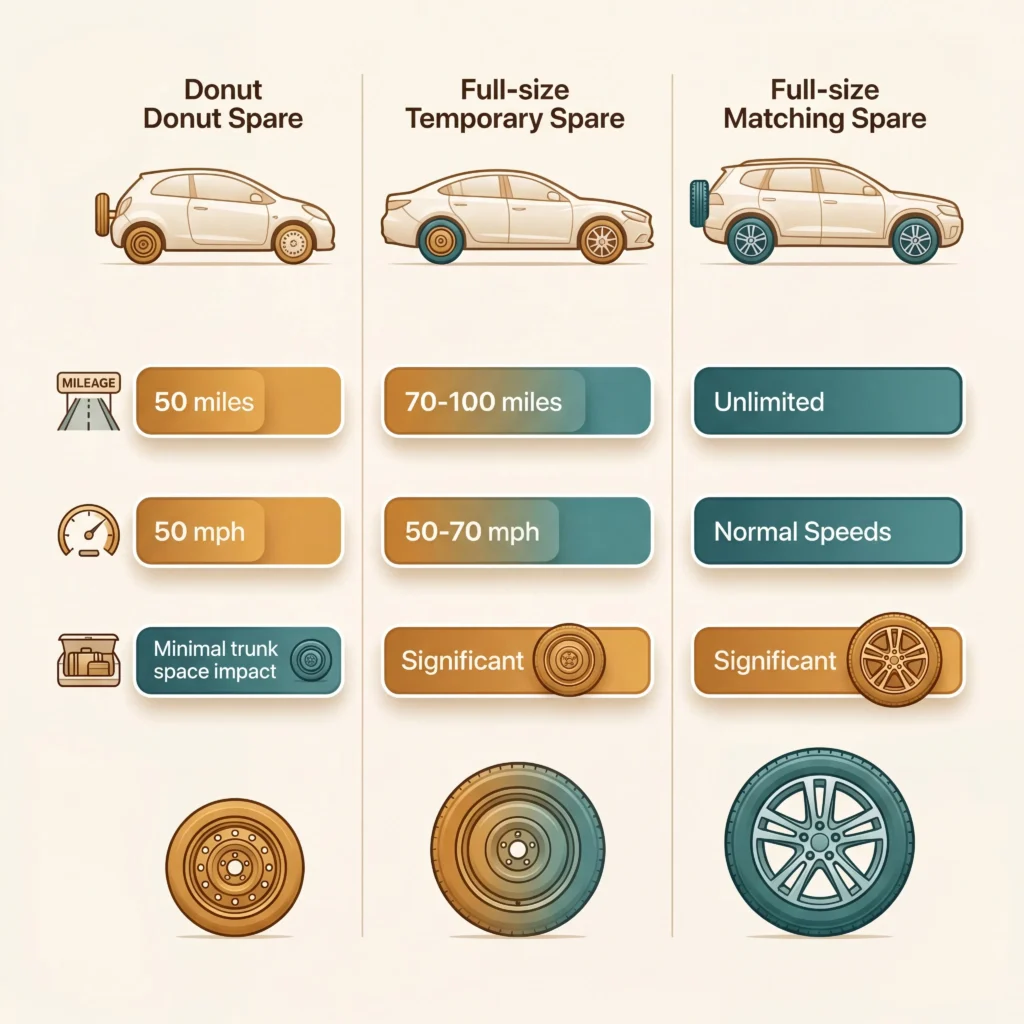
Not all spare tires are created equal. The little donut sitting in most trunks is a completely different animal from a full-size spare, and the rules for each one matter more than you might think.
What Is a Donut Spare?
A donut spare (also called a compact temporary spare or space-saver spare) is that smaller, skinnier tire you’ve probably seen tucked under your trunk floor. It’s designed to save space and weight, not to perform like your regular tires. Most measure around 15-18 inches in diameter compared to your standard 16-20 inch tires.
What is a donut spare tire? A donut spare is a compact, lightweight temporary tire designed for emergency use only. It typically requires 60 PSI (compared to 32-35 PSI for regular tires) and has a thinner tread with less grip than standard tires.
The trade-off for that compact size is reduced traction, handling, and durability. Your car will feel different with a donut on. I noticed it immediately the first time I drove on one: the steering pulled slightly, and braking felt less confident.
Full-Size Spare Tires
Full-size spares match your other tires in dimensions and usually offer better handling. You’ll typically find these on trucks, SUVs, and some larger vehicles. They’re heavier and take up more space, but they give you more flexibility in an emergency.
Some full-size spares are matching spares (identical to your other four tires), while others are non-matching (same size but different brand or model). The matching type can actually go into your regular tire rotation, which is pretty handy.
Vehicles Without Traditional Spares
Quick heads up: some newer vehicles don’t come with any spare at all. Many BMW, Mercedes, and some Hyundai models ship with tire inflation kits or run-flat tires instead of a traditional spare. If that’s your situation, your emergency options look different. Check your trunk before you need it.
If you have run-flat tires, they’re designed to travel about 50 miles at reduced speed after a puncture, but they have their own limitations. Our guide on whether you can patch a run flat tire covers what to expect with that technology.
The 50/50/5 Framework: My Rule of Thumb
The industry talks about the “Rule of 50” but I like to think of it as the 50/50/5 framework: 50 miles maximum, 50 mph maximum, and ideally no more than 5 days on a donut spare. That gives you a simple mental model for emergency planning.
The Comparison You’ve Been Looking For
| Feature | Donut Spare | Full-Size Temporary | Full-Size Matching |
|---|---|---|---|
| Max Distance | 50-70 miles | 70-100 miles | Full tire life |
| Max Speed | 50 mph | 50-70 mph | Normal speeds |
| Typical PSI | 60 PSI | 35-40 PSI | Same as other tires |
| Trunk Space | Minimal | Significant | Significant |
| Can Be Rotated | No | No | Yes |
| Handling Impact | Noticeable | Mild | None |
| Cost to Replace | $50-150 | $100-200 | $150-300+ |
Note: Prices are estimates that vary by brand, retailer, and location.
Garrett’s guide on tire sidewall damage goes deeper into the structural differences if you’re curious about why these limits exist. The short version: donut spares have thinner sidewalls and less rubber, which means they heat up faster and wear out quicker. For more on tire size measurements and how they affect compatibility, check out our complete sizing guide.
Which One Do You Have?
Check your trunk or look under your vehicle (trucks often mount spares underneath). If it’s noticeably smaller than your regular tires, it’s a donut. If it looks the same size, check the sidewall for markings. Temporary spares usually say “TEMPORARY USE ONLY” right on them.
How Far Can You Drive on a Spare Tire
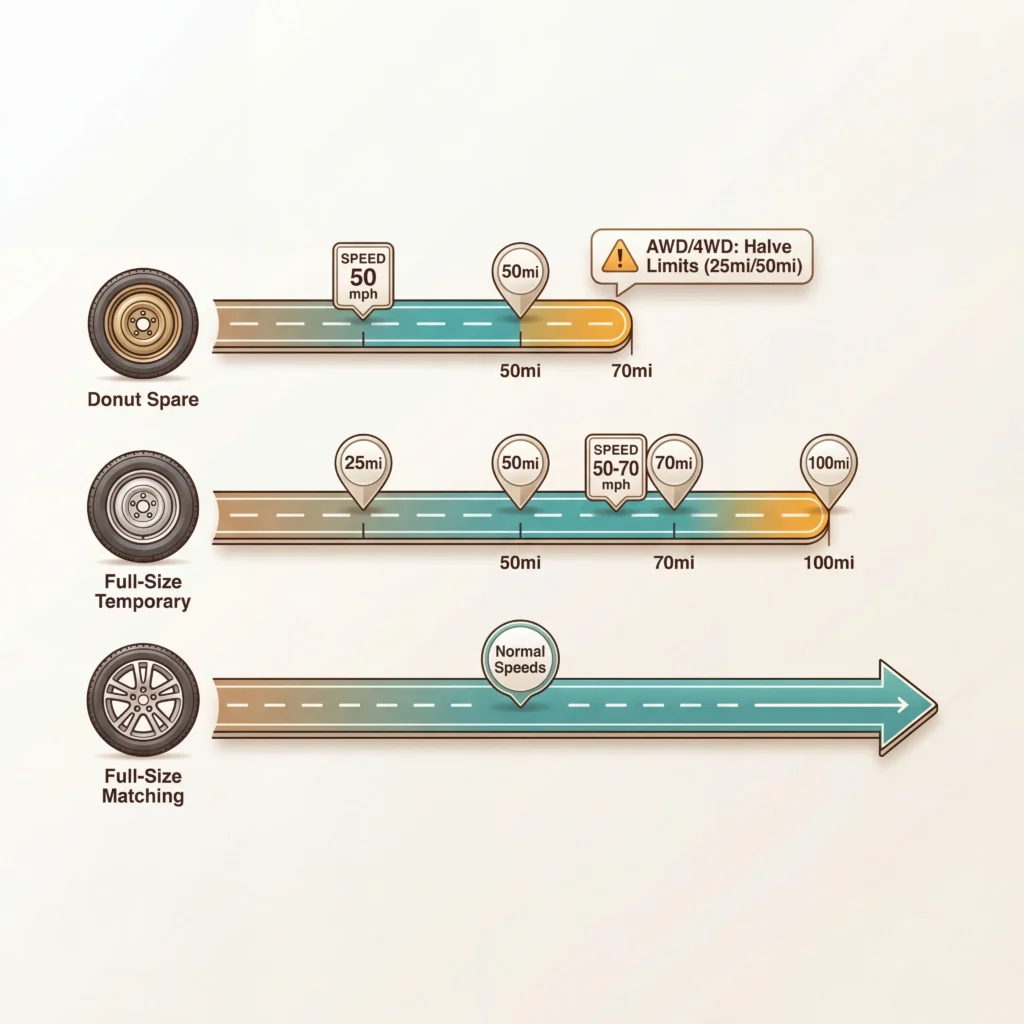
The “Rule of 50” gets repeated everywhere: 50 miles maximum, 50 mph maximum. It’s a solid starting point backed by AAA’s guidance on spare tire safety, but the real answer depends on what you’re working with.
Distance Limits by Spare Type
Donut spares should stay under 50 miles when possible. You can stretch to 70 miles if you absolutely must, but every mile past 50 increases your risk. The rubber compound and thin tread just aren’t built for distance.
Full-size temporary spares give you a bit more room. Most manufacturers say 70-100 miles is acceptable, though you should still get to a tire shop as soon as you can.
Full-size matching spares can technically go indefinitely since they’re regular tires. But if yours has been sitting in the trunk for years, age becomes the limiting factor (more on that later).
What the Numbers Actually Mean
These aren’t arbitrary limits. They’re based on heat buildup, as explained in NHTSA’s tire safety guidelines. Spare tires, especially donuts, heat up faster than regular tires because of their smaller contact patch and different construction. Heat degrades rubber. Enough heat, and you’re looking at a blowout.
I pushed a donut spare about 65 miles once because the nearest shop was across town. Nothing dramatic happened, but I white-knuckled the whole drive. Knowing what I know now, I wouldn’t recommend it.
Real-World Scenarios
Scenario 1: Tire shop is 30 miles away
You’re fine. Stay under 50 mph, avoid the highway if possible, and you’ll make it without drama.
Scenario 2: Tire shop is 80 miles away
This is where it gets tricky. On a donut, you’re taking a risk. Consider calling ahead to see if there’s a closer option, or plan an overnight stop if you can.
Scenario 3: You’re 200 miles from home
Don’t try to make it on a donut. Seriously. Find a local tire shop, buy a used tire if you need to, or call roadside assistance. The potential damage to your vehicle (and yourself) isn’t worth saving a few bucks.
Scenario 4: You’re in a rental car
Spare tire policies vary by rental company. Some include roadside assistance, others charge for tire damage. Check your rental agreement before you hit the road.
For more on speed-related limits, check out the detailed breakdown in how fast can you drive on a spare tire.
Speed Limits for Spare Tires
Speed matters just as much as distance. Maybe more, actually. The heat buildup I mentioned earlier? It gets way worse at higher speeds.
The 50 MPH Rule
Most donut spares are rated for 50 mph maximum. This isn’t a suggestion. The sidewall of your spare probably has this number printed right on it (along with that “TEMPORARY USE ONLY” warning you’ve been ignoring).
At 50 mph, a donut spare can handle the heat generation. At 70 mph? You’re asking for trouble. The tire builds heat faster than it can dissipate, the rubber compound starts breaking down, and suddenly you’re dealing with a second flat.
Can You Go 70 MPH on a Spare Tire?
Real talk though: I’ve seen people do it. I’ve done it myself (briefly, on a full-size spare). But can you go 70 mph safely on a donut? No. The physics just don’t work in your favor.
Full-size temporary spares have a bit more flexibility. Some are rated for 60-70 mph. Check your owner’s manual or the tire sidewall for the specific rating.
Highway Driving on a Spare
If you absolutely have to take the highway, here’s my advice:
- Stay in the right lane
- Keep your hazards on if you’re going significantly below the speed limit
- Take the first exit that has a tire shop
- Watch your temperature gauge (overheating can happen with mismatched tire sizes)
The handling difference on a spare is real, especially on a donut. I felt my steering pull on the highway, and lane changes were noticeably less stable. Give yourself extra following distance and skip any aggressive driving.
Cold Weather Considerations
Cold weather affects spare tires differently than regular driving conditions. Rubber hardens in low temperatures, which reduces grip. PSI also drops in cold weather (roughly 1 PSI for every 10°F drop), so a spare that was properly inflated in summer might be low by winter. If you’re dealing with a flat in freezing conditions, check that pressure before you drive.
Can You Drive on a Spare Tire for Multiple Days?
This is the question nobody wants to ask out loud. Maybe the tire shop can’t fit you in until Thursday. Maybe you’re waiting for payday. I get it.
The Honest Answer
Technically? Yes, you can drive on a spare for multiple days. People do it. I’ve done it (not my proudest moment). But every day you drive on a spare, especially a donut, adds wear and risk.
The issue isn’t just the tire itself. Driving on mismatched tires for extended periods can stress your differential, transmission, and suspension components. This is especially true for AWD and 4WD vehicles (more on that in the next section).
Making It Work (If You Have To)
If you genuinely need to stretch a spare for 3-4 days:
Keep your trips short. Instead of one 50-mile day, can you spread it across multiple 20-mile trips? The tire cools down between drives.
Stick to surface streets. Lower speeds = less heat = longer tire life. The highway is your enemy here.
Check the pressure daily. Spare tires can lose pressure faster than regular tires, especially donuts. Most need 60 PSI to function properly. I keep a digital tire gauge in my glove box for exactly this reason.
Monitor for warning signs. Vibration, pulling, or unusual sounds mean stop immediately. If your tire pressure monitoring system light comes on, take it seriously.
Can You Drive on a Spare Tire for a Week?
Can you drive on a spare for a week? This is where I have to be straight with you: a full week on a donut is pushing your luck. Even with short trips and careful driving, you’re accumulating wear on a tire that wasn’t designed for it.
If finances are the issue (and I’ve been there), call around to tire shops about used tires. Many sell quality used tires for $30-50 mounted. That’s cheaper than the transmission repair you might face otherwise.
What Happens If You Drive Too Long on a Spare
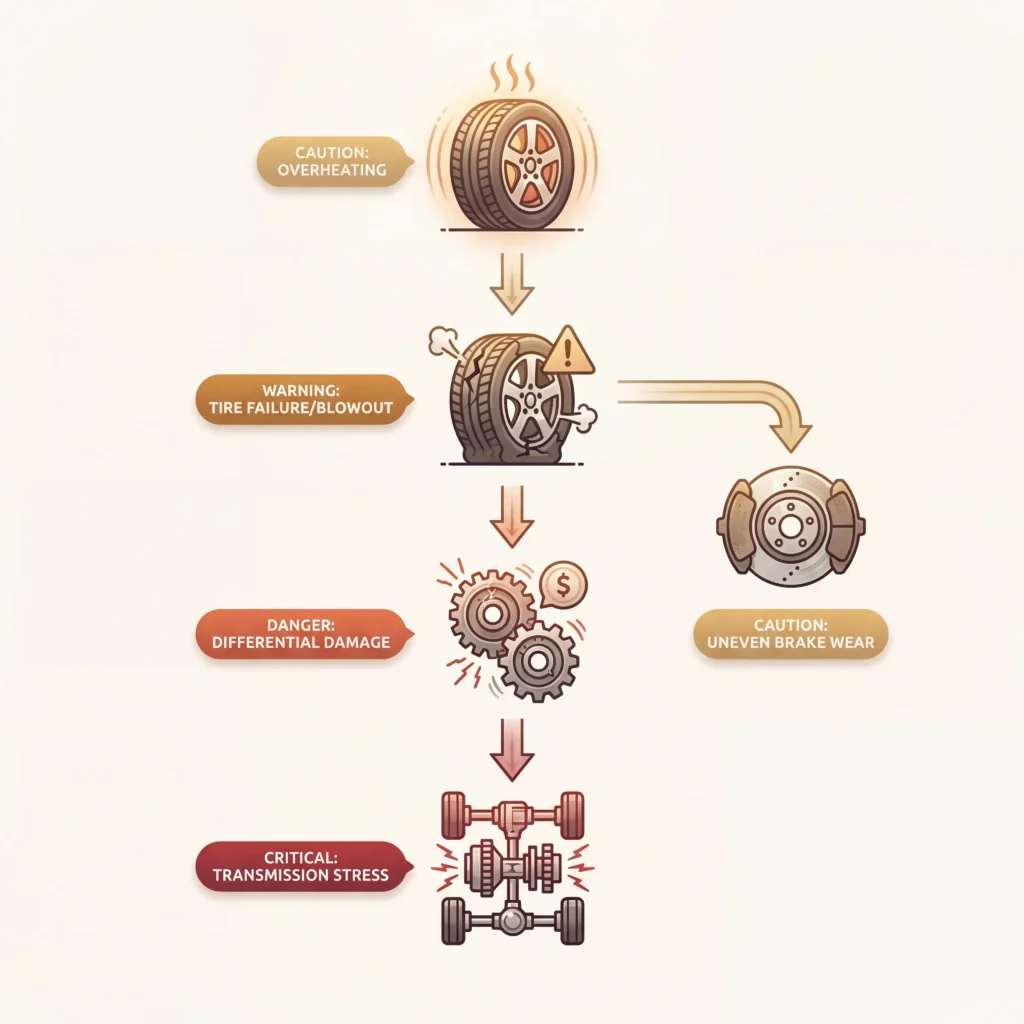
So what actually goes wrong when you ignore the limits? I learned this the hard way, and the repair bill made me wish I’d just bought a used tire.
Tire Failure
The most obvious risk: the spare fails. Blowouts aren’t just inconvenient. They’re dangerous. A spare tire blowout at highway speed can cause you to lose control, especially since you’re already working with compromised handling.
Signs your spare is giving up:
- Visible bulging on the sidewall
- Cracks in the rubber
- Vibration that wasn’t there before
- Pulling that’s getting worse
If you spot any of these, get off the road. Don’t drive another mile.
Differential Damage (The Expensive One)
This one surprised me. Driving on mismatched tire sizes makes your differential work overtime to compensate for the difference in rotation speed. Over time (or quickly, on some vehicles), this causes excessive wear or outright failure.
Differential repairs can be expensive. I’ve heard of repair bills ranging from under a thousand to several thousand dollars depending on the vehicle and extent of damage. Compare that to a $50 used tire and the math is pretty clear.
Transmission Stress
Similar story here. Your transmission expects all four wheels to rotate at similar speeds. A donut spare throws that off, creating stress on components that weren’t designed for it. AWD vehicles are particularly vulnerable.
Uneven Brake Wear
Your brakes are calibrated for matching tire sizes. A smaller spare changes the dynamic, potentially causing uneven pad wear or reduced braking effectiveness. After my extended donut adventure, I noticed my brake pads needed replacement way sooner than expected. You can learn more in our guide on how to check brake pads.
Warranty Implications
Here’s something most people don’t consider: driving on a spare beyond manufacturer recommendations may affect certain warranties. Some drivetrain warranties specifically exclude damage caused by improper tire use. Check your owner’s manual for specifics.
For more on the aftermath of flat tire situations, can I drive on a flat tire covers what happens when you skip the spare entirely.
AWD and 4WD Considerations
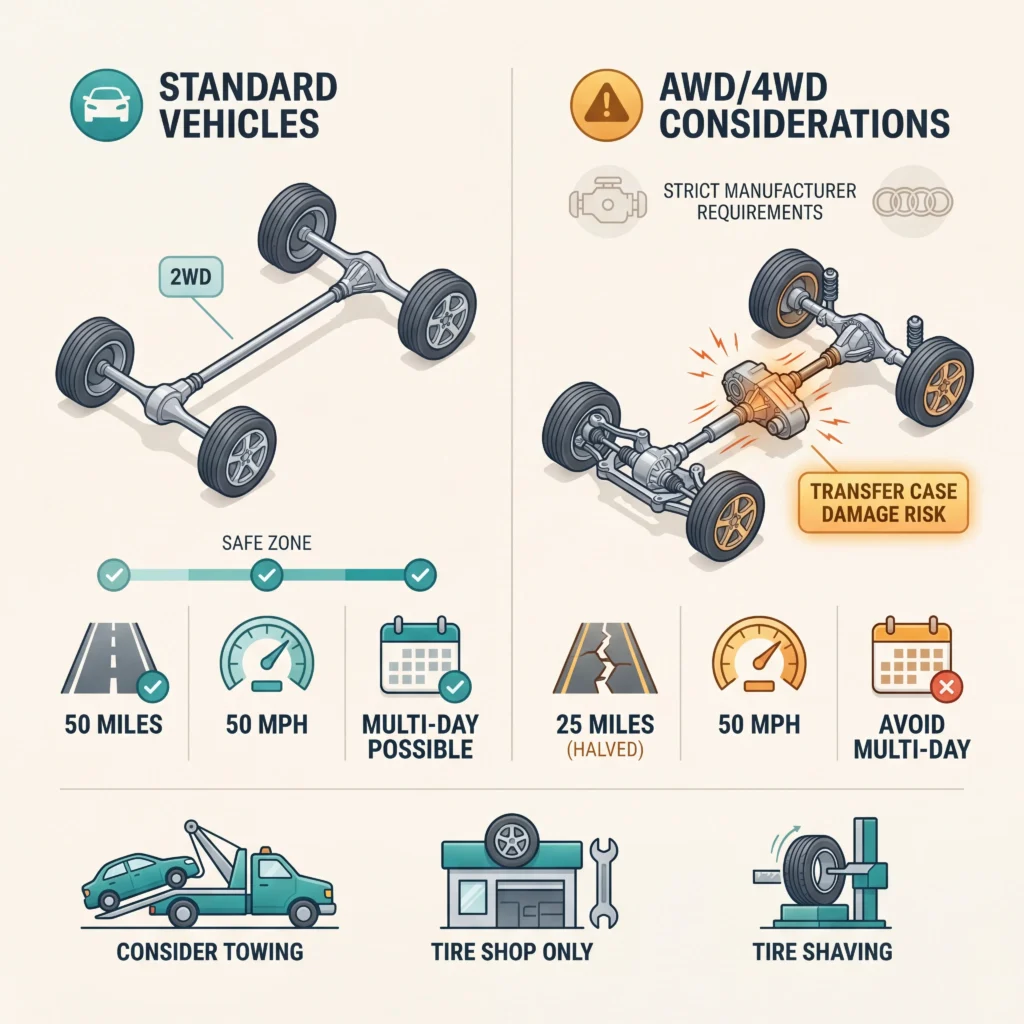
Here’s where it gets serious. If you drive an all-wheel drive or four-wheel drive vehicle, everything I’ve said so far needs an asterisk.
Why AWD Vehicles Are Different
AWD systems distribute power to all four wheels through a transfer case and differentials. These components expect all four tires to be the same size and rotate at the same speed. When you throw a mismatched spare into the mix, the system goes into overdrive trying to compensate.
What is a transfer case? The transfer case is a component that distributes engine power to all four wheels in AWD and 4WD vehicles. It relies on matching tire sizes to function properly and can be damaged by extended use of mismatched spares.
Some AWD vehicles are so sensitive to tire size differences that manufacturers recommend replacing all four tires if one gets damaged beyond repair. Subaru is particularly known for this, recommending all four tires match within 2/32″ of tread depth. Audi has similar guidelines for their quattro systems.
The Reduced Limits
For AWD and 4WD vehicles, cut every limit I’ve mentioned in half:
- 50 miles becomes 25 miles
- 50 mph stays at 50 mph (or lower if possible)
- Multiple days? Avoid entirely if you can
The cost of an AWD transfer case replacement can exceed $2,000 on some vehicles. That context makes a $30 used tire look like a bargain.
Your AWD Emergency Options
If you’re in an AWD vehicle with a flat:
- Use the spare only to get to a tire shop. Not home, not work. The tire shop.
- Consider towing. Some AAA memberships cover this. It might be worth the call.
- Ask about tire shaving. Some shops can shave a new tire down to match your existing tread depth, which is safer for AWD systems than running mismatched wear.
How to Properly Install a Spare Tire
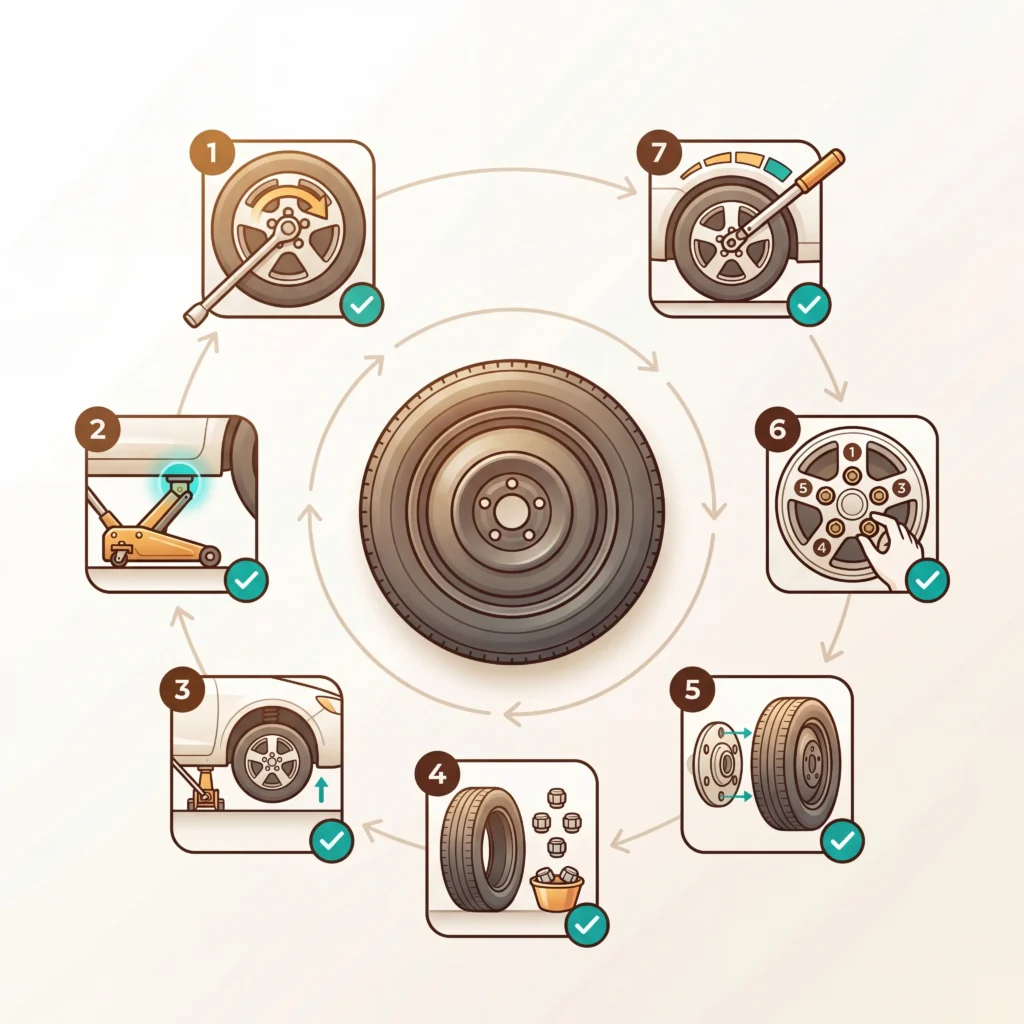
Getting the spare on correctly matters more than you might think. A poorly installed spare can come loose, damage your brake components, or fail prematurely.
Before You Start
Park on a flat, stable surface away from traffic. Turn on your hazards. Engage your parking brake. If you have them, set out reflective triangles or flares.
This is also a good time to check whether your spare has air. I once went through the whole process of jacking up my car only to discover my spare was basically flat. Now I check spare tire PSI every few months as part of my routine.
The Installation Steps
- Loosen the lug nuts before jacking. Just break them loose (about a quarter turn). Don’t remove them yet.
- Position the jack correctly. Check your owner’s manual for jack points. Wrong placement can damage your vehicle or cause the jack to slip.
- Raise the vehicle until the flat tire clears the ground. Just enough clearance. You don’t need it way up in the air.
- Remove the lug nuts and the flat tire. Keep the lug nuts somewhere you won’t lose them (your pocket, a cup holder, etc.).
- Mount the spare tire. Line up the holes, push it onto the bolts.
- Hand-tighten the lug nuts in a star pattern. This ensures even seating. Don’t use the wrench yet.
- Lower the vehicle and final-torque the lug nuts. Star pattern again. Get them snug, but don’t go crazy. Over-torquing can damage studs.
- Check your work. Give the tire a shake. It shouldn’t move.
Don’t skip this step: trust me. Double-check everything before you drive away. A loose spare is worse than a flat.
While you’re down there, it’s worth doing a quick brake inspection during tire change. You have a clear view of your brake pads and rotors, so take advantage of it.
After Installation
Check the pressure immediately if you have a gauge. Donut spares need significantly higher pressure than regular tires (usually 60 PSI). Driving on an underinflated spare defeats the entire purpose.
Also, don’t forget your flat tire and tools. I’ve seen people leave their expensive hydraulic jack on the shoulder. Not ideal.
When to Replace Your Spare Tire
Your spare tire ages even if you never use it. Rubber degrades over time, and a spare that’s been sitting in your trunk for 10 years might not be safe even though it looks fine.
The Age Factor
Tire manufacturers generally recommend replacing tires (including spares) after 6-10 years regardless of tread depth or appearance. The rubber compound breaks down due to heat, oxidation, and environmental factors. The NHTSA provides guidance on tire aging that’s worth reviewing.
The range depends on storage conditions: spares in hot climates (like trunk storage in Arizona) degrade faster than those in moderate climates with climate-controlled garages.
Check your spare’s age by looking at the DOT code on the sidewall. The last four digits indicate the week and year of manufacture. For example: 2519 means week 25 of 2019.
Signs Your Spare Needs Replacement
Even before the age limit, watch for:
- Cracks in the sidewall or tread. Any visible cracking means the rubber is degrading.
- Dry rot. The tire looks faded, brittle, or has small cracks throughout.
- Flat spots. If it’s been sitting on one spot for years, it might have deformed.
- Persistent pressure loss. If it won’t hold air, it’s done.
For a deeper look at spare tire longevity, how long does a spare tire last covers the full breakdown.
Storage Matters
How you store your spare affects its lifespan. Trunks get hot in summer, which accelerates rubber breakdown. Spares mounted underneath vehicles face road debris, moisture, and UV exposure.
If you’re serious about protecting your spare (especially on RVs or trailers), a cover for spare tire on camper can extend its life significantly.
Replacement Options
When it’s time for a new spare:
- OEM replacement from your dealer (most expensive but guaranteed fit)
- Aftermarket compact spare kits (check compatibility carefully)
- Used spare from a junkyard (cheap, but verify age and condition)
Some people upgrade from a donut to a full-size spare if they have the trunk space. It’s worth considering if you do a lot of highway driving or live far from tire shops.
Explore Spare Tire Topics In-Depth
I’ve covered a lot of ground here, but spare tires and flat tire emergencies are a bigger topic than one guide can handle. I’ve written detailed guides on each of these related topics if you want to go deeper (and honestly, some of these surprised me when I first researched them).
Flat Tire Emergencies
- Can I Drive on a Flat Tire – What happens if you try to skip the spare entirely? Spoiler: bad things.
- How Fast Can You Drive on a Spare Tire – The speed limits broken down by tire type, with the physics explained.
Spare Tire Types and Equipment
- Donut Spare Tire – Everything about compact spares, from sizing to limitations.
- Spare Tire Mount – Options for trucks, SUVs, and anyone who wants their spare accessible.
- Spare Tire PSI – The pressure guide I wish I’d found before my spare went flat.
- Cover for Spare Tire on Camper – Protecting your RV spare from UV damage and the elements.
Tire Repair Options
- Tire Plugs – When a plug can save your tire and when it can’t.
- How Long Does a Tire Plug Last – The lifespan question that surprised me.
- Tire Plug Patch – The combo repair that tire shops actually recommend.
- Can You Patch a Run Flat Tire – Short answer: it depends, and not always how you’d expect.
Maintenance and Longevity
- How Long Does a Spare Tire Last – Age matters more than mileage for spares sitting in your trunk.
What I’ve Learned About Spare Tires
After years of dealing with flat tires (mine and friends’), here’s what I wish someone had told me at the beginning: the rules exist for good reasons, but they’re not one-size-fits-all.
I’ve pushed the limits more times than I’d like to admit. Sometimes it worked out fine. Other times, I ended up with a repair bill that made me cringe. The pattern I’ve noticed? The people who respect the limits and plan ahead almost never end up stranded or facing expensive repairs.
The biggest lesson: checking your spare before you need it is worth its weight in gold. Ten seconds with a tire gauge every few months beats 45 minutes on the shoulder of a highway wondering if your spare is too flat to use.
If nothing else, remember this: a spare tire is a bridge, not a destination. It exists to get you from “problem” to “solution,” not to replace your regular tires. Treat it that way and it’ll do its job when you need it most.
— Corinne Desai
FAQ
How long can you drive on a donut spare tire?
Most donut spares are designed for 50 miles maximum, though you can stretch to 70 miles in an emergency. The limiting factor is heat buildup. Donut spares have thinner rubber and smaller contact patches, which means they heat up faster than regular tires. Exceeding 70 miles significantly increases your risk of a blowout or damage to your vehicle’s differential. The AAA recommends sticking to these limits whenever possible.
Can I drive on a spare tire for a week?
You can, but it’s not ideal. Every day on a spare (especially a donut) adds wear and stress to your vehicle’s drivetrain. If you absolutely need to stretch it for a week, keep trips short, stick to surface streets, check the pressure daily, and watch for warning signs like vibration or pulling. Consider buying a cheap used tire if finances are tight. A $40 tire beats a potential transmission repair.
Can I drive 200 miles on a spare tire?
On a donut spare, 200 miles is firmly in the danger zone. You’re almost guaranteed to overheat the tire and risk a blowout. On a full-size spare, 200 miles is less risky but still not recommended. I’d suggest finding a closer tire shop, buying a used tire at your destination, or splitting the trip with an overnight stop if you have no other options.
Can I go 70 mph on a spare tire?
Not on a donut. The 50 mph limit exists because higher speeds generate more heat than the tire can handle. Some full-size temporary spares are rated for 60-70 mph (check your sidewall), but even then, I’d stay closer to 55-60 to be safe. The handling difference on a spare makes highway speeds feel sketchy anyway.
What happens if I drive too far on a spare tire?
Several things can go wrong: the spare can fail (blowout), your differential can sustain damage from the size mismatch, your transmission can face stress, and your brakes may wear unevenly. The expensive consequence is differential or transmission damage, which can cost significantly more than a replacement tire. That’s way more than a replacement tire costs.
Do I need to replace all four tires if I have AWD?
Some AWD manufacturers (Subaru and Audi in particular) recommend this because mismatched tread depths can damage the transfer case and differentials. Subaru specifically recommends all four tires match within 2/32″ of tread depth. Check your owner’s manual for your specific vehicle. An alternative is tire shaving, where a shop shaves a new tire down to match your existing tread depth. Not all shops offer this, but it’s worth asking.
How do I know if my spare tire is still good?
Check three things: the DOT date code (last four digits tell you week and year of manufacture), the physical condition (look for cracks, dry rot, or bulging), and the pressure (should hold air without constant refilling). Most experts recommend replacing spares after 6-10 years regardless of appearance, with the shorter end for hot climate storage.
Your Next Steps
You’ve got the knowledge now. Here’s what to do with it:
Right now: Go check your spare tire. Pop open the trunk or crawl under your vehicle. Is it there? Does it have air? When was it made? I’ve talked to too many people who discovered their spare was flat during an actual emergency.
This week: Grab a tire pressure gauge if you don’t have one. They’re under $20 and they’ll save you from the panic of wondering whether your spare is usable.
This month: Consider whether your spare setup matches your driving needs. If you’re frequently on highways far from tire shops, a full-size spare might be worth the trunk space trade-off.
When you need it: Stick to the limits. 50 miles and 50 mph for donuts. Get to a tire shop as soon as possible. Your car (and your wallet) will thank you.
If you’re dealing with a flat right now, start with can I drive on a flat tire to understand your immediate options. And if your spare needs air, spare tire PSI has the exact pressure you need.
When in doubt, get it checked. Peace of mind is worth the trip.
You’ve got this. And your car will thank you.
— Corinne Desai
About the Author
Corinne Desai — Car Care Contributor
Corinne Desai writes about tire pressure monitoring, spare tires, and check engine lights for BrakeTireGuide. Her interest in car maintenance started after a frustrating experience at a tire shop, where she realized how little she knew about her own vehicle. That gap in knowledge sent her down a path of self-education that has lasted several years and covered more dashboard warning lights than she can count.
Corinne’s writing focuses on making car topics approachable for people who didn’t grow up around garages. She explains things the way she wishes someone had explained them to her when she was starting out: without the jargon or the judgment. When she’s not writing about TPMS sensors or spare tire pressure, she’s probably checking her own tire pressure in the driveway or convincing a friend to finally look at their check engine light.
Disclaimer: The information in this guide is based on personal experience and research. I’m not a certified mechanic, and your specific situation may vary. Repair costs mentioned are estimates that vary significantly by vehicle, location, and market conditions. When in doubt, consult a qualified professional. Safety always comes first.