


How to reset tire pressure light when it won’t turn off? If you’ve filled all four tires and that little warning is still glowing at you from the dashboard, you’re not alone. I get it. The first time this happened to me, I sat in a gas station parking lot for twenty minutes convinced something was seriously wrong with my car.
Here’s the quick answer: your tire pressure light usually needs a manual reset after you inflate your tires. The system doesn’t always update on its own. You can reset it by holding the TPMS reset button for a few seconds, driving at highway speed for about ten minutes, or using the deflate-reinflate method. Most cars, the reset button works.
Quick heads up: These reset methods are based on what’s worked on my vehicles over the years. Your car might be a little different, so check your owner’s manual if you’re not sure. And if any of this feels uncomfortable or the problem keeps coming back, there’s no shame in having a mechanic take a look.
I’m going to save you the headache I went through. This guide covers all four reset methods, which one to try first based on your situation, and what to do if none of them work. If you’re seeing other tire pressure warnings too, check out our complete service tire monitor system guide for the bigger picture.
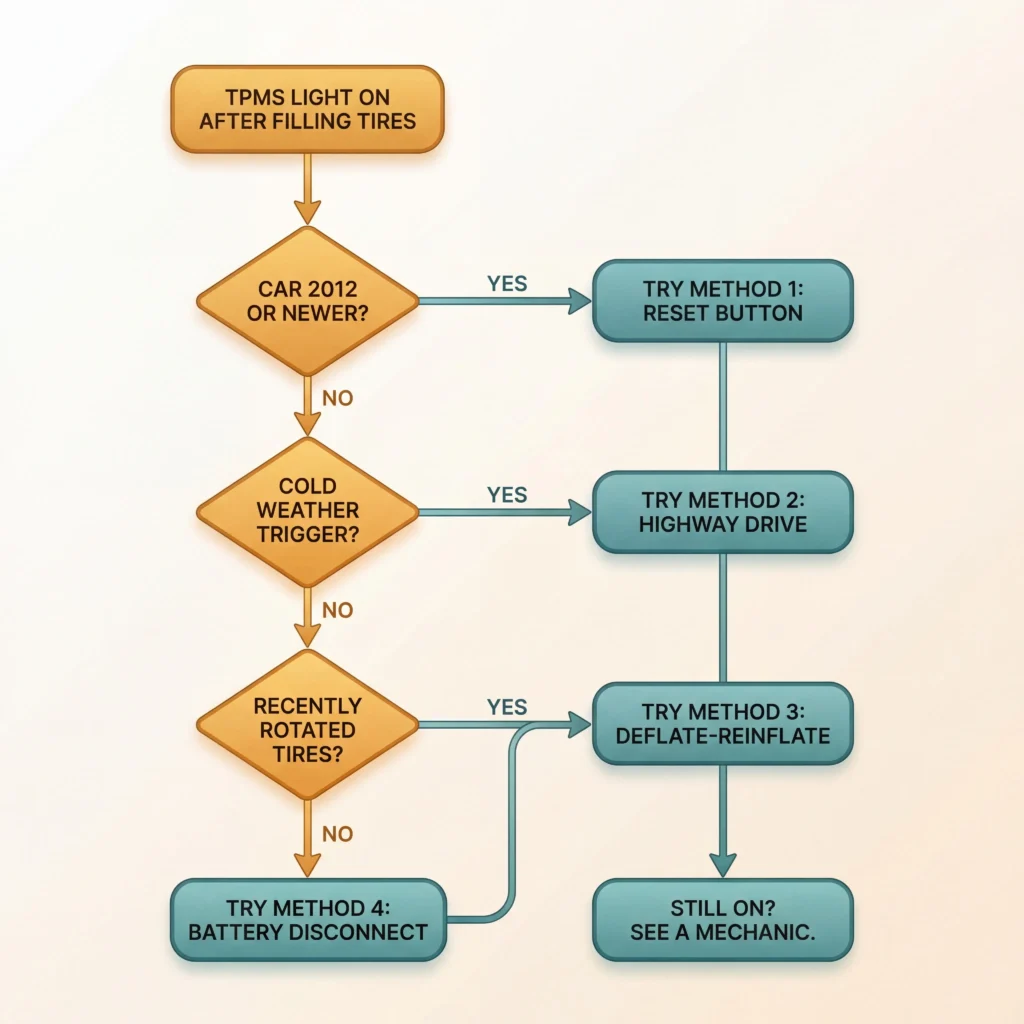
Which Method Should You Try First?
Not sure where to start? Here’s the short version:
- Your car is 2012 or newer: Start with Method 1 (reset button). Most modern vehicles have one.
- The light came on during cold weather: Try Method 2 (highway drive). Temperature drops trigger false alarms that often clear themselves.
- You just rotated your tires or installed new ones: Go straight to Method 3 (deflate-reinflate). The system may need to relearn the sensor positions.
- Nothing else has worked: Method 4 (battery disconnect) is the last resort.
Why Your Tire Pressure Light Stays On After Inflating
You did everything right. Checked the pressure, added air, double-checked it again. So why is that little light still staring at you?
The short answer is that your car’s TPMS (that’s the tire pressure monitoring system) needs to recalibrate. It doesn’t automatically know you fixed the problem. Think of it like a smoke detector that keeps beeping after you’ve already put out the toast.
There are a few reasons this happens. Temperature changes mess with tire pressure more than most people realize. Your tires can lose one to two PSI for every ten degrees the temperature drops. So if you filled them up yesterday afternoon and checked this morning when it’s colder, the pressure actually did drop overnight. Weird, but that’s just physics doing its thing.
Another common culprit? The spare tire. A lot of people (myself included, for way too long) forget that the spare has a sensor too on many vehicles. If your spare is sitting at 30 PSI when it should be at 60, that’ll trigger the warning. I figured this out the hard way after chasing the problem through all four regular tires.
Sometimes the issue is the sensor itself. TPMS sensors run on batteries that typically last seven to ten years. If your car is getting up there in age, a dying sensor battery might be causing false alerts. But before you assume that’s the problem, try the reset methods below.
Pro Tip from Corinne: Before trying any reset method, grab a handheld tire gauge and check all five tires, including the spare. I keep a digital gauge in my glove box for exactly this reason. A decent one runs about fifteen dollars and beats guessing every time.
Related: If your light is flashing instead of staying solid, that’s a different situation that usually points to a sensor malfunction.
Method 1: Use the TPMS Reset Button
Time needed: About 5 minutes
Difficulty: Easy
Best for: Most vehicles made after 2008 (when TPMS became federally required)
This is the method I always try first. It’s the quickest fix and works on most vehicles.
Here’s how to do it:
- Turn your key to the “on” position but don’t start the engine. If you have push-button start, press the button twice without touching the brake.
- Find the TPMS reset button. On most cars, it’s located under the steering wheel or inside the glove box. Some vehicles hide it near the fuse panel. Your owner’s manual will tell you exactly where (I know, nobody wants to dig that out, but it’s worth the two minutes).
- Press and hold the button until the tire pressure light blinks three times. This usually takes about three to five seconds.
- Start your car and wait. The system needs roughly twenty minutes to recalibrate while you drive.
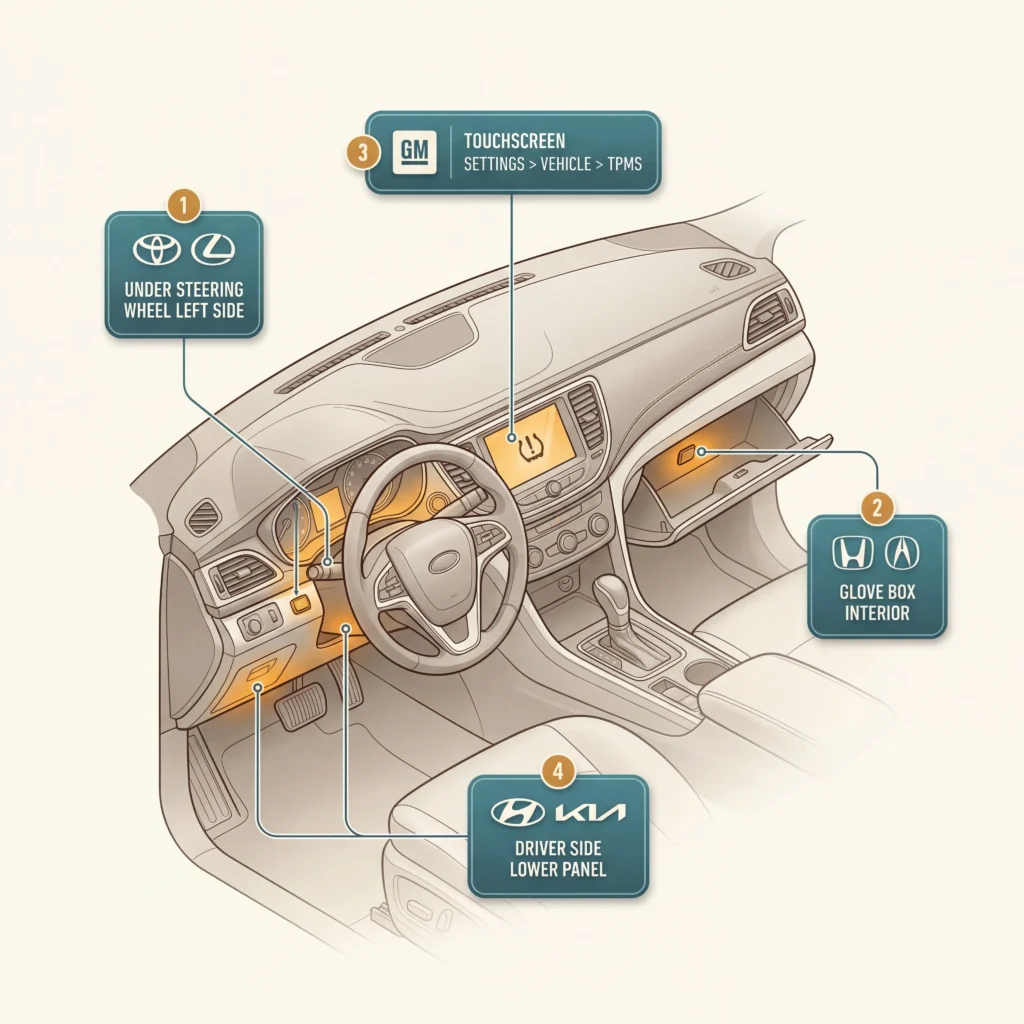
Where to Find the Reset Button by Brand
- Toyota and Lexus: Usually under the steering wheel, left side of the dash
- Honda and Acura: Often in the glove box or driver’s side lower panel
- Chevy, GMC, Buick, Cadillac: Check the infotainment system under vehicle settings (no physical button on newer models)
- Ford and Lincoln: Typically through the dashboard display menu or instrument cluster settings
- Hyundai and Kia: Under the steering wheel or accessible through the settings menu
Don’t skip this step, trust me. A lot of people press the button once and let go. You need to hold it until you see that triple blink. That’s how you know the system registered the reset command.
Pro Tip from Corinne: If your car doesn’t have a physical button (looking at you, newer GM vehicles), the reset is usually buried in your touchscreen. Go to Settings, then Vehicle, then Tire Pressure or TPMS. The option might be called “Relearn Tires” or “Reset TPMS.”
[IMAGE: Location of TPMS reset button under steering wheel]
Method 2: Drive at Highway Speed for 10 Minutes
Time needed: 10-15 minutes of driving
Difficulty: Easy
Best for: Cold weather situations, vehicles with indirect TPMS
Some vehicles reset automatically after you drive for a bit. This works especially well on cars with indirect TPMS systems, which use wheel speed sensors instead of pressure sensors inside each tire.
The process is simple. Get your tires to the correct pressure (check the sticker inside your driver’s door for the right number, not the max pressure on the tire sidewall). Then drive at around 50 mph or higher for ten to fifteen minutes without stopping.
The heat from driving warms up your tires, which increases the pressure slightly and helps the sensors recalibrate. After you park and restart the car, the light should be off.
This method works best when the light came on due to cold weather. I’ve had mornings where my light popped on, I drove to work on the highway, and it turned itself off by the time I parked. Temperature swings in the fall and spring make this pretty common.
Quick heads up though. If the light doesn’t go off after a solid highway drive, move on to the next method. Driving around hoping it fixes itself only works if there’s no actual underlying issue.
Method 3: Deflate and Reinflate All Four Tires
Time needed: 20-30 minutes
Difficulty: Moderate
Best for: After tire rotation, new tire installation, or when other methods fail
This one takes more effort, but it’s basically a hard reset for your TPMS. I’ve used it when nothing else worked.
You’ll need a tire pressure gauge and access to an air compressor (most gas stations have one, or you can grab a portable inflator for around thirty dollars).
Here’s the process:
- Check all four tires plus your spare. Write down the current pressure and what it should be.
- Inflate each tire to 3 PSI above the recommended pressure. So if your door sticker says 35 PSI, fill to 38.
- Deflate all five tires completely. Yes, completely. You can use a small tool to press the valve core, or just unscrew the valve cap and press the pin inside.
- Reinflate all tires to the exact recommended pressure.
- Drive for a few minutes to let the system register the new readings.
This forces the TPMS to relearn all the tire positions from scratch. It’s basically telling the computer “forget everything you knew, start fresh.”
Fair warning: this takes about twenty to thirty minutes if you’re doing it at a gas station air pump. But when you’ve tried everything else and the light won’t budge, this has a solid success rate.
Pro Tip from Corinne: Don’t forget the spare. On a lot of vehicles, the spare tire has its own sensor. If you skip it during this process, you might still have problems. Most compact spares need around 60 PSI, which is way higher than your regular tires.
If you’re checking the spare and realize it needs attention, here’s more on spare tire pressure requirements and why it matters.
Method 4: Disconnect the Battery
Time needed: 15-20 minutes
Difficulty: Moderate
Tools needed: 10mm wrench or socket
Best for: When absolutely nothing else has worked
This is the nuclear option. I’d only try it after the other methods fail.
A word of caution before you start: Working with car batteries requires some basic safety awareness. Always disconnect the negative terminal (the one marked with a minus sign, usually a black cable) first. Keep metal tools away from both terminals at the same time to avoid sparks near the battery. If you’re not comfortable doing this, a mechanic can handle it quickly and cheaply.
Disconnecting your battery resets your car’s computer, which includes the TPMS module. But it also resets your radio presets, clock, and any other settings stored in memory. Some newer cars might need the infotainment system reconfigured afterward. Like any nuclear option, there’s fallout.
If you’re okay with that, here’s how:
- Turn off your car completely and remove the key from the ignition.
- Open the hood and locate the battery. Find the negative terminal (marked with a minus sign, usually a black cable).
- Use a wrench to loosen the nut on the negative terminal. Remove the cable from the battery post and set it aside where it won’t accidentally touch the terminal.
- Turn your ignition to “on” (don’t start the engine) and press the horn for about three seconds. This drains any remaining power from the system.
- Wait ten to fifteen minutes.
- Reconnect the negative cable and tighten it securely.
- Start your car. The tire pressure light should be off, and the system will recalibrate as you drive.
This is a legitimate troubleshooting step, not some random internet hack. But save it for when nothing else works.
[IMAGE: Car battery with negative terminal marked]
When the Light Won’t Reset (What to Do Next)
Okay, you’ve tried all four methods and that stubborn light is still on. Now what?
First, rule out an actual pressure problem. Use a handheld gauge (not just the reading on a gas station pump) to check every tire including the spare. Make sure you’re checking when the tires are cold, meaning the car has been parked for at least three hours.
If the pressure is fine everywhere, you’re probably looking at one of these issues:
Dead sensor battery. TPMS sensors have batteries that last about seven to ten years. If your car is older, one or more sensors might have died. There’s no way to replace just the battery. You need a new sensor.
Damaged sensor. Hit a pothole hard? Got new tires recently? Sensors can get damaged during tire changes or from road impacts. A shop can scan your TPMS to identify which sensor isn’t communicating.
Faulty TPMS module. Less common, but the computer that receives signals from your sensors can fail. This is more of a dealer-level repair.
What Will This Cost?
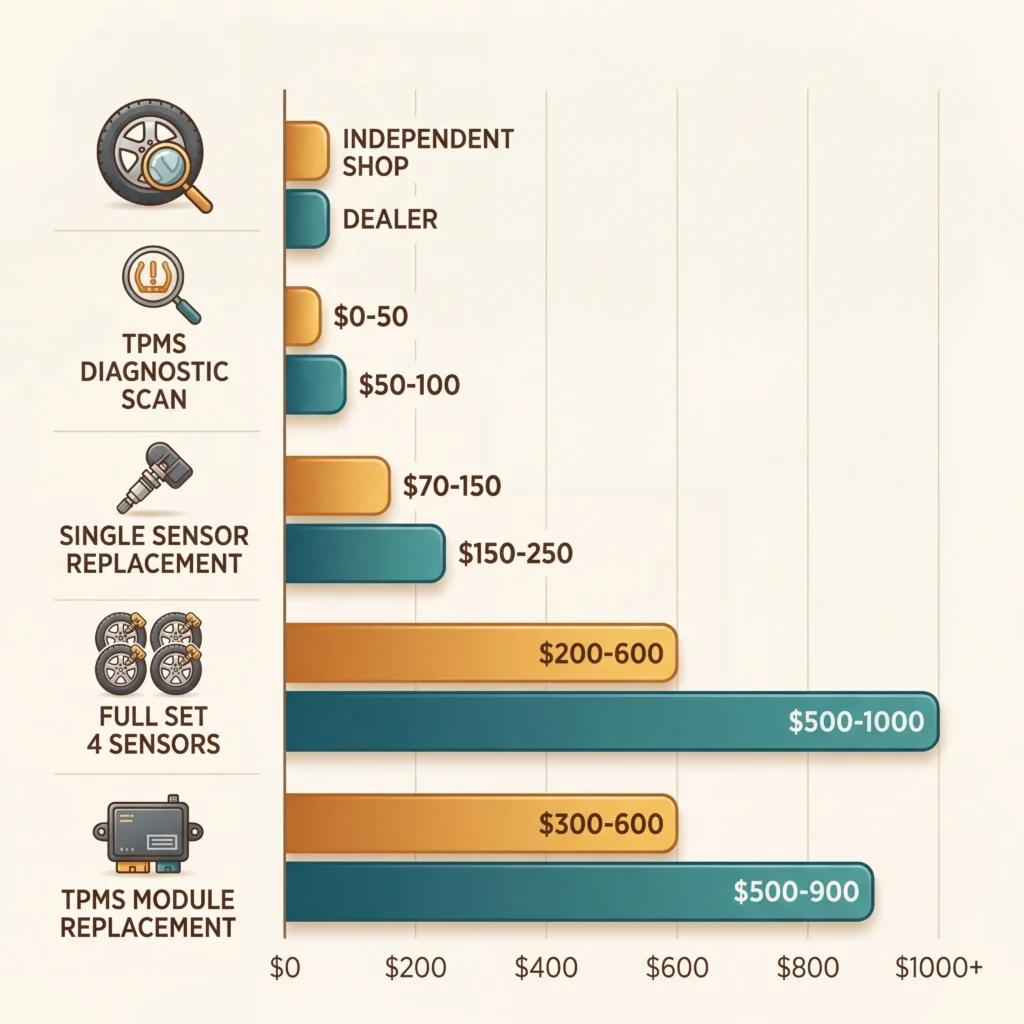
If you need professional help, here’s what to expect as of early 2026:
- TPMS diagnostic scan: Free at many tire shops (Discount Tire, America’s Tire, and Costco if you bought tires there) or $20-50 elsewhere
- Single sensor replacement: $50-80 for the sensor itself, plus $20-40 labor at an independent shop. Dealers often charge $100-150 total per wheel.
- Full set of four sensors: $200-400 at an independent shop, $400-600 at a dealer
- TPMS module replacement: $200-400 for parts, plus $100-200 labor (dealer repair)
If you’re seeing a tire pressure sensor fault message instead of just the regular warning light, that points more directly to hardware trouble.
At this point, a shop visit makes sense. Places like Discount Tire and most dealerships can run a TPMS diagnostic that identifies exactly which sensor is causing problems. The diagnostic is often free.
FAQ
How do I clear the tire pressure light?
The fastest way is using your TPMS reset button. Turn the ignition on without starting the engine, hold the reset button until the light blinks three times, then drive for about twenty minutes. If your car doesn’t have a reset button, check the infotainment settings under vehicle or maintenance options. Some models reset automatically after you drive at highway speed for ten to fifteen minutes with properly inflated tires.
Why won’t my tire pressure light go off even though pressure is fine?
A few things could be going on. The most common one I’ve seen is forgetting to check the spare tire. If it has a sensor and the pressure is low, that’ll keep the light on. Temperature changes also mess with readings, so the pressure might have dropped since you last checked. And if your car is more than seven years old, a dying sensor battery is worth considering (they don’t last forever, unfortunately).
How to reset tire pressure light on a Chevy Equinox?
Chevy doesn’t use a physical reset button on most models. Instead, go to your infotainment screen, select “Settings,” then “Vehicle,” then “Tire Pressure Monitor.” From there, choose “Relearn Tires” and follow the prompts. The system will walk you through the process. You might need to add or release air from each tire in a specific order while the car learns the sensor positions. This process works for 2018 and newer models. Older Equinoxes may have a physical button under the dash, so check your owner’s manual if the menu option isn’t there.
Can AutoZone reset TPMS?
AutoZone can help with TPMS in a couple of ways. They sell TPMS reset tools and replacement sensors, and their staff can often point you in the right direction. However, they don’t typically perform the actual reset service or diagnose sensor problems. For a full TPMS diagnostic or sensor relearn after installing new sensors, you’d need a tire shop or dealership with the right scan tool. Discount Tire and America’s Tire often do free TPMS checks. Costco tire centers do too if you bought tires there.
Getting That Light Off for Good
Let me break down what actually works. Start with the reset button if your car has one. Takes five minutes and fixes the problem more often than not. If that doesn’t do it, try the highway drive method, especially if the light came on during cold weather. The deflate-reinflate approach is your fallback when nothing else works. Save the battery disconnect for last.
Keep these resources handy:
- Why your TPMS light keeps flashing if you see blinking instead of a solid light
- Service tire pressure system message for GM-specific warnings
- Complete service tire monitor system guide for the full picture on how these systems work
The fact that you’re reading this already puts you ahead. Most people either ignore the light (not great for your tires or your safety) or panic and overpay at a shop for something they could’ve fixed in their driveway. You’ve got the tools to handle it yourself now.
Bookmark this page for next time. Winter’s coming, and that light will probably pop on again when the temperature drops.
Good luck out there.
— Corinne
