
There’s a right way to rotate tires on an all-wheel drive vehicle and several popular wrong ways. Forums are full of conflicting advice. One person says crisscross. Another says front-to-back only. A third claims AWD systems equalize wear automatically so rotation doesn’t matter.
Wrong.
AWD drivetrains are sensitive to tire diameter differences in ways that two-wheel drive systems are not. When tread depth varies between tires, you’re not just looking at uneven wear. You’re stressing the center differential, and that stress adds up. The pattern matters. The interval matters. Get either one wrong and you’re looking at drivetrain repairs that cost far more than a set of tires.
This guide covers the correct AWD tire rotation pattern, how often to rotate, and what happens to your drivetrain when you skip it. For context on how tire measurements affect your vehicle’s performance, see the complete guide to tire size measurements explained.
Safety Notice: Working under a vehicle involves serious risks. Before attempting this procedure, work on a level, solid surface and engage the parking brake. Use wheel chocks on wheels remaining on the ground. Never work under a vehicle supported only by a jack; always use jack stands rated for your vehicle’s weight. Wear appropriate gloves and eye protection.
The procedures and specifications in this article reflect general industry standards and personal experience. Your vehicle may have different requirements, so always consult your owner’s manual for specific lift points, torque values, and rotation intervals. If you’re uncertain about any step, have a qualified mechanic perform the service.
Why AWD Tire Rotation Matters More
The center differential is what separates AWD from two-wheel drive. It allows the front and rear axles to spin at different speeds when cornering. That’s how AWD maintains traction without binding.
Here’s the part nobody mentions: that differential relies on all four tires being close to the same diameter. When tread wears unevenly, tire diameters diverge. A tire with 8/32″ of tread has a measurably different rolling circumference than one with 5/32″. The center differential has to compensate constantly for that mismatch.
Most AWD systems tolerate a tread depth difference of about 2/32″ between tires. Some manufacturers spec even tighter tolerances. Exceed that threshold and you’re forcing the differential to work harder than it should. The result: premature wear on internal components, potential overheating, and eventual failure.
I’ve seen transfer cases come apart on vehicles where the owner ran mismatched tires for too long. The repair bill ran into thousands. A tire rotation every 5,000 to 7,500 miles would have prevented it.
The Correct AWD Tire Rotation Pattern
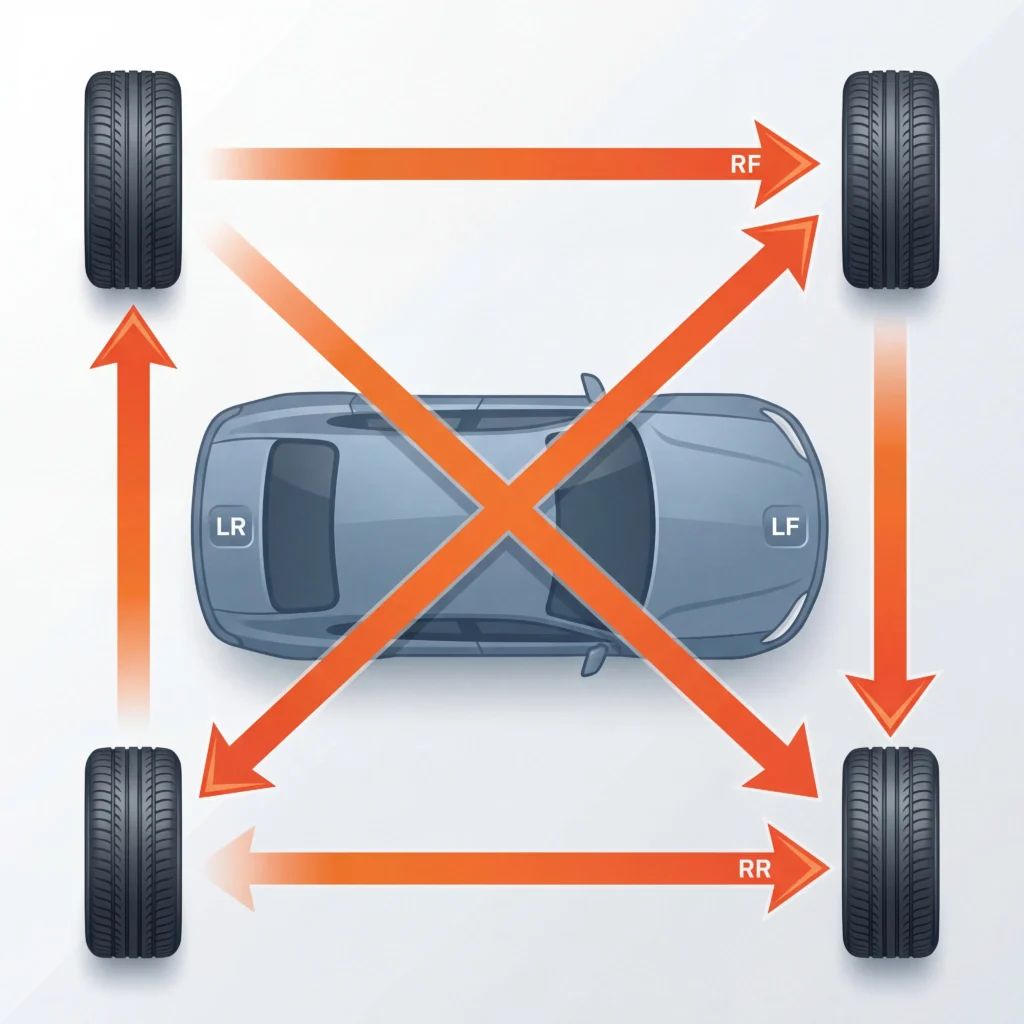
For AWD vehicles with non-directional tires (the same tread pattern works in either direction), use the X-pattern:
- Left rear moves to right front
- Right rear moves to left front
- Right front moves to left rear
- Left front moves to right rear
Every tire changes both axle position and side. This distributes wear across all four wheel positions evenly over time.
If your AWD vehicle has directional tires (check for arrows molded into the sidewall), the pattern changes. Directional tires must stay on the same side of the vehicle. Rotate front-to-rear only: left front swaps with left rear, right front swaps with right rear.
Some AWD vehicles run staggered fitments with different tire sizes front and rear. Performance sedans and sports cars often use this setup. If your front and rear tires are different sizes, you cannot rotate them at all in the traditional sense. Side-to-side swaps on the same axle are your only option, and only if the tires aren’t directional. Check your owner’s manual or the tire placard on the door jamb before assuming you can rotate.
For more on how front-wheel drive vehicles handle rotation differently, see the front wheel drive tire rotation guide.
How to Rotate Tires on an AWD Vehicle Step by Step
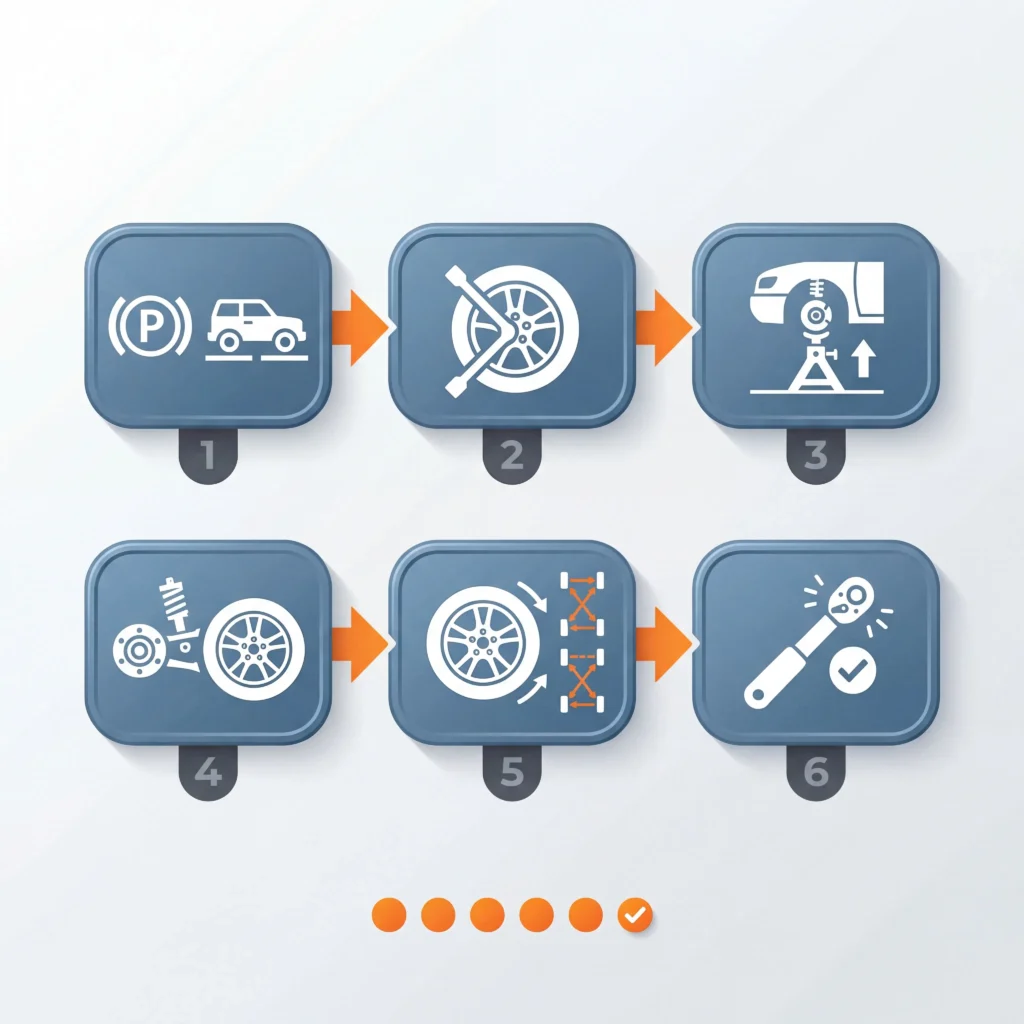
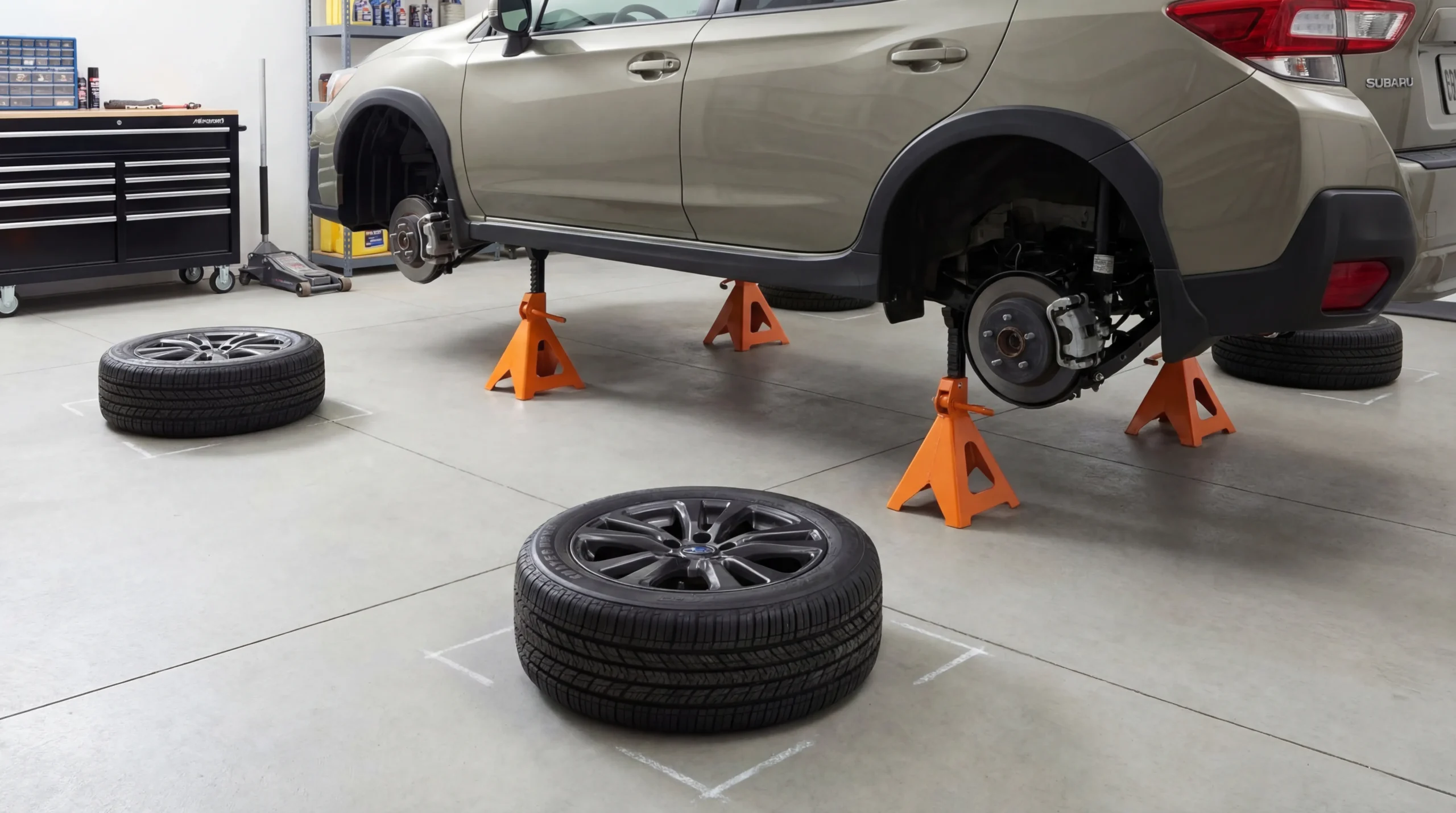
You’ll need a floor jack, four jack stands, a torque wrench, and a lug nut socket that fits your wheels. A basic scissor jack from your trunk can work in a pinch, but a floor jack is safer and faster for a four-corner rotation.
Step 1: Prepare the vehicle. Park on a level, solid surface. Engage the parking brake. If you’re only lifting one end at a time, place wheel chocks behind the tires that will stay on the ground.
Step 2: Loosen all lug nuts before lifting. With the vehicle still on the ground, break the torque on every lug nut using your lug wrench. Don’t remove them yet. Just crack them loose about a quarter turn. This is much easier with the vehicle’s weight holding the wheels in place.
Step 3: Lift and support all four corners. Use the floor jack at designated lift points specified in your owner’s manual. Incorrect lift points can damage rocker panels, pinch welds, or suspension components. Place a jack stand under each corner before you work. Never crawl under a vehicle supported only by a hydraulic jack.
Step 4: Remove all four wheels. Now that the vehicle is safely supported, fully remove the lug nuts and take the wheels off. Set them in their new positions according to the X-pattern described above.
Step 5: Mount each tire in its new location. Thread the lug nuts on by hand first to avoid cross-threading. Snug them in a star pattern (not circular) to seat the wheel evenly against the hub.
Step 6: Lower the vehicle and torque to spec. Once all four wheels are mounted and hand-tight, carefully lower the vehicle off the jack stands. Use your torque wrench to tighten lug nuts to the manufacturer’s specification. Most passenger vehicles call for somewhere between 80 and 100 lb-ft, but your vehicle may differ. Check your owner’s manual for the exact value. Check the spec. Then check it again.
The entire job takes 30 to 45 minutes once you’ve done it a few times. If this is your first rotation, budget an hour and take your time with the safety steps.
How Often to Rotate AWD Tires
Most manufacturers recommend rotating AWD tires every 5,000 to 7,500 miles. That’s more frequent than the 7,500 to 10,000 mile interval common for two-wheel drive vehicles.
The reason goes back to differential sensitivity. AWD systems need matched tire diameters. More frequent rotation keeps tread depth consistent across all four tires for longer.
Some manufacturers are stricter. Subaru, for example, recommends rotation every 7,500 miles but emphasizes that all four tires must remain within 2/32″ of each other at all times. If one tire gets damaged and needs replacement, Subaru’s guidance is to replace all four or have a tire shop shave the new tire to match existing tread depth. That’s how tight the tolerance is.
Audi and BMW have similar recommendations for their Quattro and xDrive systems. Check your specific vehicle’s maintenance schedule, as intervals can vary by model and model year.
A good rule: rotate your AWD tires at every other oil change. If you’re running synthetic oil on a 10,000-mile interval, that means rotation around 5,000 miles. Keeps the schedule simple.
Compare this to 4WD tire rotation intervals, which vary depending on whether your system is part-time or full-time.
What Happens If You Skip AWD Rotation
Skip tire rotation on a front-wheel drive car and you’ll wear out your front tires faster. Annoying, but manageable.
Skip rotation on an AWD vehicle and the consequences stack up.
Uneven tread depth creates diameter mismatch. Front tires on AWD vehicles often wear faster due to steering and braking loads. Without rotation, the front tires can end up with significantly less tread than the rears.
Diameter mismatch stresses the center differential. The differential compensates for the size difference by allowing constant slip between axles. That slip generates heat and wear.
Heat and wear degrade differential components. Clutch packs, viscous couplings, or planetary gears (depending on your AWD system type) break down over time under this stress.
Eventual failure follows. In severe cases, the differential can fail entirely. Repair or replacement costs typically run between $1,500 and $4,000 depending on the vehicle, with luxury brands often at the higher end of that range.
I’ve measured tread depth differences exceeding 3/32″ on AWD vehicles that went 15,000 miles without rotation. At that point, the owner faced a choice: buy four new tires to restore matching diameters, or risk continued differential wear. Neither option is cheap. Regular rotation would have prevented both.
AWD vs FWD vs RWD Rotation Differences
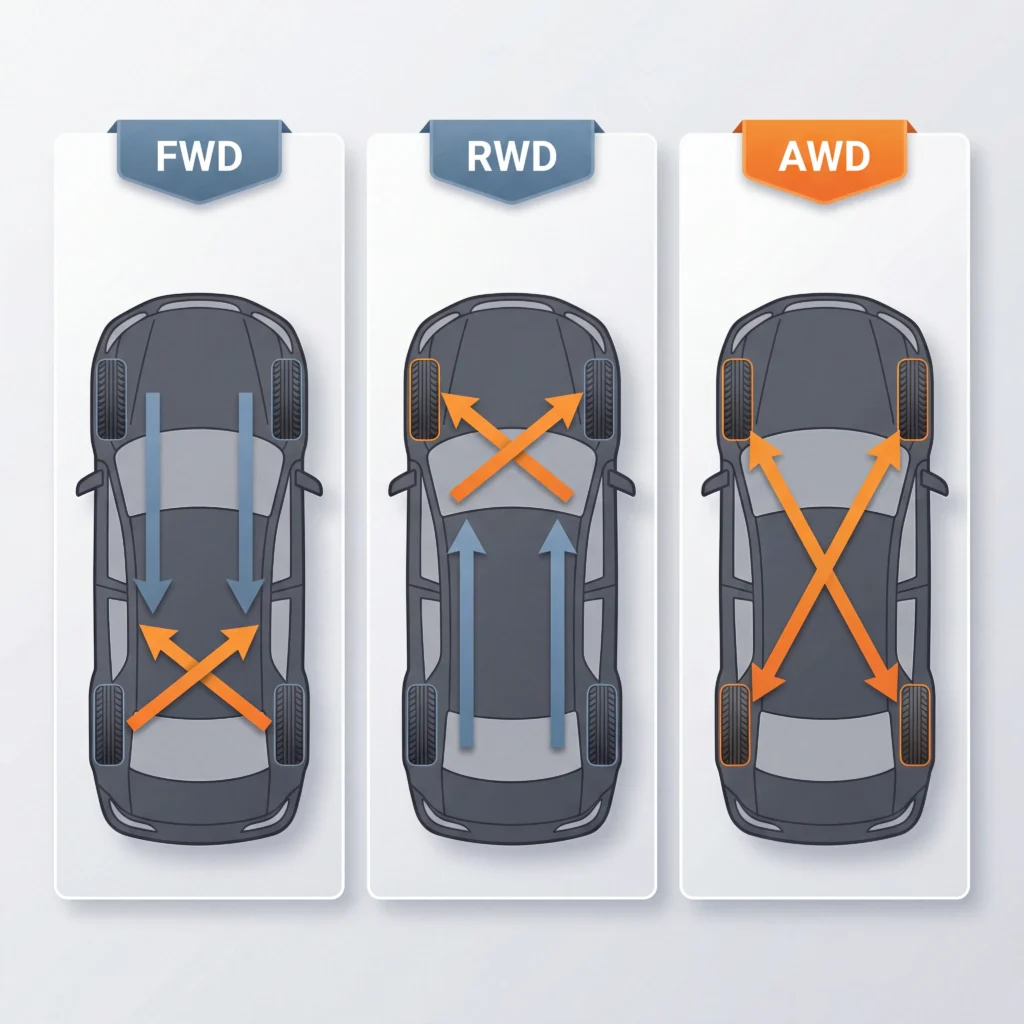
The rotation pattern depends on which axle receives power.
Front-wheel drive (FWD) vehicles see faster front tire wear because the front tires handle both propulsion and steering. The forward cross pattern moves front tires straight back while rear tires cross to the front on opposite sides. See the FWD tire rotation pattern for details.
Rear-wheel drive (RWD) vehicles wear rear tires faster from propulsion. The rearward cross pattern moves rear tires straight forward while front tires cross to the rear. The RWD rotation guide covers this in depth.
All-wheel drive (AWD) vehicles send power to all four tires, but wear still varies by position due to weight distribution, steering loads, and braking bias. The X-pattern (full crisscross) distributes wear most evenly and protects the center differential.
Four-wheel drive (4WD) systems are similar to AWD, though part-time 4WD systems behave differently when in two-wheel drive mode. The 4WD rotation pattern accounts for these differences.
The key distinction: AWD drivetrains are less tolerant of tire mismatch than any other configuration. When in doubt, rotate more often rather than less.
Frequently Asked Questions
Which way do you rotate tires on AWD?
The X-pattern works for most AWD vehicles with non-directional tires. Each tire moves to the opposite axle and opposite side: left rear to right front, right rear to left front, right front to left rear, left front to right rear. Directional tires rotate front-to-rear on the same side only.
Is tire rotation necessary in AWD?
Yes. AWD systems depend on matched tire diameters to function properly. Skipping rotation leads to uneven tread wear, diameter mismatch, and stress on the center differential. The repair costs from neglected rotation far exceed the cost of the rotation itself.
How many miles for tire rotation AWD?
Most manufacturers recommend 5,000 to 7,500 miles for AWD vehicles. This is shorter than FWD or RWD intervals because AWD drivetrains are more sensitive to tire diameter differences. Check your owner’s manual for your vehicle’s specific recommendation.
What is the 3% tire rule?
The 3% rule refers to the maximum acceptable difference in overall tire diameter on AWD vehicles. When one tire’s diameter differs from the others by more than roughly 3% (approximately 2/32″ to 3/32″ of tread depth difference), it can cause drivetrain stress. Some manufacturers use even tighter tolerances.
Do you have to rotate tires on AWD?
Technically, no law requires it. Practically, skipping rotation on AWD vehicles risks differential damage that costs thousands to repair. Consider rotation a necessary maintenance item, not an optional one.
Can I rotate AWD tires myself?
Yes, with the right equipment and attention to safety. You need a floor jack, four jack stands, and a torque wrench. The process takes 30 to 45 minutes for someone with experience, longer for beginners. If you’re uncomfortable supporting the vehicle safely on all four corners or uncertain about proper lift points, have a shop do it. Many tire shops offer free rotation if you purchased your tires there.
What if my AWD tires are already mismatched?
If tread depth varies by more than 2/32″ between tires, rotation alone won’t solve the problem. You may need to replace the most worn tires, or in some cases, replace all four to restore matching diameters. Some tire shops can shave new tires to match existing tread depth, though this service isn’t available everywhere. A tire depth gauge costs a few dollars and helps you catch mismatches before they become expensive problems.
The Bottom Line on AWD Rotation
AWD vehicles need tire rotation more than any other drivetrain type. The center differential that makes your all-wheel drive system work is also its most expensive component to replace. Keeping tire diameters matched through regular rotation is the simplest way to protect it.
Rotate every 5,000 to 7,500 miles using the X-pattern for non-directional tires or front-to-rear for directional tires. Use a torque wrench and follow the spec in your owner’s manual.
For the complete picture on tire maintenance and how sizing affects your vehicle, see Tire Size Measurements Explained, which covers everything from aspect ratios to load ratings.
Know the spec, follow the procedure, and don’t skip steps.
— Garrett Stowe
