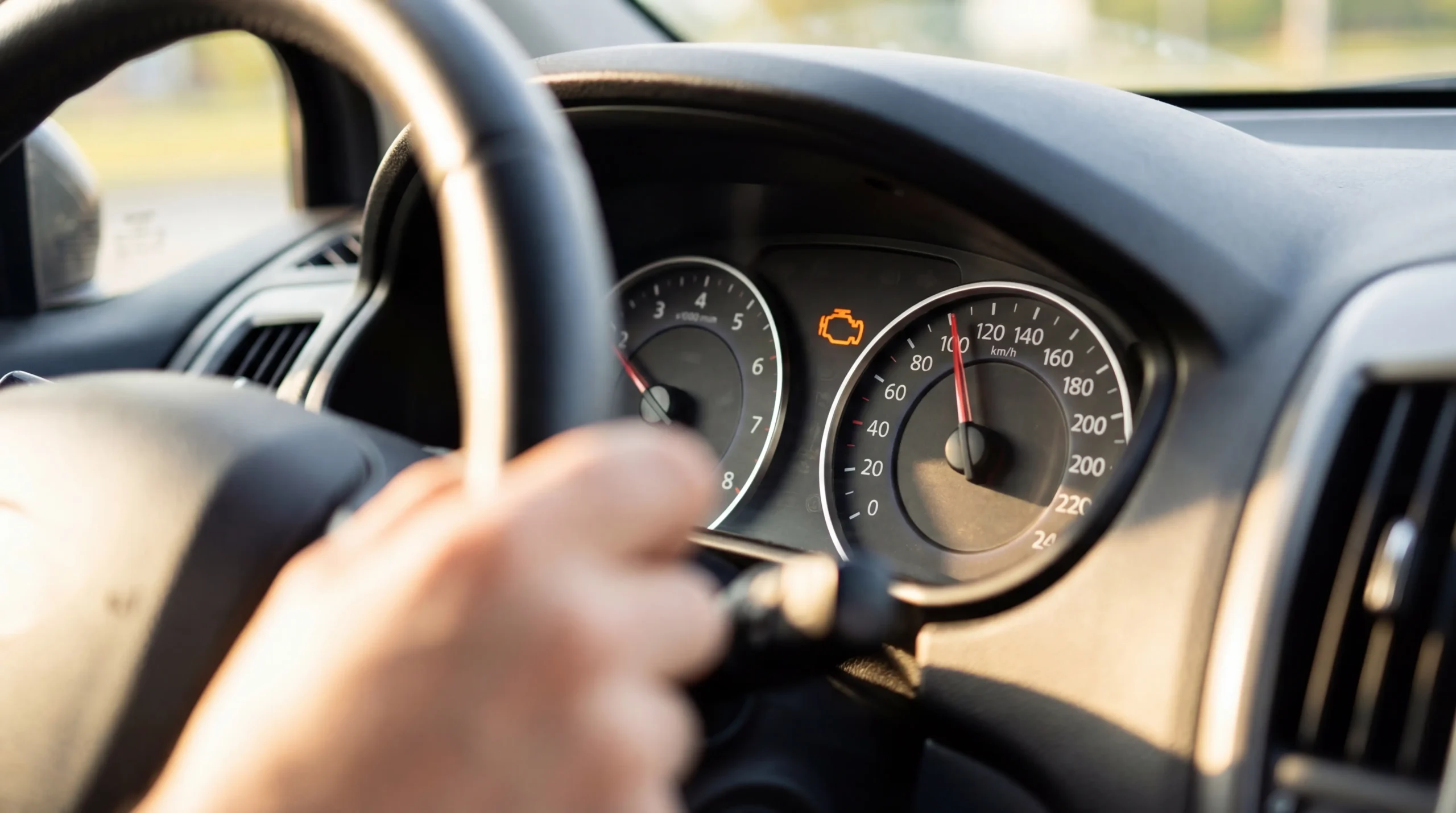

Check engine light blinking? Let’s talk about what that means. The first time mine started flashing, I was merging onto the highway and my stomach dropped. I pulled over, heart racing, convinced something catastrophic had happened. Turns out I wasn’t wrong to worry, but I also wasn’t as doomed as I thought.
A blinking check engine light means your engine is misfiring right now. This isn’t the same as a steady light that just sits there judging you. When it flashes, your car is basically screaming that unburned fuel is getting dumped into your exhaust system, and that can destroy your catalytic converter fast. We’re talking potential damage within minutes of continued driving.
The good news? Once you know what that flashing light actually means, you can take the right steps to protect your car (and your wallet). This guide covers why the light blinks, what causes it, whether you can keep driving, and how to figure out what’s going on under the hood.
For the complete picture on resetting and diagnosing engine lights, check out my full guide on how to reset check engine light.
A note before we dive in: I’m not a certified mechanic. This guide reflects what I’ve learned from my own car troubles over the years. For your specific situation, always consult a qualified professional. Also, prices and store policies mentioned here were accurate at the time of writing but may change. When in doubt, call ahead or get a quote.
What a Blinking Check Engine Light Means
A blinking check engine light signals an active engine misfire that’s severe enough to cause immediate damage. Your car’s computer flashes the light (instead of keeping it steady) specifically to get your attention because something bad is happening right now, not “sometime soon.”
Here’s what’s going on inside your engine when you see that flash. During normal operation, each cylinder fires in sequence: fuel and air mix, the spark plug ignites them, and you get power. A misfire means one or more cylinders didn’t fire properly. Maybe the spark never happened. Maybe the fuel didn’t get there. Either way, raw fuel ends up in your exhaust.
That raw fuel hits your catalytic converter, which runs extremely hot during normal operation. When unburned fuel reaches those temperatures, it can melt the converter’s internal components. I’ve seen repair estimates for catalytic converters, and they’re not pretty. Depending on your vehicle type, you could be looking at anywhere from around $800 to $1,500 for economy cars, or $2,000 to $4,000 for luxury and European models. Your actual costs will vary based on your specific vehicle, location, and where you get the work done.
So when your car flashes that light at you, it’s not being dramatic. It’s trying to save you from a repair bill that could’ve been avoided.
Blinking vs Steady Check Engine Light
Not all check engine lights mean the same thing, and understanding the difference can save you a lot of stress. Here’s the breakdown:
| Light Behavior | What It Means | Urgency | Can You Drive? | First Action |
|---|---|---|---|---|
| Steady/Solid | Stored fault code, issue needs attention | Low to Medium | Yes, but get it checked soon | Check gas cap, schedule diagnostic |
| Blinking/Flashing | Active misfire happening now | HIGH | No, pull over safely | Stop driving, call for help if needed |
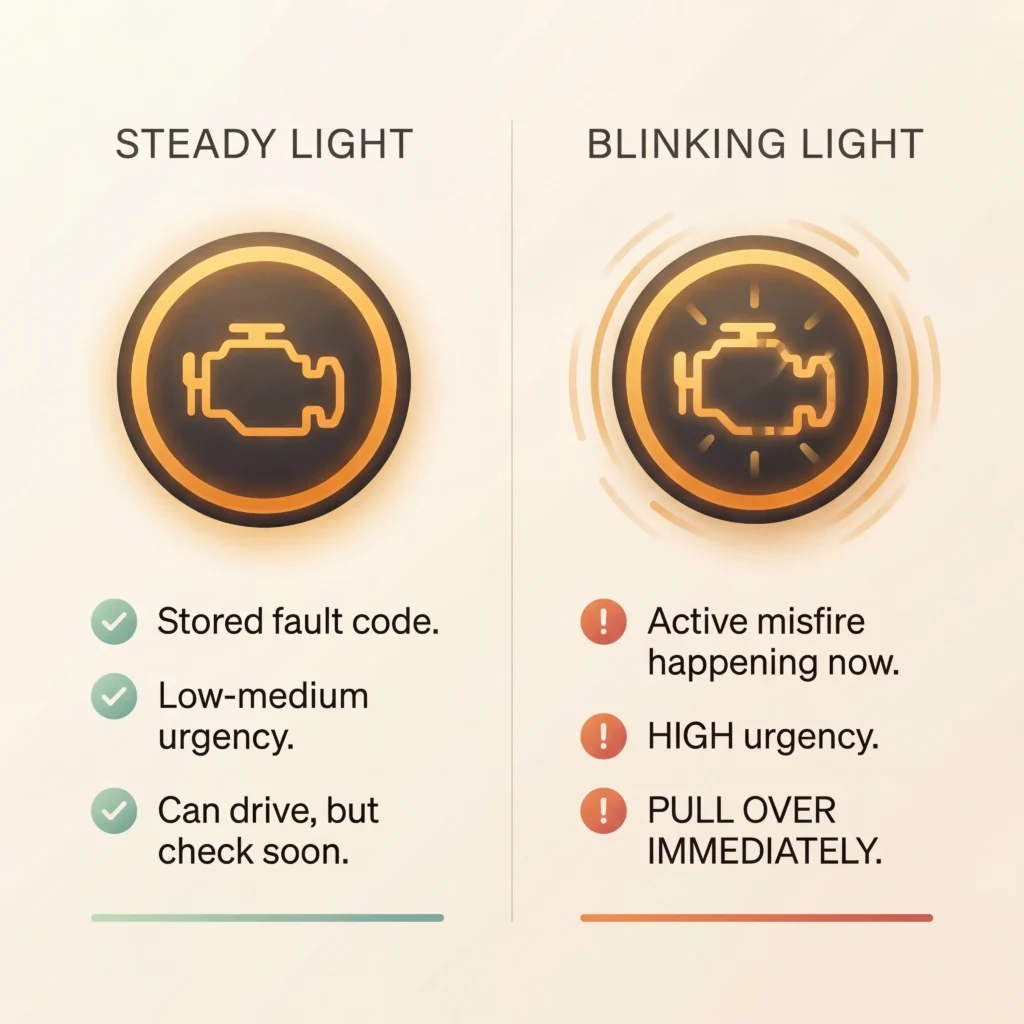
A steady light is your car saying “hey, something’s off, let’s look at this when you get a chance.” Common causes include a loose gas cap, an oxygen sensor getting older, or emissions system hiccups. Annoying? Sure. Emergency? Usually not.
A blinking light is completely different. It’s your car saying “stop what you’re doing because I’m hurting myself.” The flashing pattern is specifically designed to convey urgency. Every second you keep driving with a blinking light, you risk turning a maybe-fixable problem into a definitely-expensive one.
I learned this the hard way when I ignored what I thought was “just the engine light acting weird” for about ten minutes. Those ten minutes probably added a few hundred dollars to my repair bill. Now when I see flashing, I find somewhere safe to pull over immediately.
If your light flashes briefly and then stops, that’s a slightly different situation worth understanding too.
Common Causes of a Flashing Check Engine Light
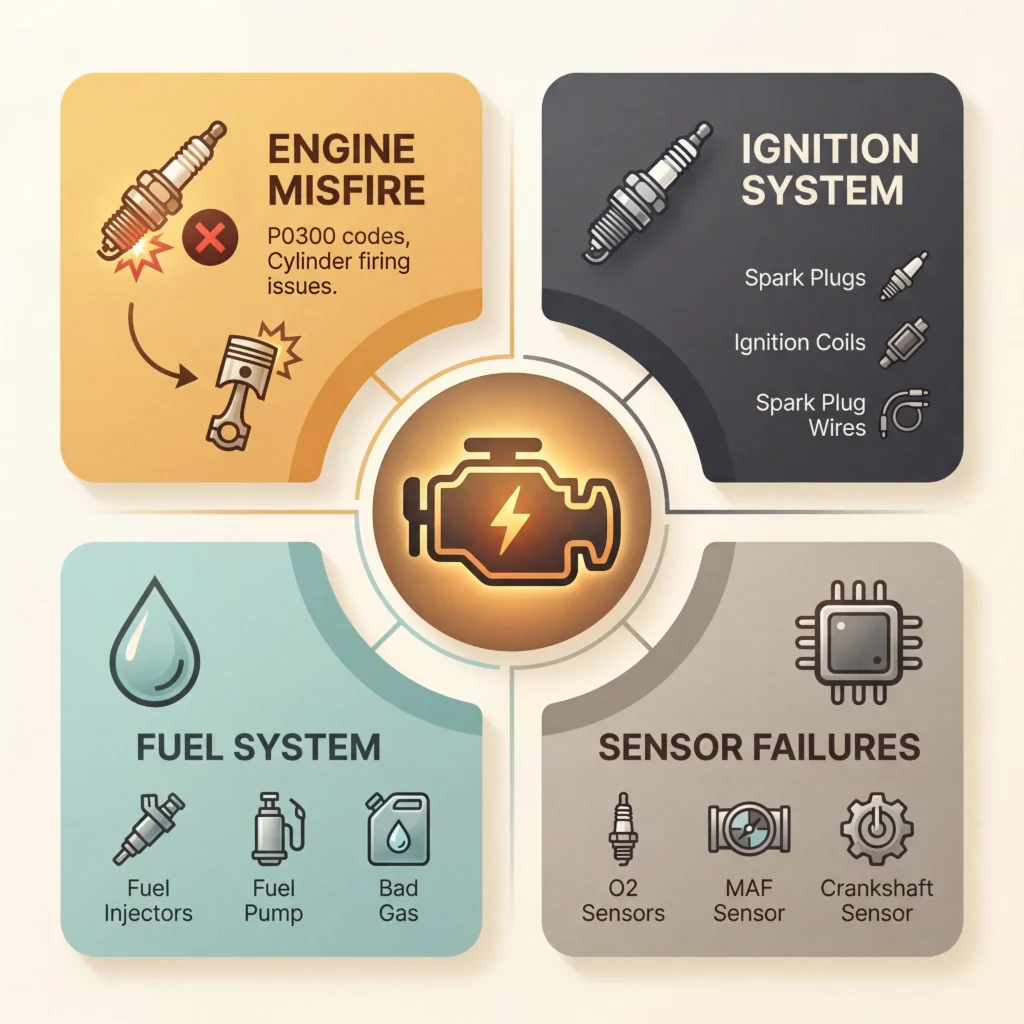
So what actually causes the misfire that triggers that blinking light? In my experience, it usually comes down to a few usual suspects.
Engine Misfire (The Big One)
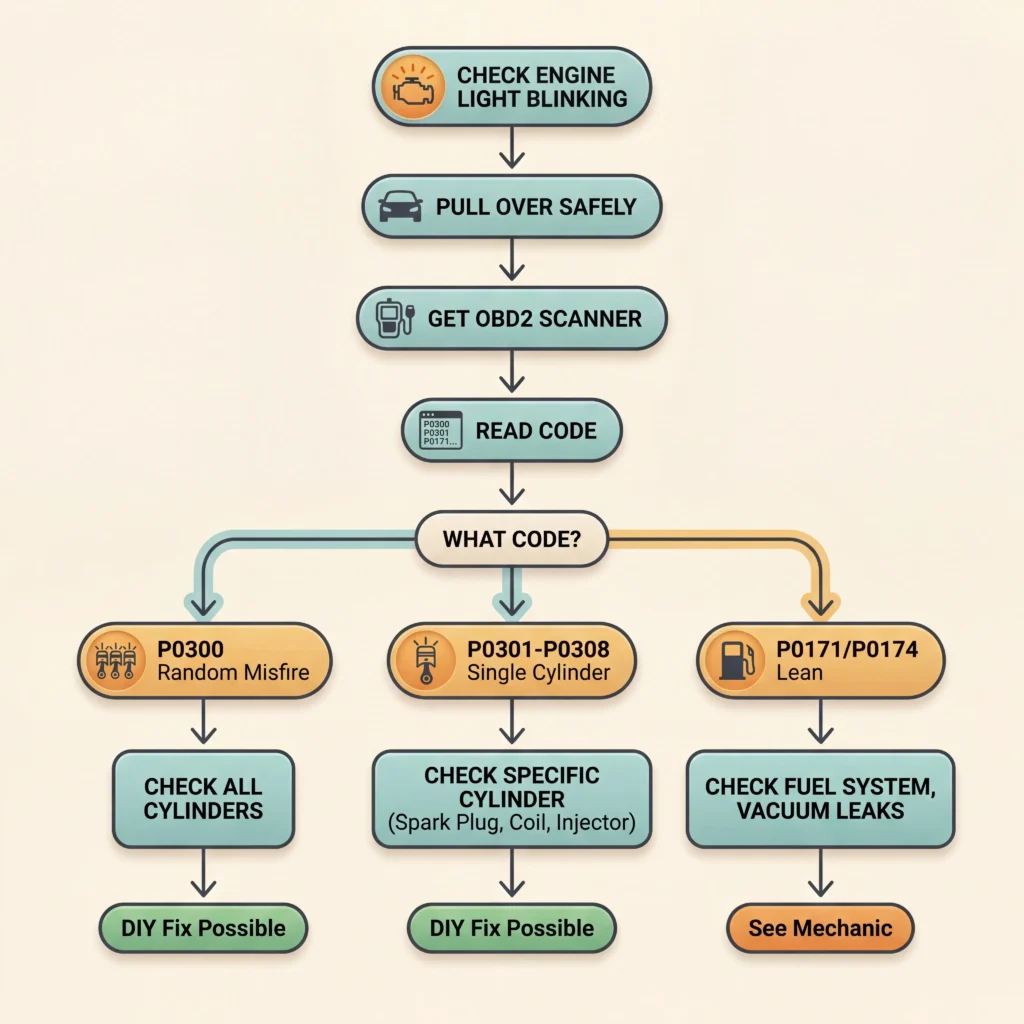
This is the most common cause by far. A misfire happens when combustion fails in one or more cylinders. Your OBD2 scanner will typically show codes like P0300 (random misfire) or P0301 through P0308 (misfire in specific cylinders 1-8). The code tells you which cylinder is having problems, which helps narrow down the fix.
Ignition System Problems
Your spark plugs, ignition coils, and spark plug wires all work together to create the spark that ignites fuel. When any of these fail, you get misfires. Worn spark plugs are super common, especially on vehicles over 60,000 miles. A failed ignition coil will usually affect just one cylinder. I’ve had a coil go bad and the car ran rough but didn’t leave me stranded.
Fuel System Issues
Clogged fuel injectors can starve a cylinder of fuel. A weak fuel pump might not deliver enough pressure. Even bad gas (contaminated or water in the fuel) can cause misfires. If your car started acting up right after filling up, the fuel itself might be the culprit.
Sensor Failures
Your engine relies on sensors to manage the air-fuel mixture. A bad oxygen sensor, mass airflow sensor, or crankshaft position sensor can throw off the balance enough to cause misfires. These are trickier to diagnose without a scanner, but the codes will point you in the right direction.
Note for diesel owners: Diesel engines don’t have spark plugs, so the diagnosis process is different. If you’re driving a diesel and see a blinking light, the causes and fixes won’t match what I’ve described here. Consult a diesel specialist.
If your light is blinking AND your car is shaking, that’s a strong sign of a severe misfire and you should stop driving immediately.
Can You Drive with a Blinking Check Engine Light
Quick answer: no, you really shouldn’t.
I know that’s not what anyone wants to hear when they’re trying to get home or make it to work. But driving with a blinking check engine light is gambling with your engine and your wallet.
Here’s what happens if you keep driving. The misfires continue. Unburned fuel keeps hitting your catalytic converter. The converter overheats (we’re talking temperatures that can exceed 1,200°F in severe cases). The internal honeycomb structure starts to melt. And now instead of maybe replacing a spark plug that might cost under $100, you’re looking at a converter replacement that could run well over a thousand dollars depending on your vehicle.
What to do instead:
- Reduce your speed immediately and avoid hard acceleration
- Turn on your hazard lights to alert other drivers
- Find a safe place to pull over as soon as possible (parking lot, wide shoulder, side street)
- Turn off the engine once you’re safely stopped
- Check for obvious issues (do you smell rotten eggs? hear unusual sounds? see smoke?)
- If you absolutely must drive to get somewhere safe, keep it under 2 miles and go slowly
If you can’t pull over immediately (highway with no shoulder, unsafe area, heavy traffic): Stay calm. Reduce speed as much as safely possible, turn on hazards, avoid acceleration, and take the very next exit or turn-off. Your safety comes first, but minimize engine load until you can stop.
The only time I’d say “drive a short distance” is if you’re in an unsafe location and need to get to a parking lot or side street. Even then, baby it. No acceleration, no highway speeds.
From what I’ve seen, most people who end up with huge repair bills from a blinking light are the ones who thought “I’ll just make it home first.” Don’t be that person. I was that person once. The extra few hundred dollars taught me to never ignore a flashing light again.
How to Diagnose the Problem
Once you’re safely stopped, you have options for figuring out what’s wrong. You don’t have to guess.
Using an OBD2 Scanner
This is honestly the best investment I’ve made for car stuff. A basic OBD2 scanner typically runs around $20 to $50 at most auto parts stores or online (prices vary, so shop around). It plugs into a port under your dashboard, usually located below the steering wheel on the driver’s side. Look for a trapezoidal-shaped connector, sometimes hidden behind a small plastic cover.
Turn your key to “on” without starting the engine, and the scanner reads whatever codes your car has stored.
Common misfire codes you might see:
- P0300: Random/multiple cylinder misfire detected
- P0301-P0308: Misfire detected in cylinder 1-8 (the last digit tells you which cylinder)
- P0171/P0174: System too lean (not enough fuel)
- P0172/P0175: System too rich (too much fuel)
The code won’t tell you exactly what part failed, but it narrows things down considerably. A P0303 code means cylinder 3 is misfiring, so you’d check the spark plug, coil, and injector for that specific cylinder.
Getting a Code Read
Many major auto parts chains (like AutoZone, O’Reilly, and Advance Auto) offer free code reads as a customer service. However, policies vary by location and by state, as some states have restrictions on who can perform diagnostic services. Call your local store before making the trip to confirm they offer this service in your area.
If you can safely get to one of these stores, they’ll plug in their scanner and tell you what codes are present. They can’t diagnose the problem for you, but the codes give you a starting point.
What the Codes Mean for Your Next Steps
If you get a single-cylinder misfire code and your car has been running fine otherwise, it’s probably something straightforward like a spark plug or coil. If you’re seeing multiple codes or lean/rich codes alongside misfires, the problem might be more involved.
Either way, having the code before you talk to a mechanic puts you in a better position. You’ll know if their diagnosis makes sense.
If your car is still under warranty: Check whether dealer diagnostic services are covered before paying elsewhere. Some warranties include free diagnostics for powertrain issues.
If your check engine light is on but your car seems fine, that’s a different scenario that doesn’t require the same urgency.
Frequently Asked Questions
Can I drive my car with the check engine light blinking?
You shouldn’t drive more than absolutely necessary. A blinking light means active damage is happening to your catalytic converter with every minute you keep going. If you need to move to a safer location, keep it under 2 miles at low speed with your hazards on. Otherwise, stop and get it diagnosed. I know it’s inconvenient, but it’s way less inconvenient than a major repair bill. I learned that lesson firsthand.
What is the most common cause of a flashing check engine light?
Engine misfires cause the vast majority of flashing check engine lights. The misfire itself can come from worn spark plugs, failed ignition coils, clogged fuel injectors, or sensor issues. In my experience, spark plugs and ignition coils are the most frequent culprits, especially on vehicles with higher mileage. These are also some of the more affordable fixes if you catch them early.
Why is my check engine light blinking and my car jerking?
That combination usually means you have a severe misfire happening across multiple cylinders, or one cylinder is misfiring badly enough to shake the whole engine. The jerking is your engine struggling to run smoothly with incomplete combustion. This is a “pull over now” situation. The shaking puts extra stress on engine mounts and other components, and the misfire is actively damaging your catalytic converter.
How do I tell if I blew my engine?
A blown engine typically shows more dramatic symptoms than just a flashing light. You’d see things like metal shavings in your oil, major coolant or oil leaks, knocking sounds that won’t stop, or an engine that won’t turn over at all. A flashing check engine light by itself doesn’t mean your engine is blown. It means something is causing misfires. Caught early, most misfire causes are fixable without replacing the whole engine. Get it diagnosed before assuming the worst.
How long does it typically take to fix a misfiring engine?
It depends entirely on the cause. Replacing a spark plug might take a mechanic 30 minutes to an hour. Swapping an ignition coil is similar. More involved issues like fuel injector cleaning or sensor replacement could take a few hours. If multiple components need attention, you might be looking at a half-day or more. Your mechanic can give you a better estimate once they’ve read the codes and inspected the engine.
What to Do Next
A blinking check engine light feels scary, but now you know what it means and how to handle it:
- Blinking means active misfire: pull over safely (hazards on) and don’t push it
- Use an OBD2 scanner or a parts store code read to identify what’s happening
- Common fixes like spark plugs and coils are manageable when caught early
- Driving on a blinking light risks turning a small repair into a catalytic converter replacement
If your light is flashing, the most important thing is to stop driving and figure out what’s going on. A little inconvenience now beats a major repair bill later.
For more on diagnosing and fixing engine light issues, head back to my complete guide on how to reset check engine light.
— Corinne
