By Garrett Stowe | Technical Editor with hands-on tire and brake experience | Published: March 7, 2026 | 14 min read
Quick Answer: A tire size like P225/65R17 91H tells you everything: P means passenger vehicle, 225 is the width in millimeters (about 8.86 inches), 65 is the aspect ratio (sidewall height as a percentage of width), R means radial construction, 17 is the wheel diameter in inches, 91 is the load index (1,356 pounds per tire), and H is the speed rating (130 mph max). Get any of these wrong and you’re looking at handling problems, premature wear, or worse.
Important: The information in this guide is for educational purposes and reflects personal experience with tire specifications. It is not professional automotive advice. Tire sizing affects vehicle safety, handling, speedometer accuracy, and potentially warranty coverage. Always verify specifications with your vehicle’s door placard, owner’s manual, or a qualified tire professional before making purchasing decisions. The techniques and guidelines shared here worked in my experience but may not apply to every vehicle or situation. When in doubt, consult a certified mechanic or tire specialist.
Table of Contents
Introduction
Let us explain tire size measurements in plain language. This gets repeated wrong across half the internet. Tire sizing looks complicated, but it follows a standard format that hasn’t changed in decades. The problem is that most guides either oversimplify (leaving out critical specs like load index) or bury you in jargon without explaining why any of it matters for your specific vehicle.
I’ve mounted and balanced more tires than I can count. The sizing mistakes I’ve seen range from minor annoyances to genuine safety hazards: wrong load ratings on trucks, mismatched aspect ratios causing speedometer errors, and drivers running tires too narrow for their wheel width. Every one of those problems traces back to not understanding the numbers on the sidewall.
This guide breaks down every element of tire sizing: what the numbers mean, how they affect your vehicle, and where the common mistakes happen. Whether you’re replacing worn tires or considering a size change for appearance or performance, the specs covered here apply to passenger vehicles, light trucks, SUVs, and trailers. You’ll find complete load index and speed rating charts, comparison tables for different sizing systems, and the specific consequences of getting sizes wrong.
The Tire and Rim Association sets the standards for sizing in the United States. The numbers I reference throughout come from those industry specs, not guesswork.
Explain Tire Size Measurements: What Do the Numbers Mean?
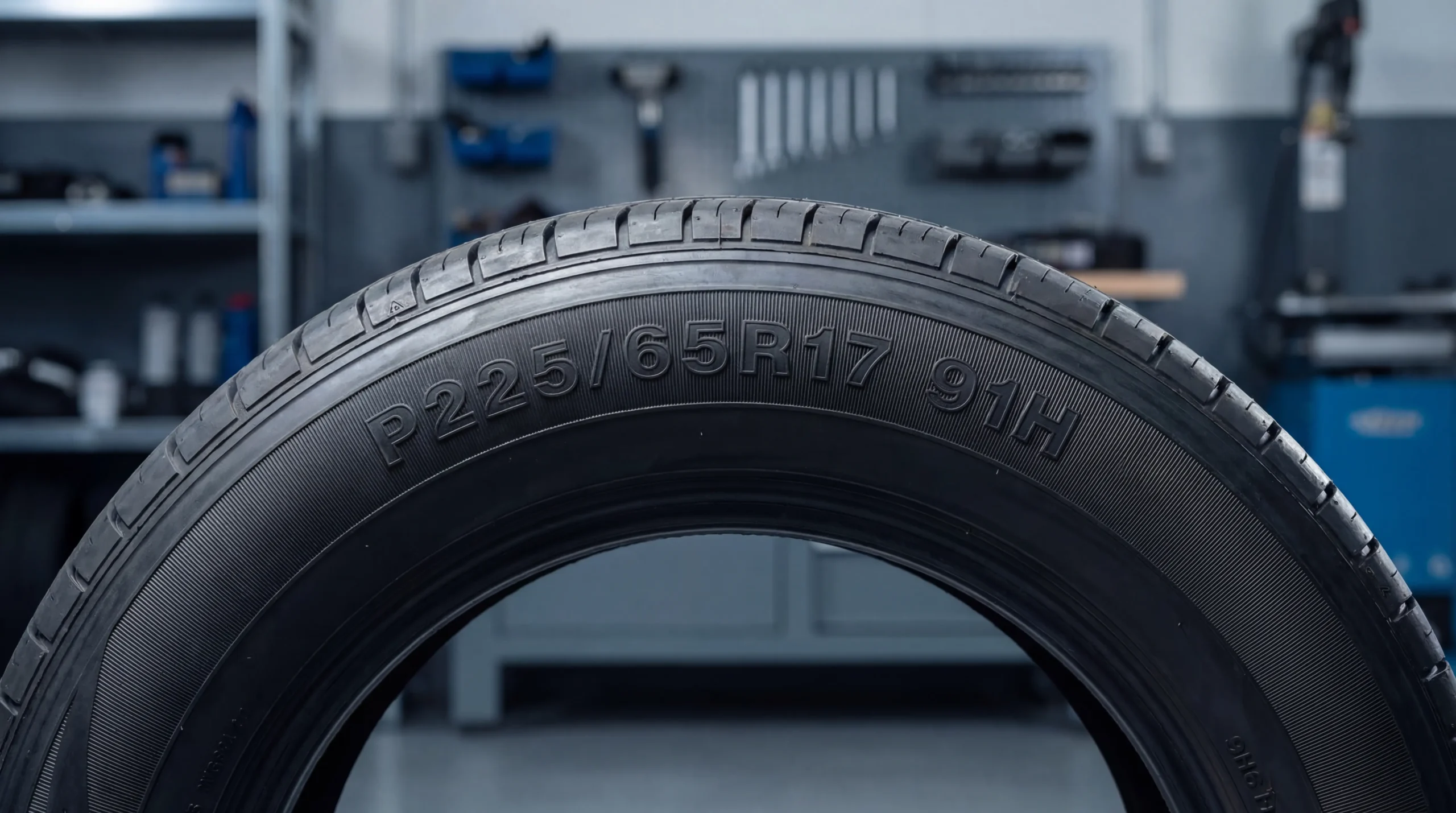
Tire size numbers communicate six distinct specifications in a standardized sequence. Here’s the breakdown for a common size: P225/65R17 91H.
What is Tire Size? Tire size is a standardized alphanumeric code that specifies a tire’s type, dimensions, construction method, and performance capabilities. This code appears on every tire sidewall and must match your vehicle’s requirements for safe operation.
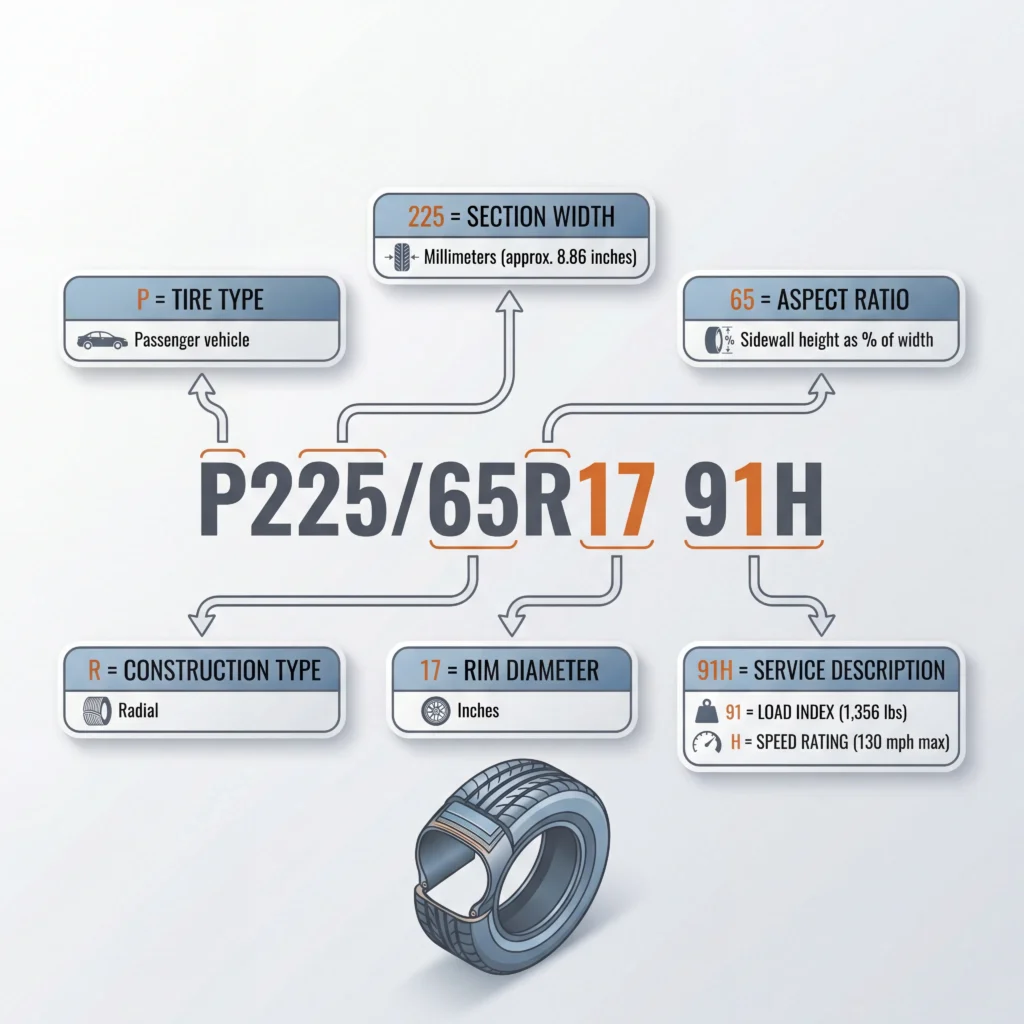
The sequence reads left to right:
- P = Tire type (Passenger vehicle)
- 225 = Section width in millimeters
- 65 = Aspect ratio (sidewall height as percentage of width)
- R = Construction type (Radial)
- 17 = Rim diameter in inches
- 91 = Load index (weight capacity code)
- H = Speed rating (maximum sustained speed)
Each element affects fitment, performance, and safety differently. Skip one and you’re making decisions with incomplete data. The sections below cover each specification in the detail it deserves, including the conversion math that most guides leave out.
For a simplified breakdown aimed at first-time tire buyers, the tire size number meaning guide walks through one example size from start to finish.
How to Read Tire Size Step-by-Step
Reading tire size becomes automatic once you know the pattern. Let’s work through P225/65R17 91H piece by piece.
Step 1: Identify the tire type letter. The P at the beginning indicates a P-Metric passenger tire. No letter means Euro-Metric. LT means Light Truck. ST means Special Trailer.
Step 2: Read the section width. The 225 is measured in millimeters from sidewall to sidewall when the tire is mounted and inflated. Divide by 25.4 to get inches: 225 divided by 25.4 equals 8.86 inches wide.
Step 3: Calculate the aspect ratio. The 65 after the slash means the sidewall height equals 65% of the section width. Math: 225mm multiplied by 0.65 equals 146.25mm sidewall height (about 5.76 inches).
Step 4: Note the construction type. R means radial. Nearly every tire sold today uses radial construction. D or B indicates diagonal (bias-ply) construction, mostly found on trailers and some specialty applications.
Step 5: Match the rim diameter. The 17 specifies a 17-inch wheel. The tire’s inner bead must seat on a wheel of exactly this diameter.
Step 6: Check the load index. The 91 corresponds to 1,356 pounds maximum load capacity per tire at maximum inflation pressure. This is a lookup value from a standardized chart.
Step 7: Verify the speed rating. H means the tire is rated for sustained speeds up to 130 mph. Your replacement tires should match or exceed your original equipment speed rating.
The numbers work together. Change one and you change the overall tire diameter, which affects speedometer accuracy, gear ratios, and clearance. The 275 tire size in inches guide shows these calculations for a popular truck size, and the 285 tire size in inches page covers the next size up.
Tire Type Letters Explained (P, LT, ST, T)
The letter (or absence of one) before the width number tells you what category of vehicle the tire was designed for. This matters more than most people realize.
P-Metric (P): Passenger vehicle tires. The P designation follows Tire and Rim Association standards for cars, crossovers, minivans, and light-duty pickups. Load capacity is calculated assuming a specific inflation pressure formula.
LT-Metric (LT): Light truck tires. Designed for vehicles that carry heavy cargo or tow trailers. The internal construction uses more plies, and the load capacity tables differ from P-Metric. A P265/70R17 and an LT265/70R17 are not interchangeable despite having the same dimensional numbers.
Euro-Metric (no letter): European standard sizing. A 225/65R17 without a letter uses European Tyre and Rim Technical Organisation specs. The dimensions match P-Metric, but load capacity calculations may differ slightly.
ST (Special Trailer): Trailer-only tires. Never use ST tires on a drive or steering axle. They’re engineered for towed applications with different load and speed characteristics.
T (Temporary): Compact spare tires. Designed for limited emergency use only. Most temporary spares are rated for 50 mph maximum and should be replaced with a full-size tire promptly.
The type designation connects directly to load capacity. I’ve seen trucks running P-Metric tires fail under load because the owner matched the dimensions but not the type. The sidewall showed the right numbers, but the tire wasn’t built for the application. The tire sidewalls guide covers all the markings beyond just size.
Section Width: The First Three Numbers
Section width is the tire’s measurement from sidewall to sidewall at the widest point, not the tread width. The number appears in millimeters.
What is Section Width? Section width measures the linear distance between the outer sidewalls of an inflated tire mounted on its specified rim width. This measurement excludes any protective ribs, decorations, or lettering that protrudes from the sidewall surface.
Common section widths for passenger vehicles range from 185mm (compact cars) to 275mm (SUVs and trucks). Performance vehicles often run 245mm to 305mm or wider.
To convert to inches: divide millimeters by 25.4.
| Section Width (mm) | Width (inches) | Typical Application |
|---|---|---|
| 195 | 7.68 | Compact sedans |
| 215 | 8.46 | Mid-size sedans |
| 235 | 9.25 | Crossovers, SUVs |
| 265 | 10.43 | Trucks, large SUVs |
| 275 | 10.83 | Heavy-duty trucks |
| 285 | 11.22 | Off-road trucks |
Wider tires increase contact patch area, which can improve grip in certain conditions. But width must match your wheel width range. A 275mm tire on a 7-inch wheel won’t seat properly. Check the tire manufacturer’s approved rim width range before ordering.
The tradeoff: wider tires increase rolling resistance and can cause rubbing on suspension components or fender wells. If you’re considering upsizing from 265 to 275 or 285, measure your current clearance first. The inside tire wear guide explains what happens when tires contact suspension components under load.
Aspect Ratio: Understanding Sidewall Height
The two-digit number after the slash represents the aspect ratio: sidewall height expressed as a percentage of section width. A 65 aspect ratio means the sidewall is 65% as tall as the tire is wide.
Calculating Sidewall Height:
For a 225/65R17:
- Section width: 225mm
- Aspect ratio: 65%
- Sidewall height: 225 multiplied by 0.65 equals 146.25mm (5.76 inches)
For a 225/55R17:
- Section width: 225mm
- Aspect ratio: 55%
- Sidewall height: 225 multiplied by 0.55 equals 123.75mm (4.87 inches)
Lower aspect ratios create a shorter, stiffer sidewall. This tends to improve steering response and cornering stability but may reduce ride comfort. Higher aspect ratios provide more cushion but can feel less precise.
Aspect Ratio Ranges:
| Range | Characteristics | Typical Use |
|---|---|---|
| 80-75 | More sidewall flex, softer ride | Truck and SUV comfort tires |
| 70-65 | Balanced comfort and handling | Standard passenger vehicles |
| 60-55 | Improved responsiveness | Sport sedans and crossovers |
| 50-35 | Maximum grip, firm ride | Performance and ultra-high performance |
Here’s the part nobody mentions: changing aspect ratio while keeping the same width changes your overall tire diameter. A 225/65R17 has an overall diameter of about 28.5 inches. Drop to a 225/55R17 and you’re at roughly 26.7 inches. That 1.8-inch difference throws off your speedometer by approximately 6%, making it read faster than your actual speed.
Tire Construction: What R, D, and B Mean
The letter after the aspect ratio indicates internal construction. This affects durability, ride quality, and heat dissipation.
R (Radial): The internal cord plies run perpendicular to the direction of travel, from bead to bead. Radial construction is the standard for modern passenger vehicles and light trucks. Benefits include longer tread life, better fuel economy, improved handling, and superior heat dissipation.
D (Diagonal/Bias-Ply): The cord plies crisscross at angles to the direction of travel. Still used in some trailer tires, agricultural equipment, and vintage vehicle applications. Bias-ply tires have stiffer sidewalls and can carry heavy loads but generate more heat and wear faster than radials.
B (Belted Bias): A bias-ply tire with added stabilizer belts under the tread. Provides some of the handling benefits of radials while maintaining bias-ply load characteristics. Rare in current production.
For any modern car, truck, or SUV: you want radial tires. The R in your tire size should match. Mixing radial and bias-ply tires on the same vehicle creates unpredictable handling.
Some tire sizes show “ZR” before the diameter. This indicates a Z-rated tire (149+ mph capability) using radial construction. The ZR designation predates the current speed rating system but still appears on high-performance tires.
Rim Diameter: Matching Tire to Wheel
The final number before the load index specifies wheel diameter in inches. A tire marked R17 fits a 17-inch wheel. Period.
Common rim diameters for passenger vehicles: 15, 16, 17, 18, 19, 20. Trucks and SUVs often run 17, 18, 20, or 22-inch wheels. The trend toward larger wheels continues, but bigger isn’t automatically better.
What Changes With Rim Diameter:
Upsizing wheels (plus-sizing) while maintaining overall diameter requires adjusting tire width and aspect ratio. For example:
- Original: 225/65R17 (overall diameter: approximately 28.5 inches)
- Plus-one: 235/55R18 (overall diameter: approximately 28.2 inches)
- Plus-two: 245/45R19 (overall diameter: approximately 27.7 inches)
The goal is keeping overall diameter within 3% of original, per most manufacturer guidelines. Go beyond that and you’re affecting speedometer accuracy, ABS calibration, and potentially warranty coverage.
Larger rim diameters with lower profile tires can improve steering response. The tradeoff: less sidewall cushion means harsher ride quality and increased vulnerability to pothole damage. I’ve seen bent wheels and tire sidewall damage from 20-inch setups hitting road imperfections that stock 17-inch wheels would have absorbed.
The OEM spec exists for a reason. Your vehicle’s engineers picked the original size to balance performance, comfort, and durability. Deviating can work, but understand what you’re trading.
Load Index Explained + Complete Chart
Load index is a numerical code indicating maximum weight capacity per tire at maximum inflation pressure. This number appears after the rim diameter.
What is Load Index? Load index is a standardized numerical code ranging from 0 to 150 that corresponds to a specific weight capacity in pounds. The relationship is not linear: a load index of 91 equals 1,356 pounds while 101 equals 1,819 pounds.
The load index must meet or exceed your vehicle manufacturer’s specification. Running tires with insufficient load capacity creates a risk of tire failure, especially under full passenger and cargo loads.
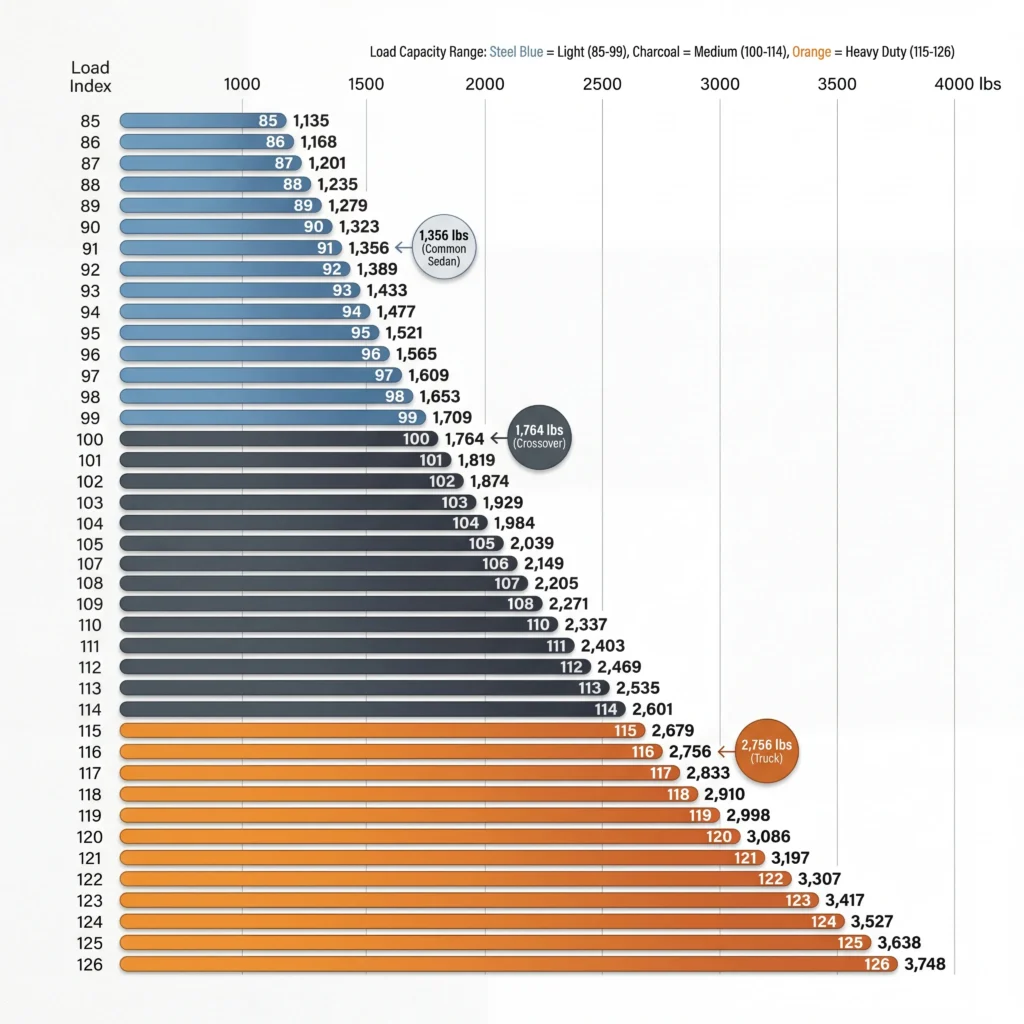
Load Index Chart (Common Passenger Vehicle Range):
| Load Index | Capacity (lbs) | Load Index | Capacity (lbs) |
|---|---|---|---|
| 85 | 1,135 | 100 | 1,764 |
| 86 | 1,168 | 101 | 1,819 |
| 87 | 1,201 | 102 | 1,874 |
| 88 | 1,235 | 103 | 1,929 |
| 89 | 1,279 | 104 | 1,984 |
| 90 | 1,323 | 105 | 2,039 |
| 91 | 1,356 | 106 | 2,094 |
| 92 | 1,389 | 107 | 2,149 |
| 93 | 1,433 | 108 | 2,205 |
| 94 | 1,477 | 109 | 2,271 |
| 95 | 1,521 | 110 | 2,337 |
| 96 | 1,565 | 111 | 2,403 |
| 97 | 1,609 | 112 | 2,469 |
| 98 | 1,653 | 113 | 2,535 |
| 99 | 1,709 | 114 | 2,601 |
Extended Range for Trucks and Heavy Applications:
| Load Index | Capacity (lbs) | Load Index | Capacity (lbs) |
|---|---|---|---|
| 115 | 2,679 | 121 | 3,197 |
| 116 | 2,756 | 122 | 3,307 |
| 117 | 2,833 | 123 | 3,417 |
| 118 | 2,910 | 124 | 3,527 |
| 119 | 2,998 | 125 | 3,638 |
| 120 | 3,086 | 126 | 3,748 |
LT-Metric tires show two load index numbers separated by a slash (e.g., 121/118). The first applies to single-wheel mounting. The second applies to dual-wheel (inner/outer) mounting on heavy-duty trucks.
Never downgrade load index. If your vehicle came with load index 99 tires, replacing them with 91-rated tires creates a safety concern. The reverse is fine: higher load index provides a safety margin.
Speed Rating Explained + Complete Chart
Speed rating indicates the maximum sustained speed a tire can safely maintain. The letter code appears immediately after the load index.
The speed rating doesn’t mean you should drive that fast. It indicates the tire’s heat dissipation capability and structural integrity at high speeds. Tires with higher speed ratings typically provide better handling response even at normal highway speeds.
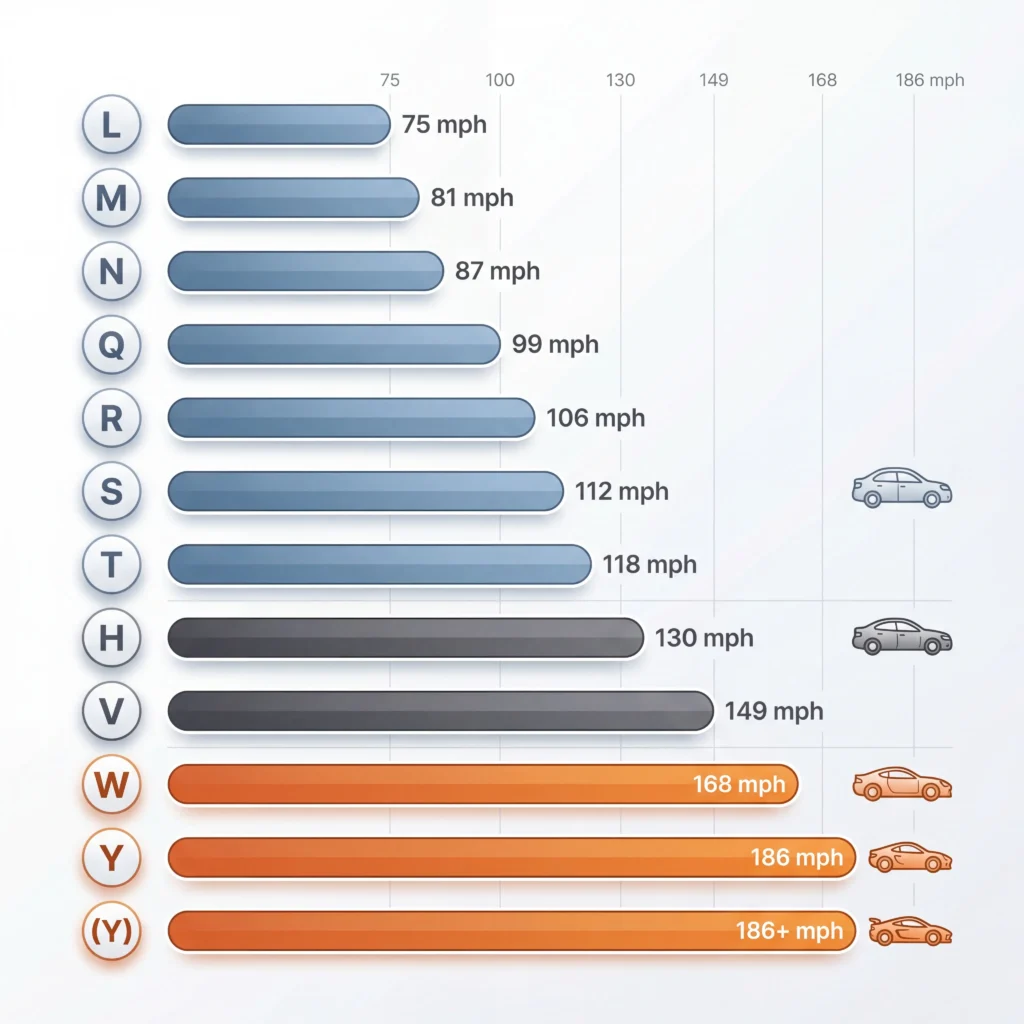
Speed Rating Chart:
| Rating | Max Speed (mph) | Typical Application |
|---|---|---|
| L | 75 | Off-road, light truck |
| M | 81 | Temporary spare tires |
| N | 87 | Temporary spare tires |
| Q | 99 | Winter tires, light trucks |
| R | 106 | Light trucks, heavy-duty |
| S | 112 | Family sedans, vans |
| T | 118 | Standard passenger vehicles |
| U | 124 | (Less common) |
| H | 130 | Sport sedans, crossovers |
| V | 149 | Sports cars, performance sedans |
| W | 168 | High-performance vehicles |
| Y | 186 | Ultra-high performance |
| (Y) | 186+ | Track-capable exotic vehicles |
Z-Rating Note: Tires marked ZR (e.g., 255/40ZR17) are rated above 149 mph. The specific maximum (W, Y, or (Y)) appears after the load index. ZR is a legacy designation that persists on performance tires.
Your replacement tires should match or exceed the original speed rating. Downgrading affects handling characteristics and may affect insurance coverage in some cases. If your vehicle came with H-rated tires and you install T-rated replacements, you’ve reduced the tire’s cornering grip and heat tolerance.
Winter tires often carry lower speed ratings (Q or R) because of their softer compound. That’s acceptable for seasonal use, but be aware of the limitation.
P-Metric vs LT-Metric vs Euro-Metric: Key Differences
These three sizing systems use the same numerical format but differ in load calculations and construction standards. Mixing them up causes problems.
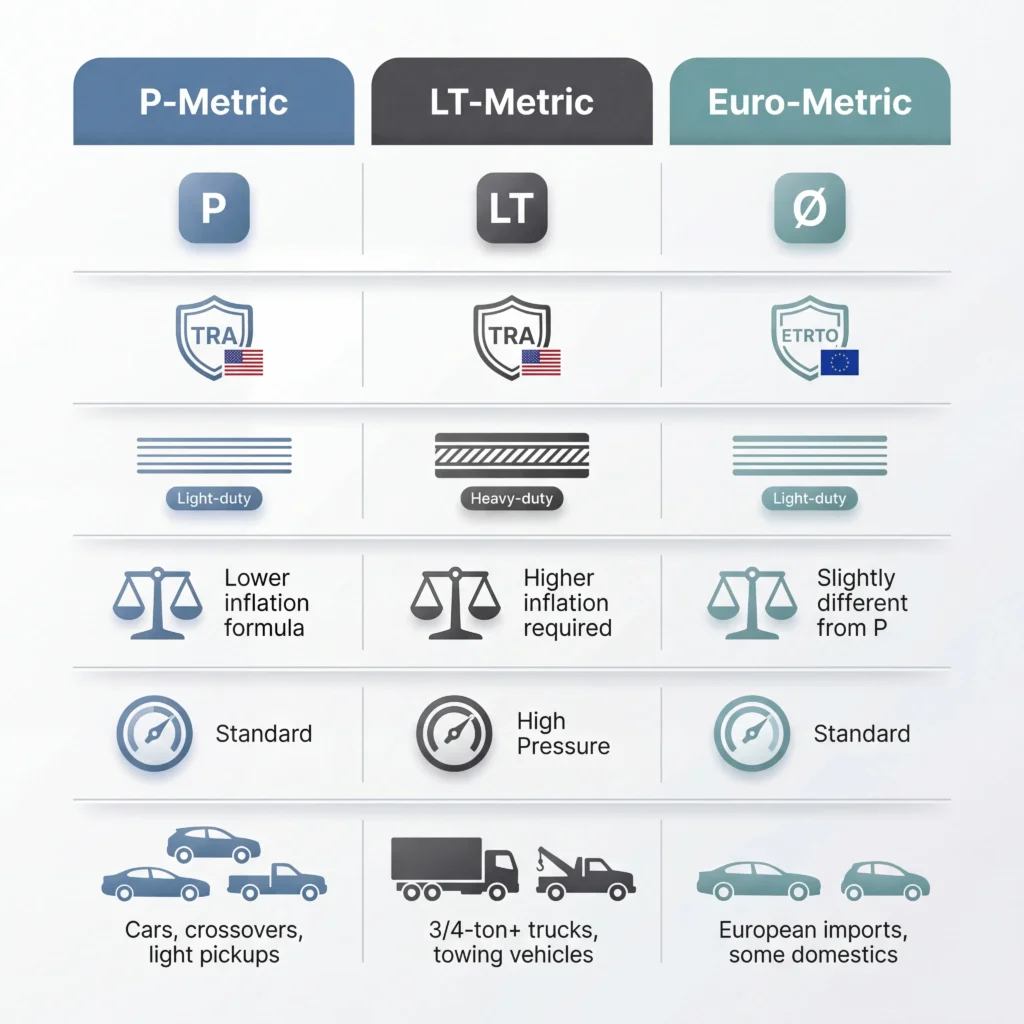
| Feature | P-Metric | LT-Metric | Euro-Metric |
|---|---|---|---|
| Prefix | P | LT | None |
| Standards Body | TRA (USA) | TRA (USA) | ETRTO (Europe) |
| Ply Construction | Light-duty | Heavy-duty | Light-duty |
| Load Calculation | Lower inflation formula | Higher inflation required | Slightly different from P |
| Typical Vehicles | Cars, crossovers, light pickups | 3/4-ton+ trucks, towing vehicles | European imports, some domestics |
Why This Matters:
A P265/70R17 and LT265/70R17 have identical dimensions but different weight capacities. The P-Metric version might be rated at load index 115 (2,679 lbs). The LT-Metric version at the same size could carry significantly more with its reinforced construction and higher inflation pressure requirement.
If your truck’s door placard specifies LT tires and you install P-Metric, you’ve potentially reduced your load capacity below what the vehicle requires. This is where I’ve seen real failures: truck owners matching dimensional numbers without checking the type designation.
Euro-Metric tires (no letter prefix) are common on imported vehicles. They’re dimensionally identical to P-Metric but may have slightly different load ratings at the same index number. When in doubt, verify the actual pound rating on the sidewall rather than assuming the index matches exactly.
The numbers tell a clearer story than guesswork. Check your vehicle’s placard, note the complete tire designation including the prefix, and match it on replacements.
As Rohan covers in his guide on brake pad wear, braking behavior directly affects tire wear patterns. Aggressive braking with undersized tires accelerates the problem.
Where to Find Your Tire Size
Three locations provide your vehicle’s tire size specification. Use the manufacturer’s recommendation, not necessarily what’s currently on the car (previous owners sometimes install incorrect sizes).
1. Driver’s Side Door Jamb Placard
Open your driver’s door and look for the sticker on the door frame or the B-pillar. This placard shows:
- Original tire size(s) approved for the vehicle
- Recommended cold inflation pressure (front and rear)
- Vehicle load capacity information
This is your primary reference. The spec here came from the vehicle engineers.
2. Owner’s Manual
The tire specification section lists approved sizes, including any optional sizes from the factory. Some vehicles offer multiple tire size options from the manufacturer: a base size and an upgrade package size.
3. Current Tire Sidewall
Look at the tires currently on your vehicle. The full size designation is molded into the sidewall. But verify this matches your door placard. Previous owners may have installed incorrect sizes.
Additional Resources:
Some online tools can decode your tire size from your Vehicle Identification Number (VIN). This can be helpful for confirming original equipment specifications.
Do Not Rely Solely On:
- Online tire size databases as your only source (they contain errors)
- Guesses based on what looks similar
- A different vehicle’s specifications
When changing tire sizes, keeping overall diameter within 3% of the original is a common guideline. Beyond that, you’re affecting speedometer accuracy, anti-lock brake calibration, traction control systems, and potentially your warranty. Tire shops can calculate equivalent sizes, or use the manufacturer’s approved alternative sizes from your manual.
If you’re researching specific sizes like 275 tires or 285 tires, those guides include vehicle fitment information.
Common Tire Sizing Mistakes to Avoid
This is where most DIY guides get it wrong: they explain what the numbers mean but not where people actually mess up. Here are the mistakes I’ve seen repeatedly.
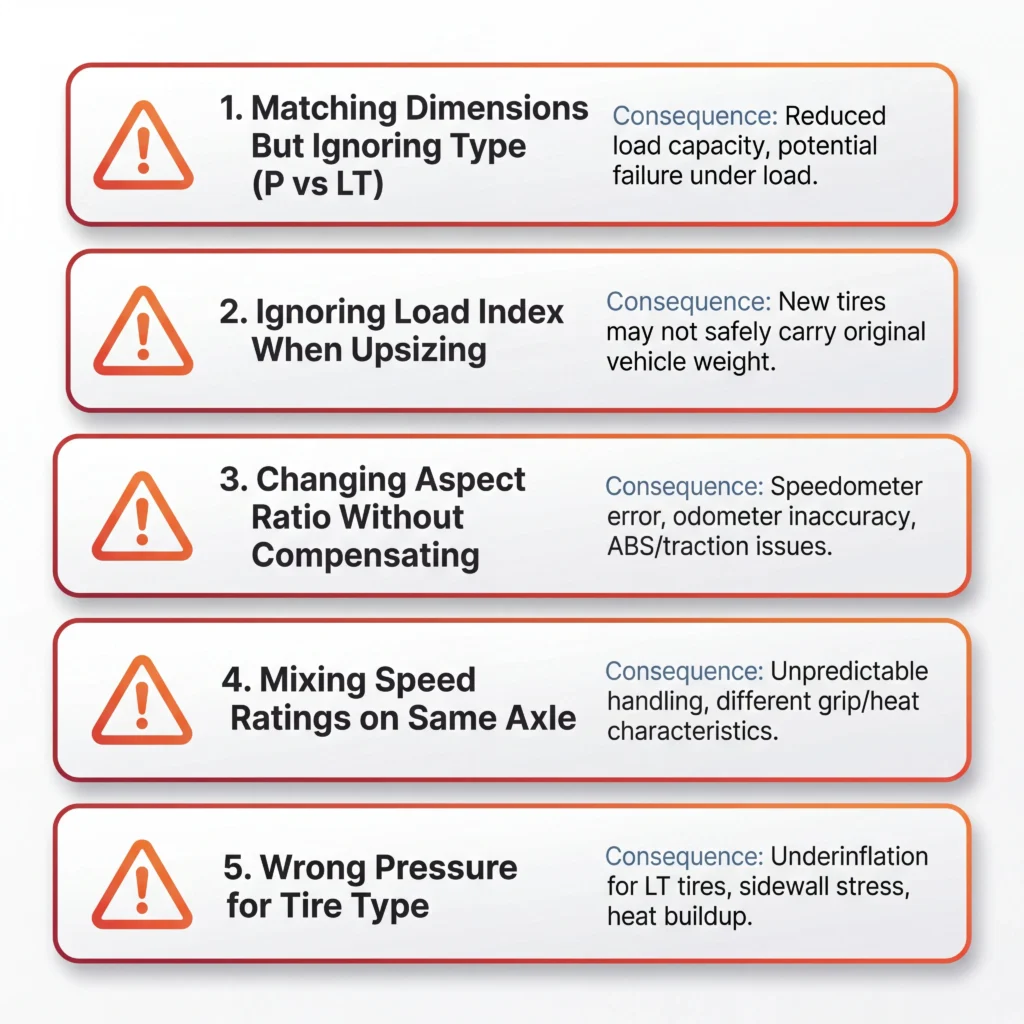
Mistake #1: Matching Dimensions But Ignoring Type
A P265/70R17 is not interchangeable with an LT265/70R17. Same numbers. Different construction. Different load capacity. If your vehicle requires LT tires and you install P-Metric, you’ve undersized for the application. I’ve tested this both ways on trucks: the LT tire handles load without issue while the P-Metric sidewall shows visible stress at the same weight.
Mistake #2: Ignoring Load Index When Upsizing
Truck owner wants bigger tires. Finds a size that fits. Doesn’t check load index. The new tires look great but can’t safely carry the weight the original spec required. Compare load indexes directly: the replacement must equal or exceed the original.
Mistake #3: Changing Aspect Ratio Without Compensating
Switching from 225/65R17 to 225/55R17 because someone said it looks sportier. That’s an overall diameter change of approximately 7%. Your speedometer now reads fast. Your odometer racks up fewer miles than you’ve actually traveled. Your ABS and traction control calibrations are off. Either keep overall diameter within 3% of original or understand the tradeoffs.
Mistake #4: Mixing Speed Ratings on the Same Axle
One tire blows out. Driver replaces it with whatever fits at the nearest shop. Now there’s an H-rated tire paired with a T-rated tire on the same axle. Handling becomes unpredictable because the tires have different grip characteristics and heat tolerances.
Mistake #5: Running the Wrong Pressure for the Tire Type
LT tires often require higher inflation pressure than P-Metric tires to achieve their rated load capacity. Running an LT tire at P-Metric pressure recommendations underinflates it for its design, causing sidewall flex, heat buildup, and accelerated wear.
For rotation patterns that help tires wear evenly regardless of type, see the guides on AWD tire rotation, front wheel drive tire rotation, and rear wheel drive tire rotation.
What Happens If You Use the Wrong Tire Size?
The consequences depend on how wrong the size is and in which direction. Minor mismatches cause inconvenience. Major mismatches cause failures.
Speedometer and Odometer Errors
Tires larger than original: speedometer reads slower than actual speed. Odometer accumulates fewer miles than traveled.
Tires smaller than original: speedometer reads faster than actual speed. Odometer accumulates more miles than traveled.
A 3% diameter change produces approximately 3% speedometer error. Generally acceptable. A 10% change? That’s a speeding ticket waiting to happen.
Handling and Braking Changes
Wider tires may improve dry grip but can increase hydroplaning risk in wet conditions. Narrower tires concentrate weight on a smaller contact patch, potentially increasing braking distance.
Changing aspect ratio affects steering response. Lower profiles feel more direct but transmit more road imperfections.
Clearance Issues
Larger overall diameter or wider width can cause rubbing against fender wells, suspension components, or brake calipers. This creates noise, vibration, and accelerated wear on both tires and the components they contact. The inside tire wear pattern often results from interference issues.
Load Capacity Concerns
Wrong. Running load index below your vehicle’s requirement creates a risk of tire failure. Tires flex beyond their design limits, generate excess heat, and can fail under load. This is the most serious sizing error because it creates a genuine safety concern that no amount of correct dimensional sizing can compensate for.
Warranty and Insurance Implications
Installing non-approved tire sizes may void portions of your vehicle warranty, particularly for drivetrain components. Some insurance policies have provisions about vehicle modifications that include tire changes. Check your specific coverage.
ABS and Traction Control Calibration
These systems calculate wheel speed based on expected tire circumference. Significantly different tire sizes send incorrect data to the control modules. The systems still function but may intervene at unexpected times or fail to intervene when needed.
Explore Tire Care In-Depth
The spec sheet says one thing. The shop floor says another. These guides cover the practical side of tire sizing, rotation, measurement, and maintenance: the details that matter when you’re actually working on your vehicle.
Tire Sizing Guides
Tire Size Number Meaning – Beginner-level walkthrough of one complete tire size. Start here if the P225/65R17 format still looks like code.
275 Tire Size in Inches – Full dimensions for 275-width tires across common aspect ratios. Includes fitment data for trucks and SUVs running this size range.
285 Tire Size in Inches – The next step up from 275. Conversion tables, diameter calculations, and vehicle compatibility notes.
Tire Sidewalls – Every marking beyond the size code: DOT date, UTQG ratings, load range, directional arrows. The complete sidewall reference.
Tire Rotation by Drive Type
AWD Tire Rotation – All-wheel drive systems are sensitive to tire diameter differences. The correct rotation pattern helps prevent drivetrain wear.
Front Wheel Drive Tire Rotation – FWD vehicles wear fronts faster because they handle both steering and drive forces. Pattern and interval covered here.
Rear Wheel Drive Tire Rotation – RWD rotation with notes on staggered fitments common on sports cars. Some setups can’t be rotated conventionally.
4WD Tire Rotation – Four-wheel drive has transfer case considerations that differ from AWD. Part-time vs full-time systems require different approaches.
Tire Measurement Tools
Tire Tread Gauge – Types (probe, dial, digital), how to read measurements in 32nds of an inch, and the minimum legal tread depth.
Digital Tire Tread Depth Gauge – Digital gauges offer precision to 0.01mm. Features comparison and accuracy notes.
Tire Gauge for Motorcycles – Motorcycles need low-PSI-range gauges with angled chucks. Standard car gauges often don’t fit the valve access.
Tire Balance and Alignment
Tire Balance Beads – Internal balancing beads as an alternative to wheel weights. How they work, when they’re appropriate, material comparisons.
Motorcycle Tire Balancer – Static balancing stands for DIY motorcycle tire service. Setup procedure and weight placement technique.
How Long Does a Tire Alignment Take – Time expectations for two-wheel vs four-wheel alignment. Factors that extend shop time.
Tire Wear and Damage
Inside Tire Wear – Inner edge wear traces to negative camber or worn suspension components. Diagnosis flowchart and fix priorities.
Tire Sidewall Damage – Cracks, bulges, cuts: which are superficial and which require immediate replacement. The sidewall can’t be patched.
Explore all our tire care guides for the complete library.
What I’ve Learned – Garrett’s Take
“I installed wrong-load-rating tires on a truck once. The dimensional numbers matched perfectly. The sidewall showed stress marks within two weeks of loaded driving.
That mistake cost me a set of tires and taught me to read the entire designation, not just the size portion. The tire type letter and load index aren’t optional information: they’re engineering specifications with real consequences.
Every tire sizing question comes down to this: match the complete spec or accept unknown risk. The numbers exist because the Tire and Rim Association tested these combinations. Your specific driving conditions might have some flexibility, but the load rating doesn’t.
I’ve pulled apart enough of these to know that tire failures almost always trace back to one of two causes: underinflation or overloading. Both relate directly to understanding the specs on the sidewall. Close enough doesn’t exist when it comes to load capacity.”
— Garrett Stowe, Technical Editor
Frequently Asked Questions
Q: Can I use 225 tires instead of 235?
A: Yes, in many cases, but check three things first. The 225 must fit your wheel width range (most wheels that fit 235 also accommodate 225). Your load index must match or exceed the original spec. And you’re accepting a roughly 4% narrower contact patch, which slightly reduces grip. On most passenger vehicles, 225 vs 235 is within acceptable variance. On trucks or vehicles with high load requirements, verify the load rating carefully.
Q: How to read tire size for dummies?
A: Focus on five parts. First letter: P means car, LT means truck. First three numbers: width in millimeters. Number after the slash: sidewall height as percentage of width. Letter R: means radial (standard construction). Last two numbers: wheel diameter in inches. Everything after that: load capacity and speed rating. A 225/65R17 is 225mm wide, with a sidewall 65% of that width, radial construction, fitting a 17-inch wheel.
Q: Is a 275 tire the same as a 33?
A: No. A 275 is section width in millimeters (about 10.83 inches wide). A 33 refers to overall diameter in inches (using flotation sizing for off-road tires). These measure completely different dimensions. A 275/70R18 has an overall diameter of approximately 33.2 inches, which is where confusion arises. The numbers describe different specifications.
Q: Can I use a 65 tire instead of 60?
A: Maybe. A 65 aspect ratio creates a taller sidewall than a 60, increasing overall diameter. For example: 225/60R17 has an overall diameter of about 27.6 inches. A 225/65R17 is about 28.5 inches. That’s a 3.3% difference, which affects speedometer accuracy and may cause clearance issues. The common guideline is to keep overall diameter within 3% of original. Beyond that, understand the tradeoffs.
Q: What does the R mean in tire size?
A: R indicates radial construction. The internal cords run perpendicular to the direction of travel. Virtually all modern passenger and light truck tires use radial construction because it provides better tread life, fuel economy, and handling compared to older bias-ply designs. If you see D instead of R, that’s a diagonal (bias-ply) tire, mostly found on trailers and specialty equipment.
Q: What is load range vs load index?
A: Load range uses letters (B, C, D, E) and dates from the older ply-rating system. Load index uses numbers (91, 105, 121) and directly corresponds to a specific pound capacity. Modern tires display load index. Load range appears primarily on LT and trailer tires as a legacy reference. Both describe weight capacity; load index is more precise.
Q: Where do I find the DOT date code?
A: On the sidewall, following the letters DOT. The last four digits indicate manufacture week and year. Code 2524 means the 25th week of 2024. Tires degrade with age regardless of tread depth. The tire sidewalls guide covers DOT codes in detail along with other sidewall markings.
Q: Do all four tires need to be the same size?
A: On most vehicles, yes. All-wheel drive systems require matched tire diameters to prevent drivetrain wear. Front-wheel and rear-wheel drive vehicles have more tolerance but still benefit from matched sets. The exception: staggered fitments (different sizes front/rear) come as original equipment on some sports cars and performance vehicles. If your vehicle didn’t come with staggered tires, don’t add them without understanding the implications.
Get the Spec Right the First Time
Tire sizing follows rules. The numbers communicate type, dimensions, construction, load capacity, and speed capability in a standardized format. Every element affects fitment, safety, and performance.
Three things to remember:
- Match the complete tire designation, not just the dimensional numbers. The type letter and load index matter as much as width, aspect ratio, and diameter.
- The common guideline is to keep overall diameter within 3% of original equipment when changing sizes. Beyond that, you’re affecting speedometer accuracy, brake system calibration, and potentially warranty coverage.
- Verify load index meets your vehicle’s requirement. Undersized load capacity is a safety concern that no amount of correct dimensional sizing can compensate for.
Start with your door jamb placard. Match the spec exactly for straightforward replacement. Research thoroughly before any size changes. The tire size number meaning guide provides the simplified version if you’re new to this. For those considering larger truck tires, the 275 and 285 tire size guides cover popular upgrade sizes.
Know the spec, follow the procedure, and don’t skip steps.
— Garrett Stowe
A note on this guide: The information above reflects personal experience and industry-standard specifications. For decisions about your specific vehicle, always consult your owner’s manual, door placard, or a qualified tire professional. Tire selection affects safety, and what works for one vehicle may not be appropriate for another.
About the Author
Garrett Stowe | Technical Editor
Garrett Stowe writes about brake systems and tire specifications for BrakeAndTire. His background is in hands-on automotive repair, where he spent a significant portion of his career working on brake and suspension systems across passenger vehicles, trucks, and fleet rigs. He transitioned to writing after getting fed up with the amount of bad information circulating on automotive forums and content sites: wrong torque values, incorrect tire ratings, and procedures described by people who had clearly never performed them. Garrett’s articles focus on specifications, correct procedures, and the real-world details that separate a proper job from a hack. His writing style is direct and assumes the reader is there to learn, not to be entertained.